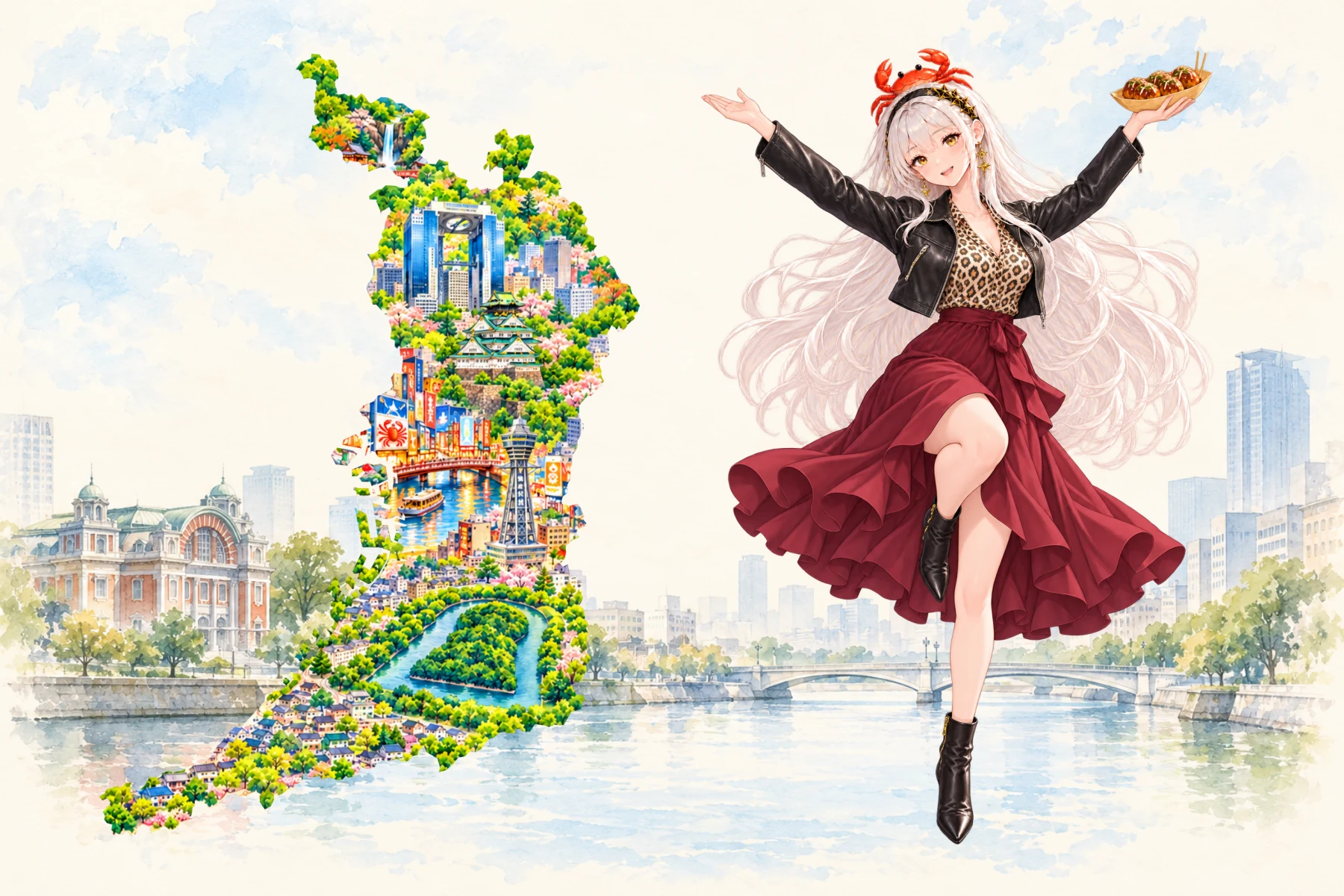
Decorative travel artwork; landmark sizes and positions are illustrative. The prefecture silhouette uses Ministry of Land, Infrastructure, Transport and Tourism administrative boundary data, 2025, via Kyodo News japan-choropleth, CC BY 4.0. Source: https://github.com/kyodo-official/japan-choropleth · https://creativecommons.org/licenses/by/4.0. Watercolour scenery is arranged within the geographic silhouette, with MIRAI and a Nakanoshima-inspired backdrop.
Osaka city · Through the year
Average monthly temperature
Osaka observation station · Climate normals, 1991–2020 · °C
Jan
6.2°C
Feb
6.6°C
Mar
9.9°C
Apr
15.2°C
May
20.1°C
Jun
23.6°C
Jul
27.7°C
Aug
29.0°C
Sep
25.2°C
Oct
19.5°C
Nov
13.8°C
Dec
8.7°C
Source: Japan Meteorological Agency, Osaka observation station. Station averages, not an average across Osaka Prefecture. Hills and different destinations can have different conditions; check the forecast before travel.
Year-round travel ideas · Visitor information checked 29 October 2026. Photograph dates and seasons appear in the captions; older photographs do not establish current displays, businesses or access.
Which Osaka would you like to meet?
Osaka is one of Kansai’s major cities, shaped by a long history of food and trade.
Look up at Dotonbori’s enormous signs, then try a hot takoyaki. Marvel at Osaka Castle’s stone walls and stop at a riverside café. A day searching for your favourite characters or laughing at a live show sounds lovely, too.
There is more to Osaka than busy streets. Nakanoshima has historic buildings beside the water; Sakai has traditions of tea and craftsmanship; Minoh offers a quieter day among the trees.
Something you want to taste. A view you want to look up at. A little shop you would like to peek inside.
Let’s explore Osaka together, starting with one of those little interests. Where would you like to begin?
Kita or Minami?
You will often hear two names in central Osaka: Kita, around Osaka Station and Umeda, and Minami, around Namba and Shinsaibashi.
Kita brings together major stations and shopping complexes; Minami has Dotonbori’s signs and shopping streets. Keeping those two areas in mind makes it a little easier to choose your first stop.
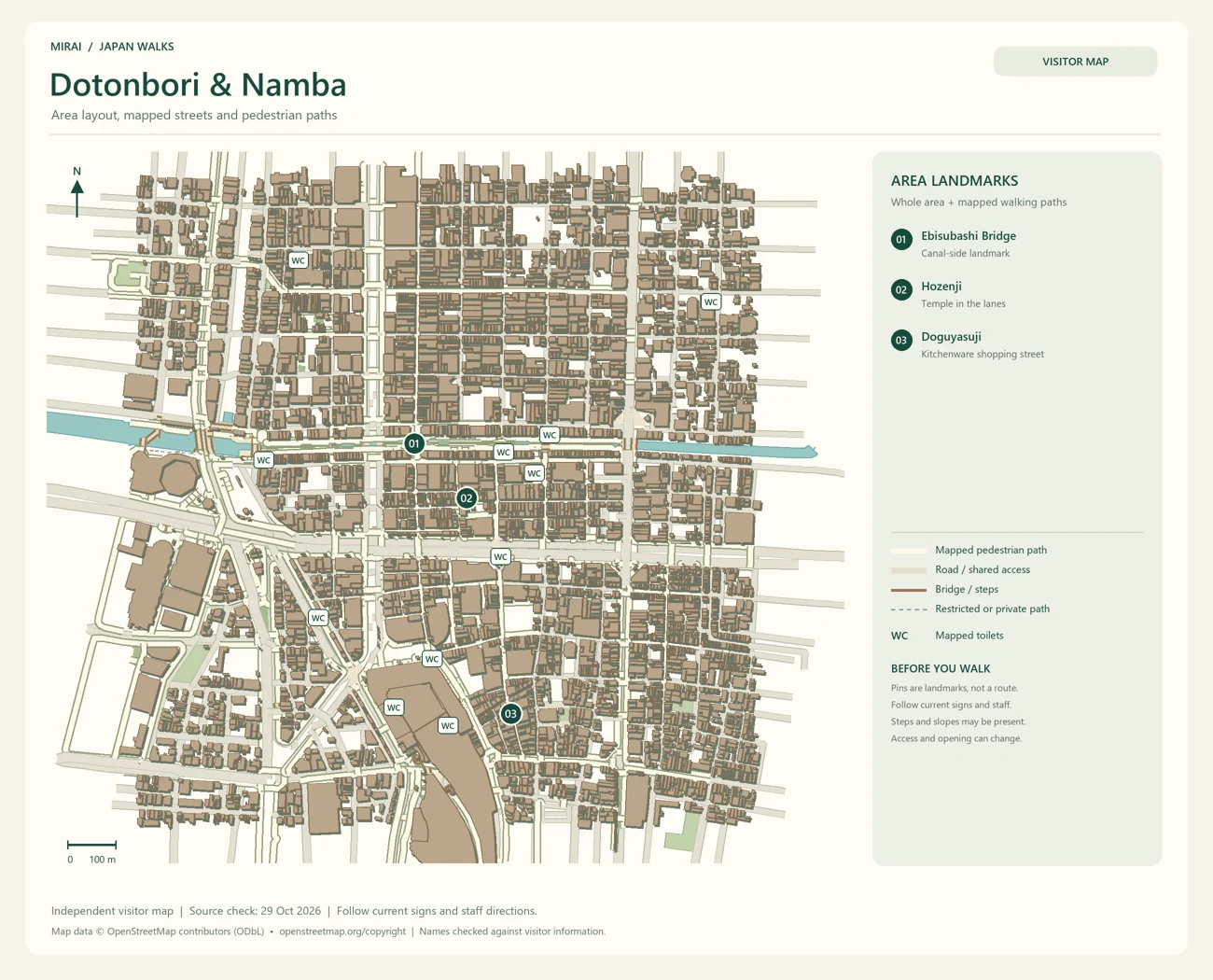
Dotonbori and Namba: follow the lively streets
If you would like to meet Osaka’s exuberant side, start with Dotonbori.
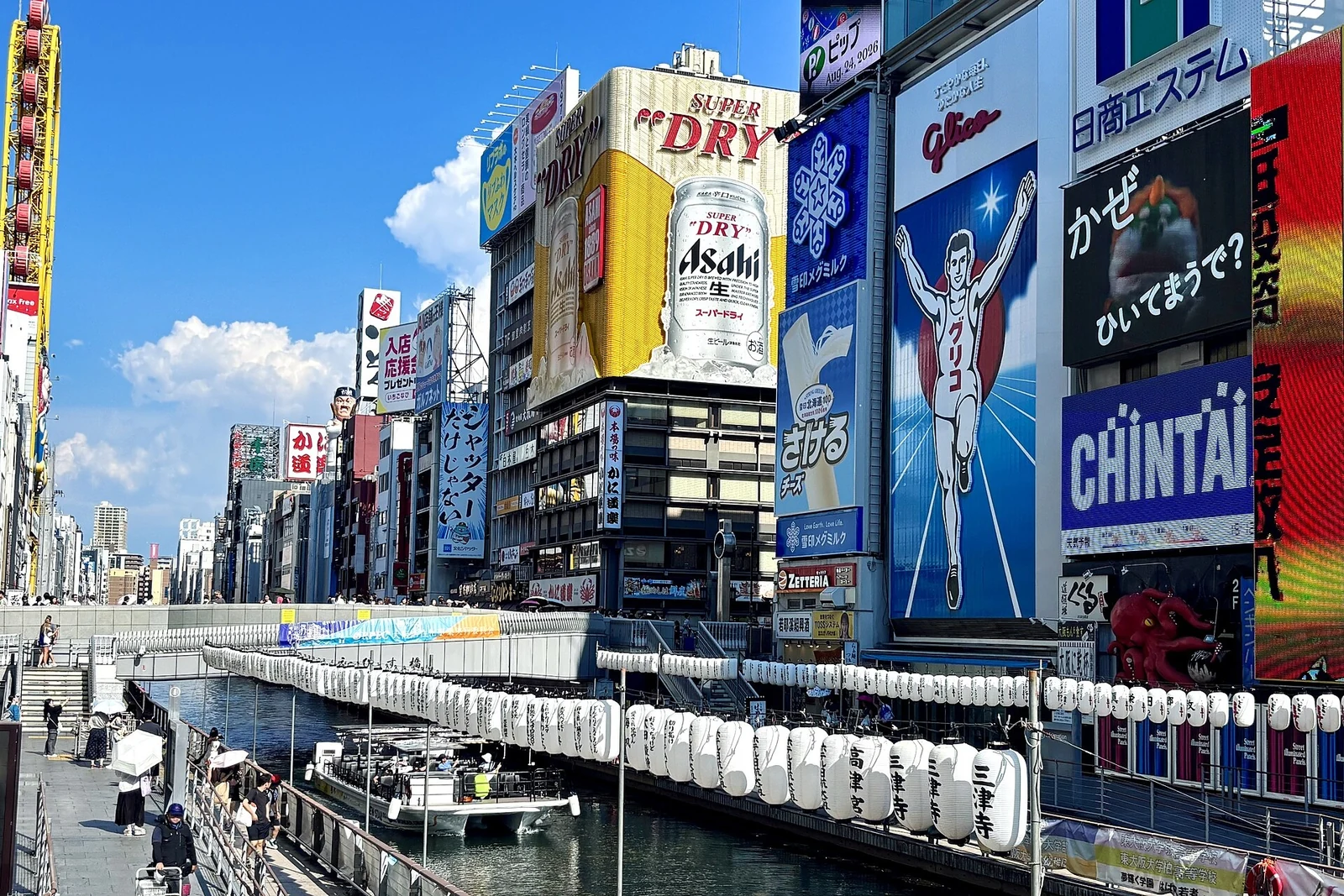
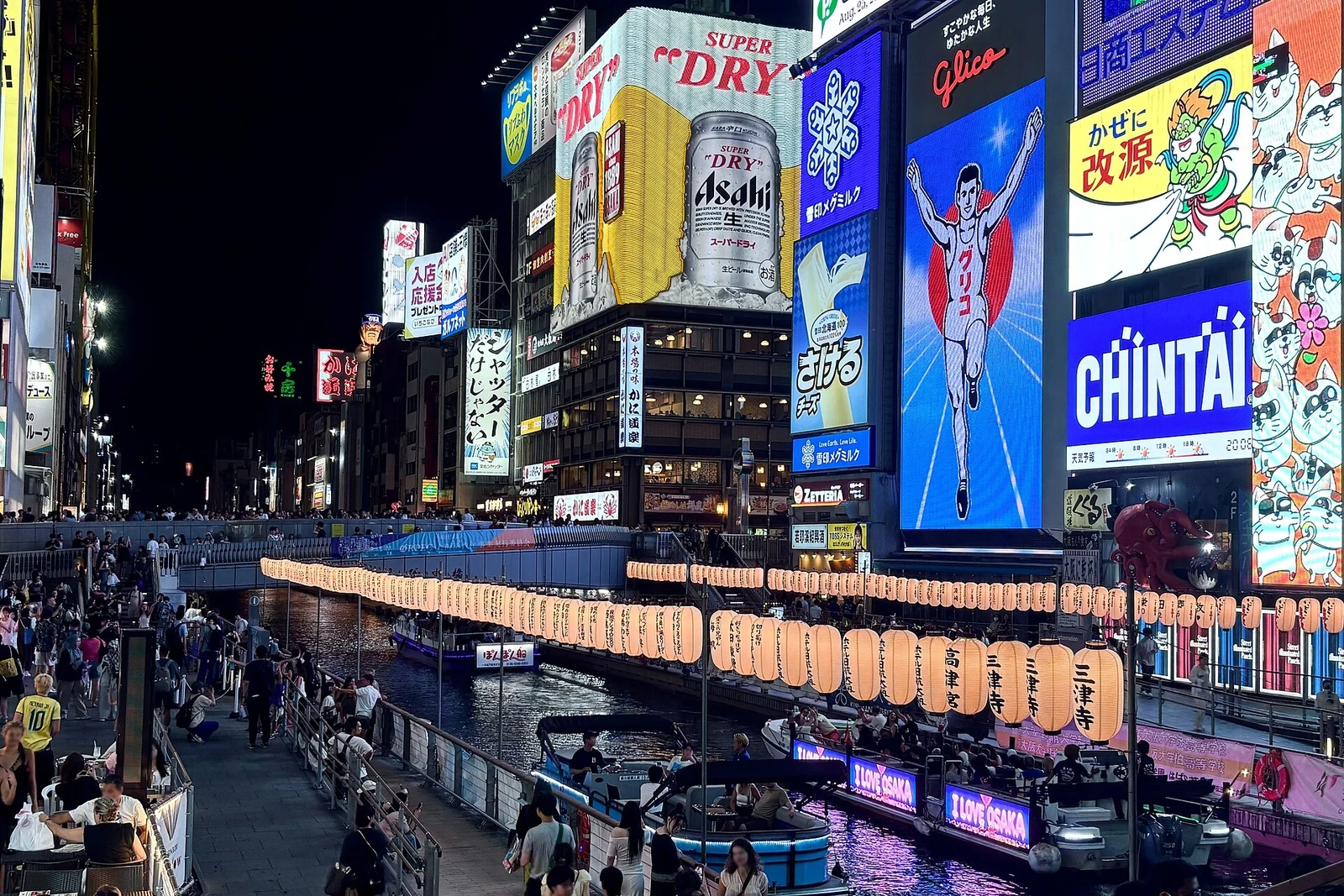
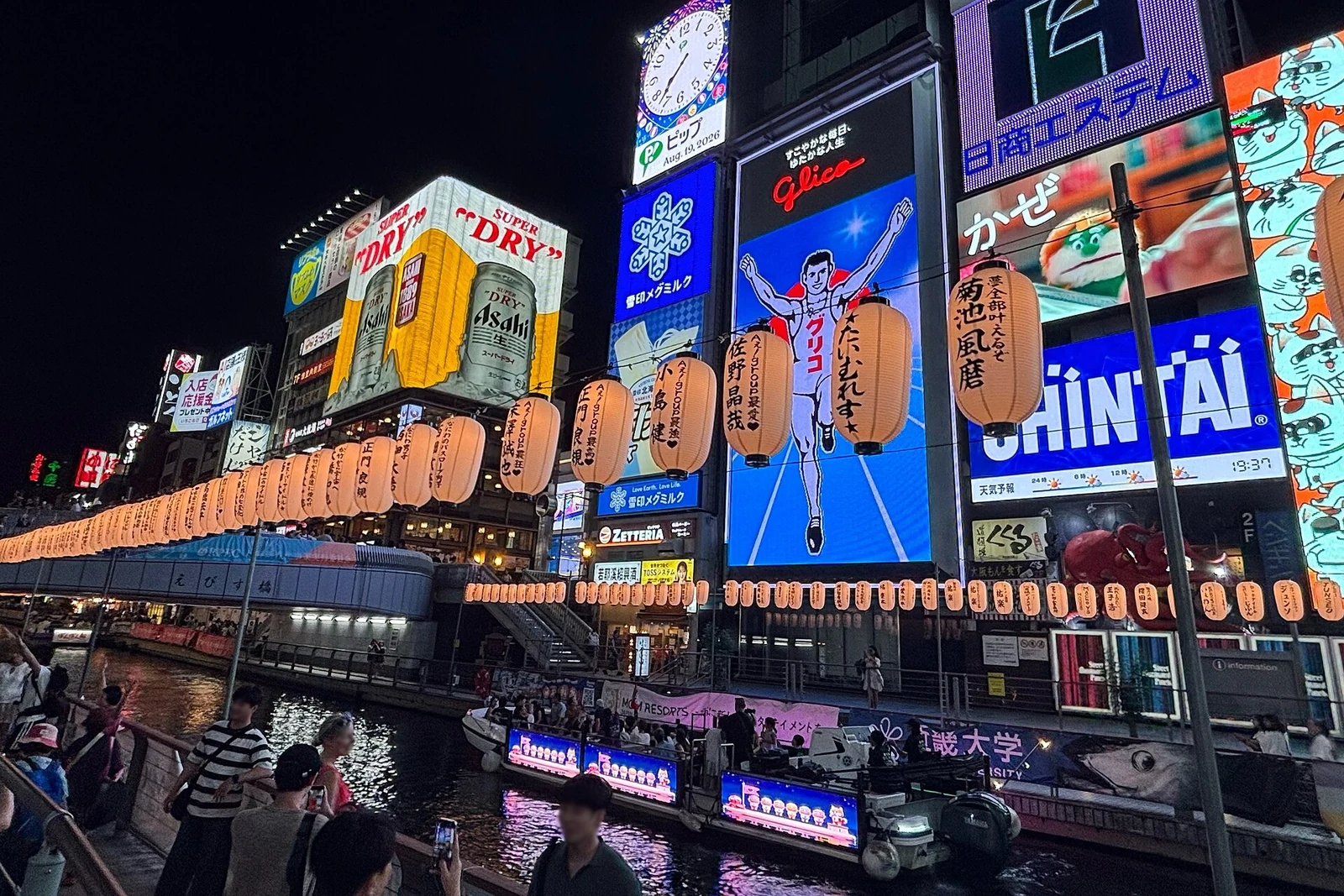
Across Ebisubashi Bridge is the Glico running-man sign. Around it, giant crabs and other three-dimensional food signs compete for your attention. You might set out to find a restaurant and end up admiring the signs instead.
The Tombori Riverwalk gives you another way to enjoy the area. The street-level view and the view from beside the canal feel different. A small change of position can make a familiar sign seem new again.
For shopping, look towards Shinsaibashi-suji. If you enjoy vintage clothes, music and individual little shops, try Amerikamura in Nishi-Shinsaibashi. Young creators gathered at the café LOOP, which opened in 1969; shops selling second-hand clothes and records helped shape the neighbourhood that followed.
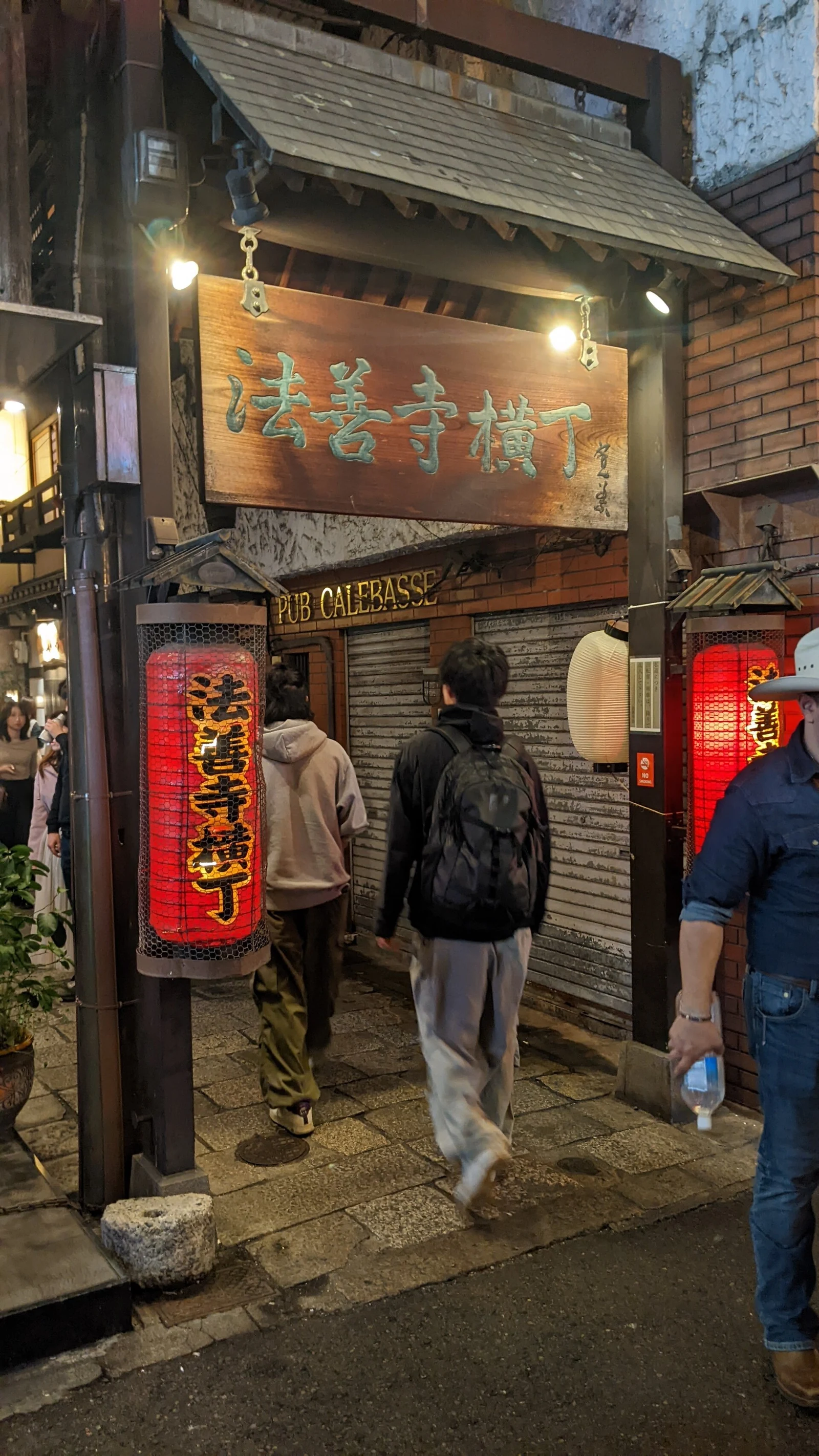
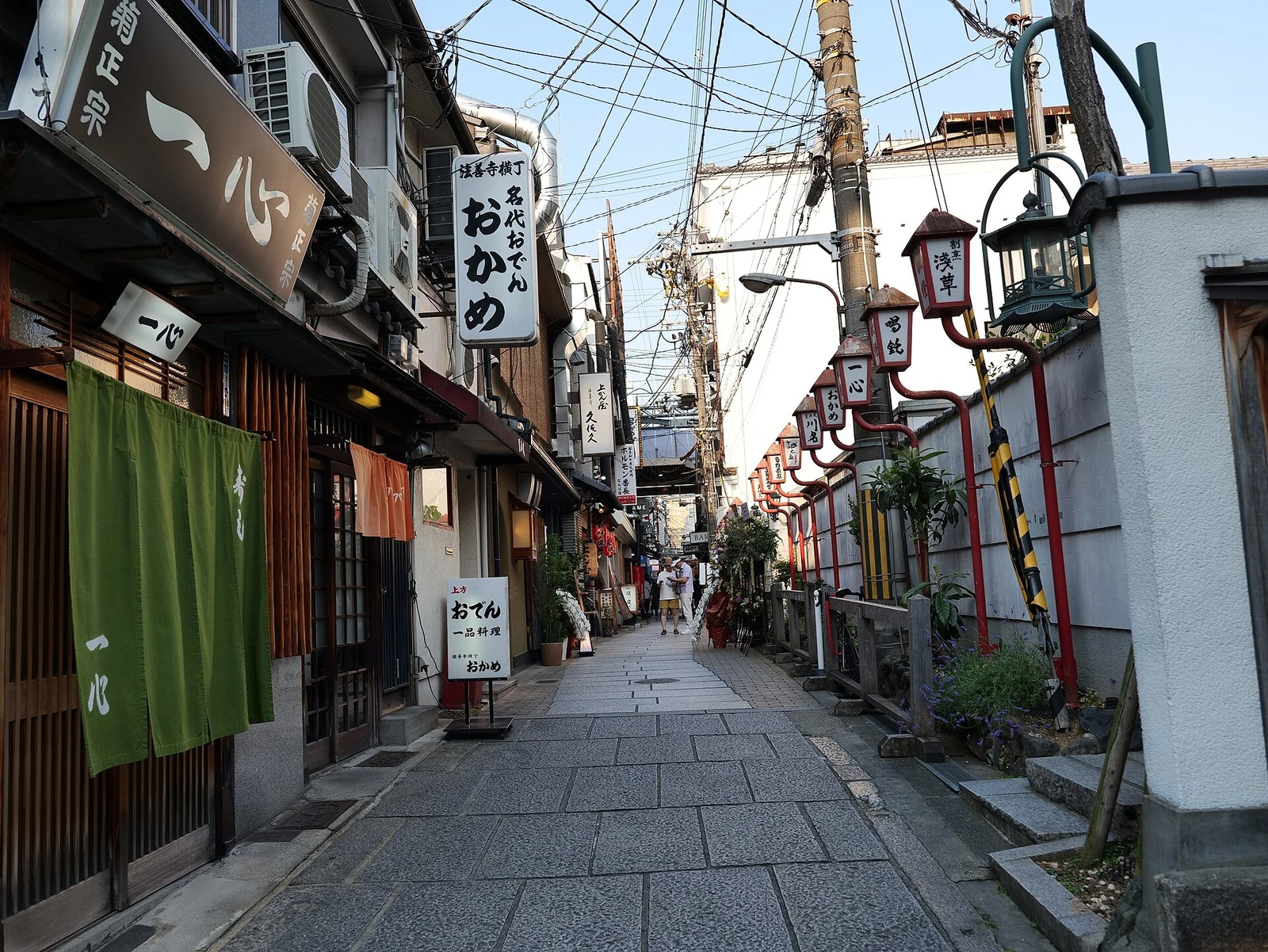
For a quieter lane, there is Hozenji Yokocho. Stone paving, lanterns and Hozenji’s moss-covered Mizukake Fudo offer a different atmosphere. Let’s share the narrow paths with people coming to pray or eat.
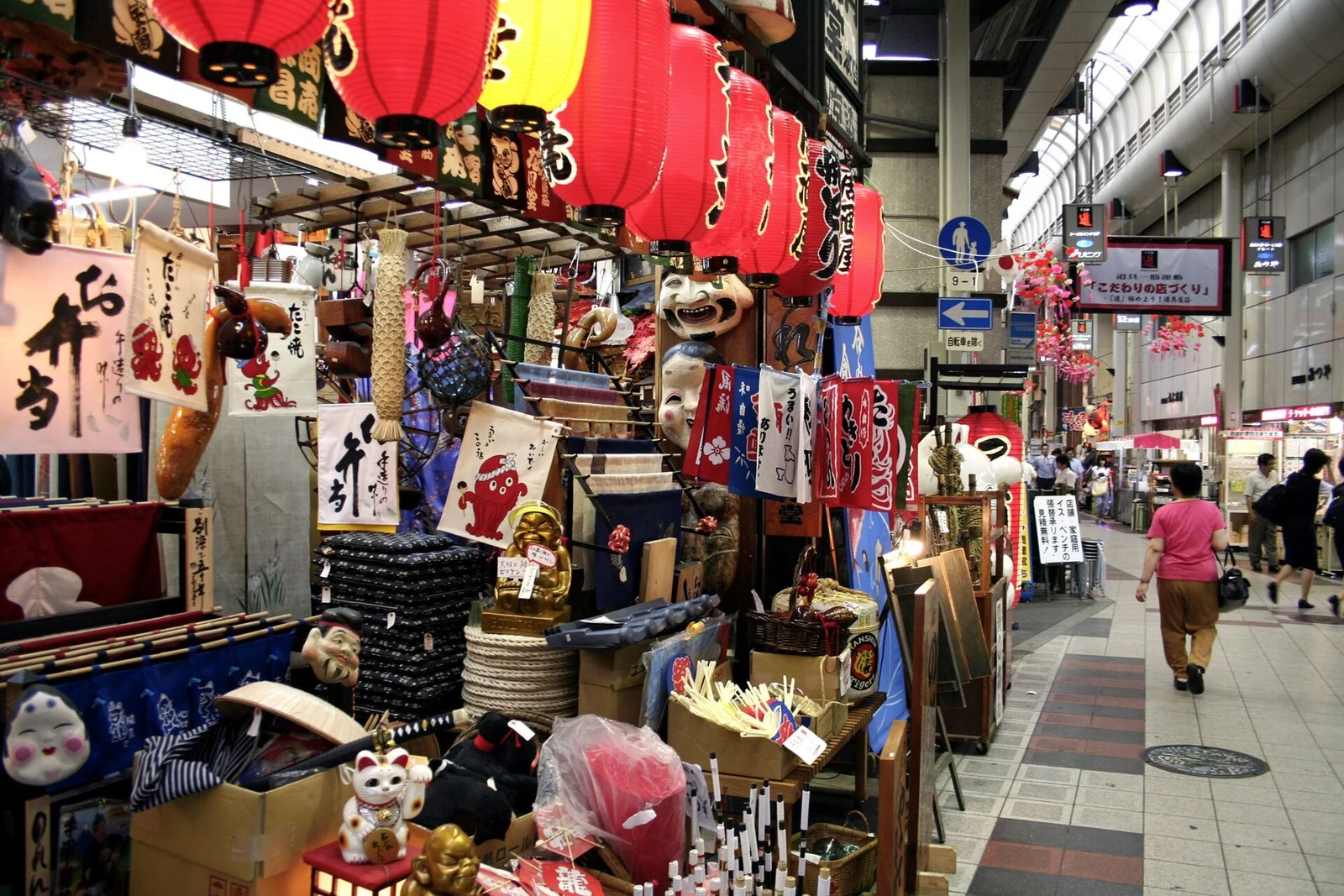
If you like cooking, Sennichimae Doguyasuji is tempting, too. Kitchen tools, tableware and food replicas can set you imagining what you might make. It is fun to find the shops behind the food, so close to the places where you enjoy it.
File:Dotonbori ao 01.jpg — Sakai Yayoi. https://commons.wikimedia.org/wiki/File:Dotonbori_ao_01.jpg | CC0 http://creativecommons.org/publicdomain/zero/1.0/deed.en. Resized and re-encoded; no crop or retouch.
File:Osaka Dotonbori yoru.jpg — Sakai Yayoi. https://commons.wikimedia.org/wiki/File:Osaka_Dotonbori_yoru.jpg | CC0 http://creativecommons.org/publicdomain/zero/1.0/deed.en. Resized and re-encoded; no crop or retouch.
File:Osaka Dotonbori yoru 02.jpg — Sakai Yayoi. https://commons.wikimedia.org/wiki/File:Osaka_Dotonbori_yoru_02.jpg | CC0 http://creativecommons.org/publicdomain/zero/1.0/deed.en. Resized and re-encoded; no crop or retouch.
File:Hozenji Yokocho 2023-11.jpg — Mr.ちゅらさん. https://commons.wikimedia.org/wiki/File:Hozenji_Yokocho_2023-11.jpg | CC BY-SA 4.0 https://creativecommons.org/licenses/by-sa/4.0. Resized and re-encoded; no crop or retouch.
File:Hozenji (Osaka Chuo-ku) Temple hdsr S5 24.jpg — Hyppolyte de Saint-Rambert. https://commons.wikimedia.org/wiki/File:Hozenji_(Osaka_Chuo-ku)_Temple_hdsr_S5_24.jpg | CC BY 4.0 https://creativecommons.org/licenses/by/4.0. Resized and re-encoded; no crop or retouch.
File:Osaka store.jpg — BradBeattie. https://commons.wikimedia.org/wiki/File:Osaka_store.jpg | CC BY-SA 3.0 http://creativecommons.org/licenses/by-sa/3.0/. Resized and re-encoded; no crop or retouch.
Umeda and Nakanoshima: look up, then slow down by the water
Around Osaka Station and Umeda, department stores and shopping complexes form a busy urban centre.
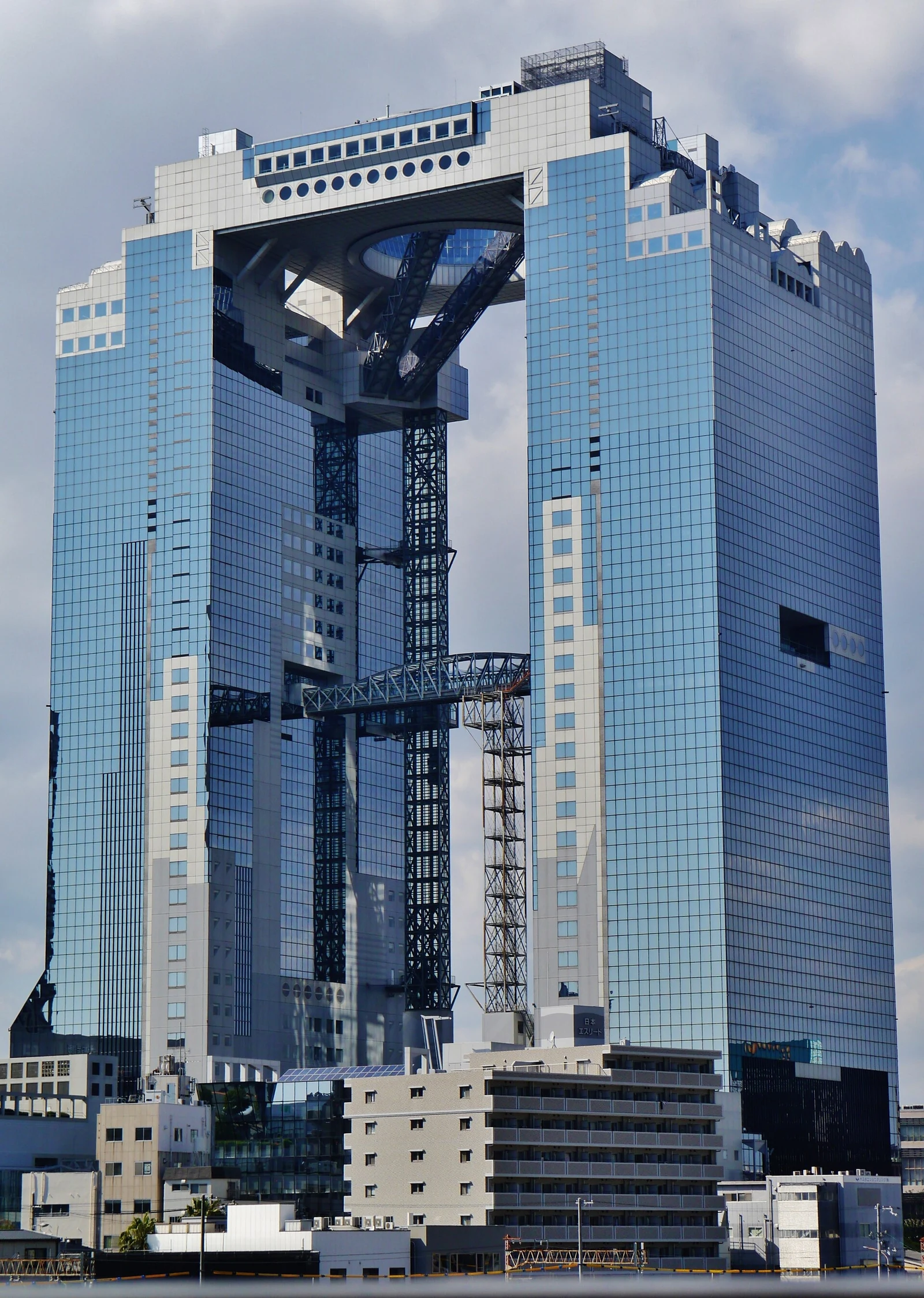
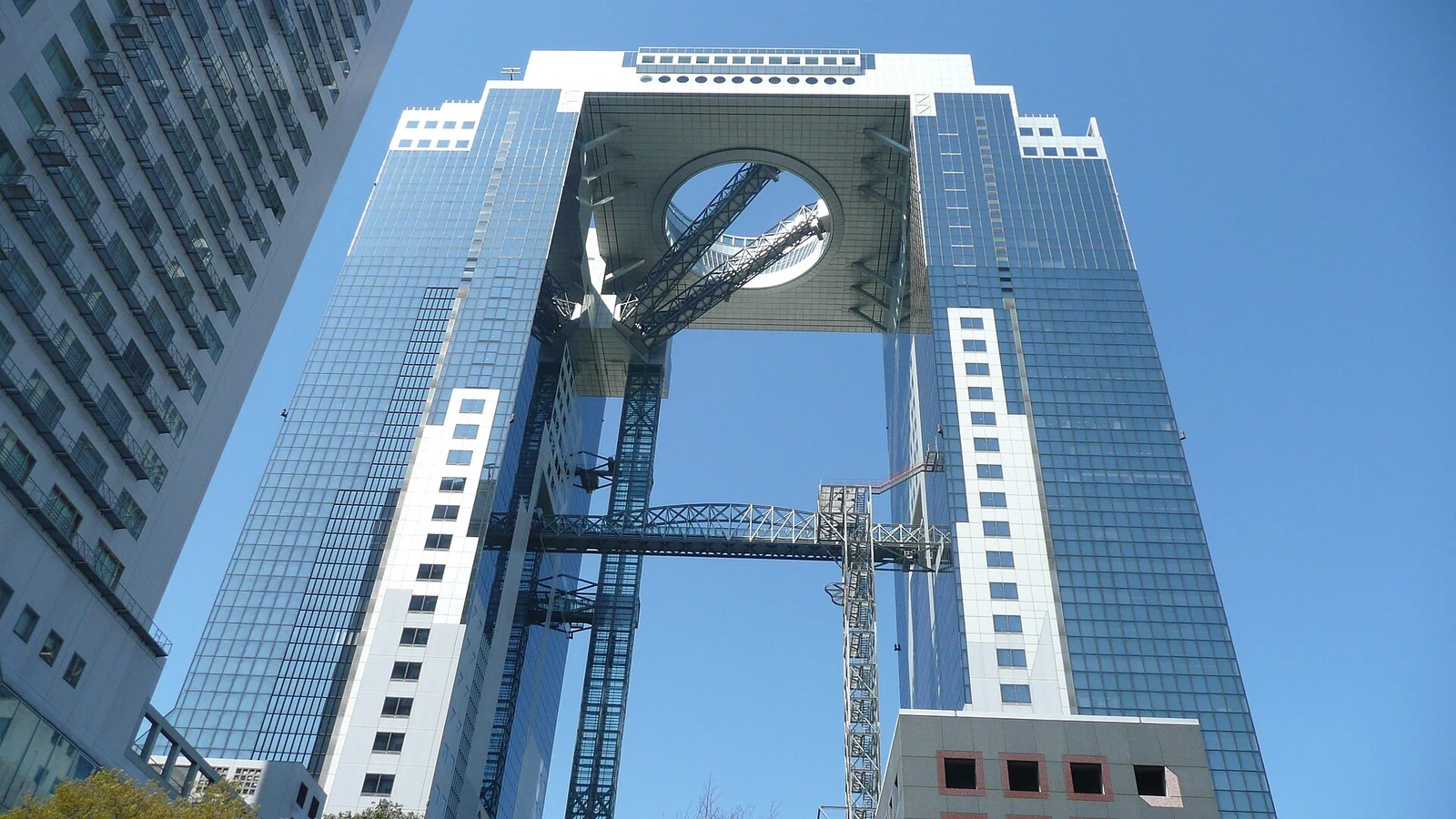
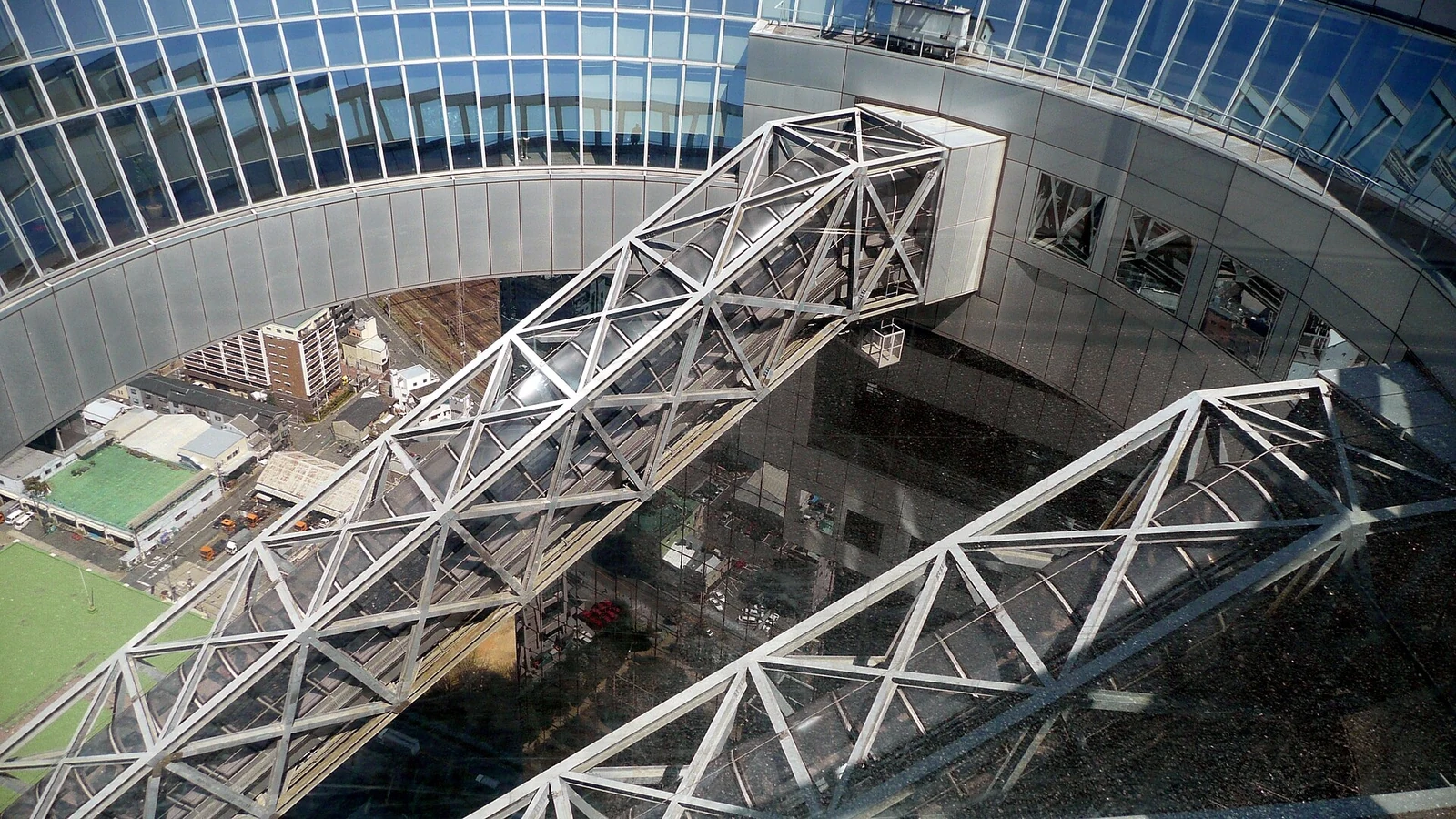
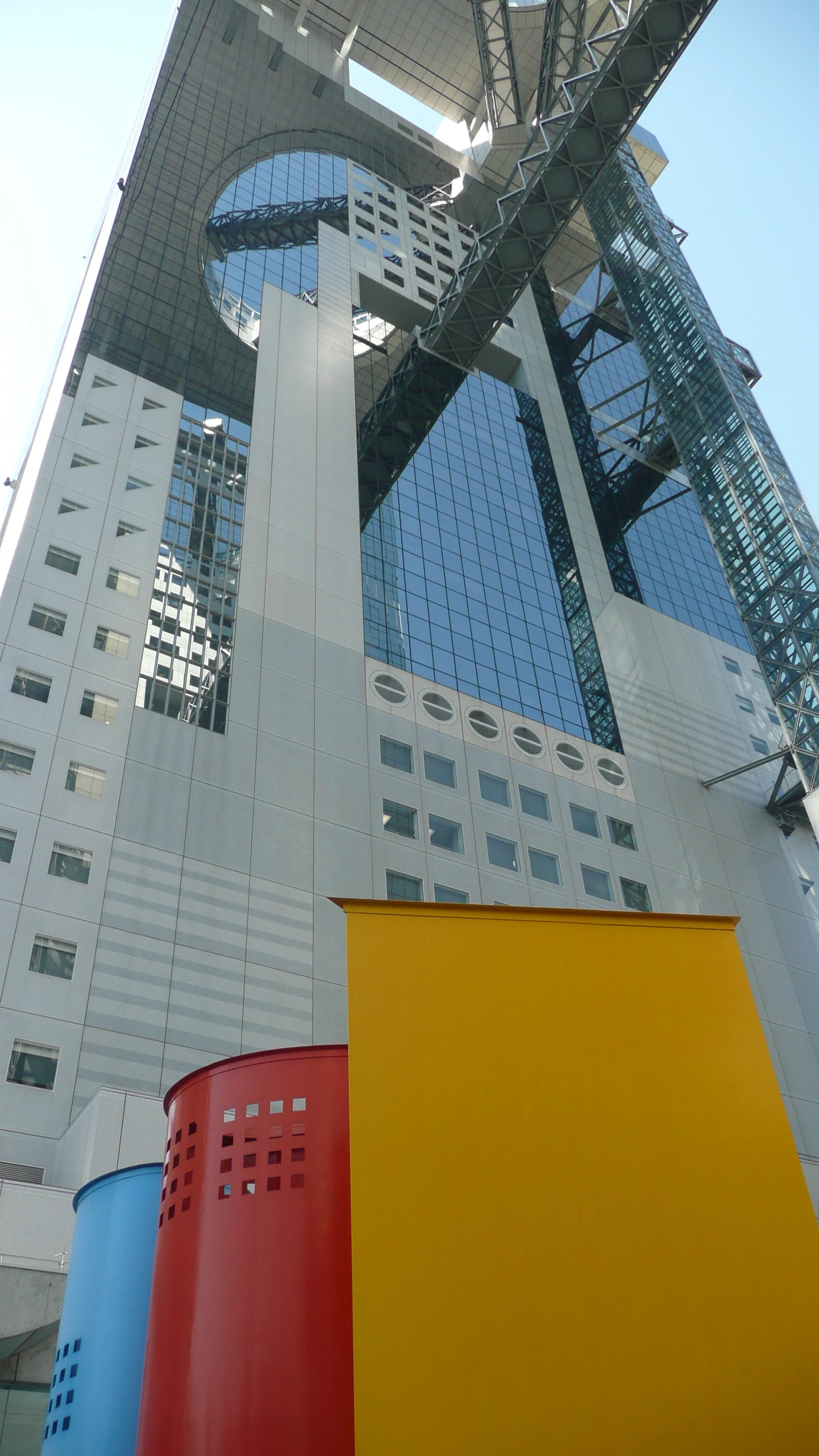
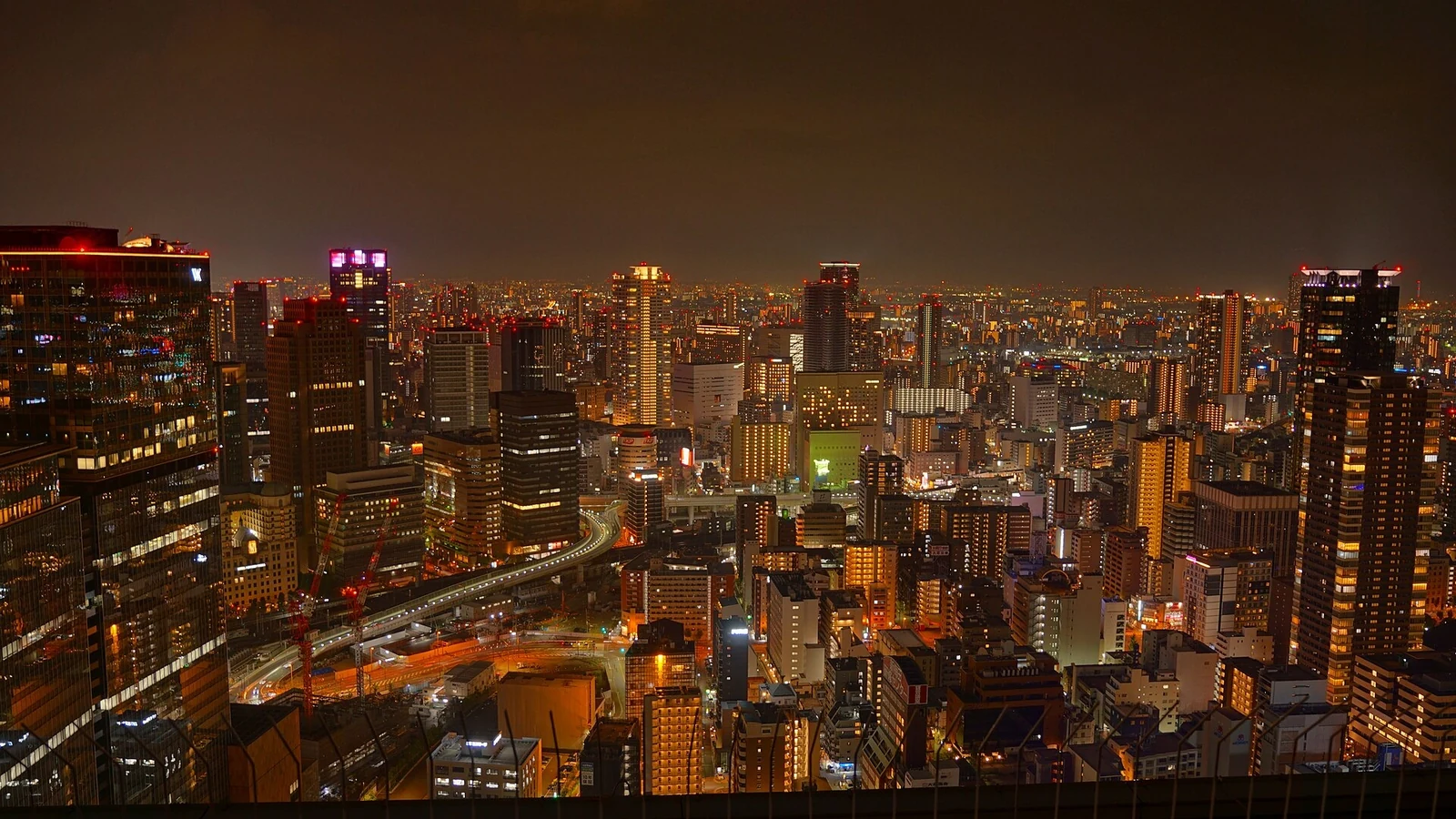
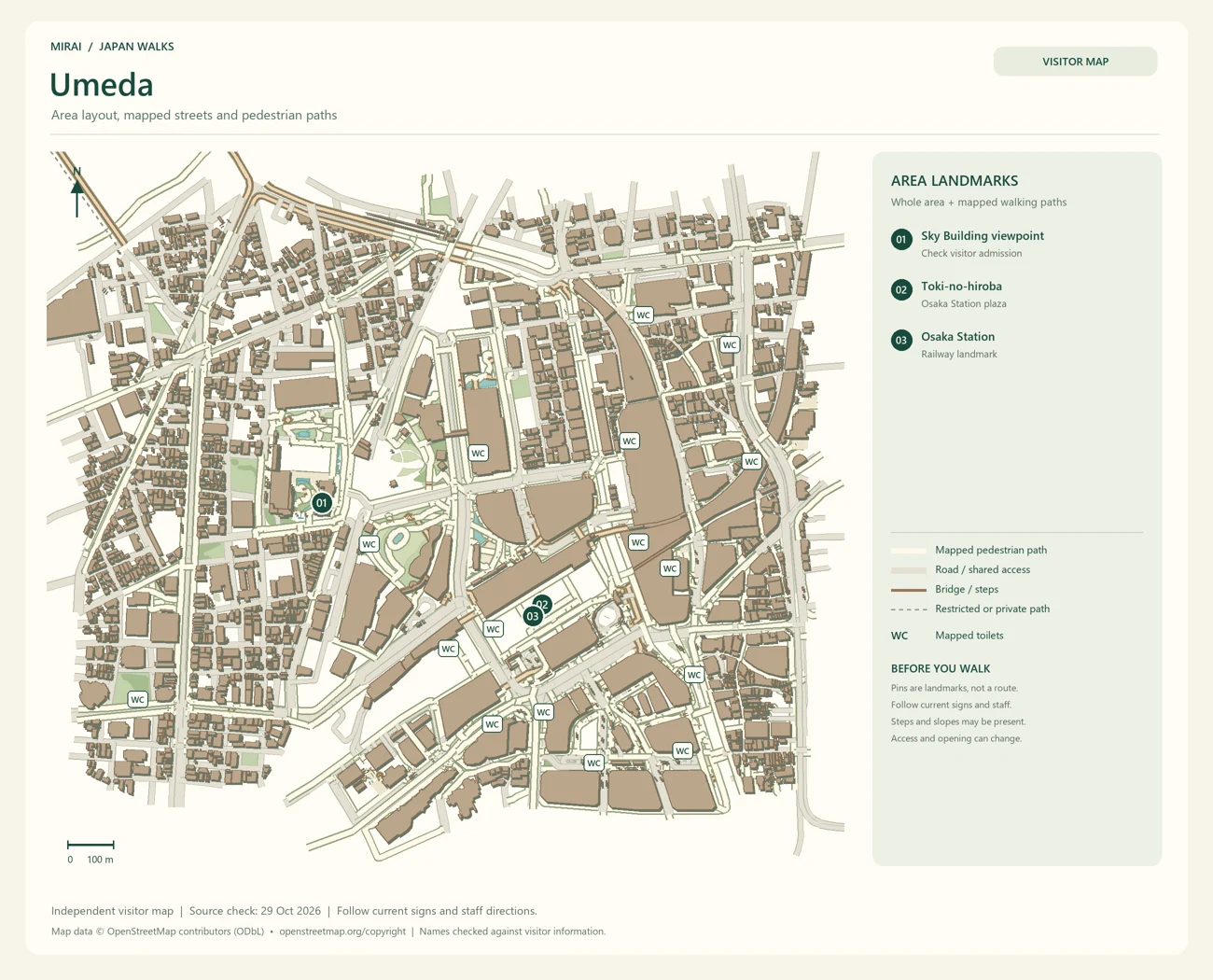
For a view from above, the Kuchu Teien Observatory at Umeda Sky Building is an appealing choice. Its two towers join at the top. Look up at the building before going up inside: the architecture deserves a little attention of its own.
At Osaka Station’s Toki-no-hiroba Plaza, a gold clock and a silver clock make useful landmarks. Umeda has several stations with similar names, so agree on the railway line and a specific meeting point as well. It would be a shame to spend your café time trying to find each other.
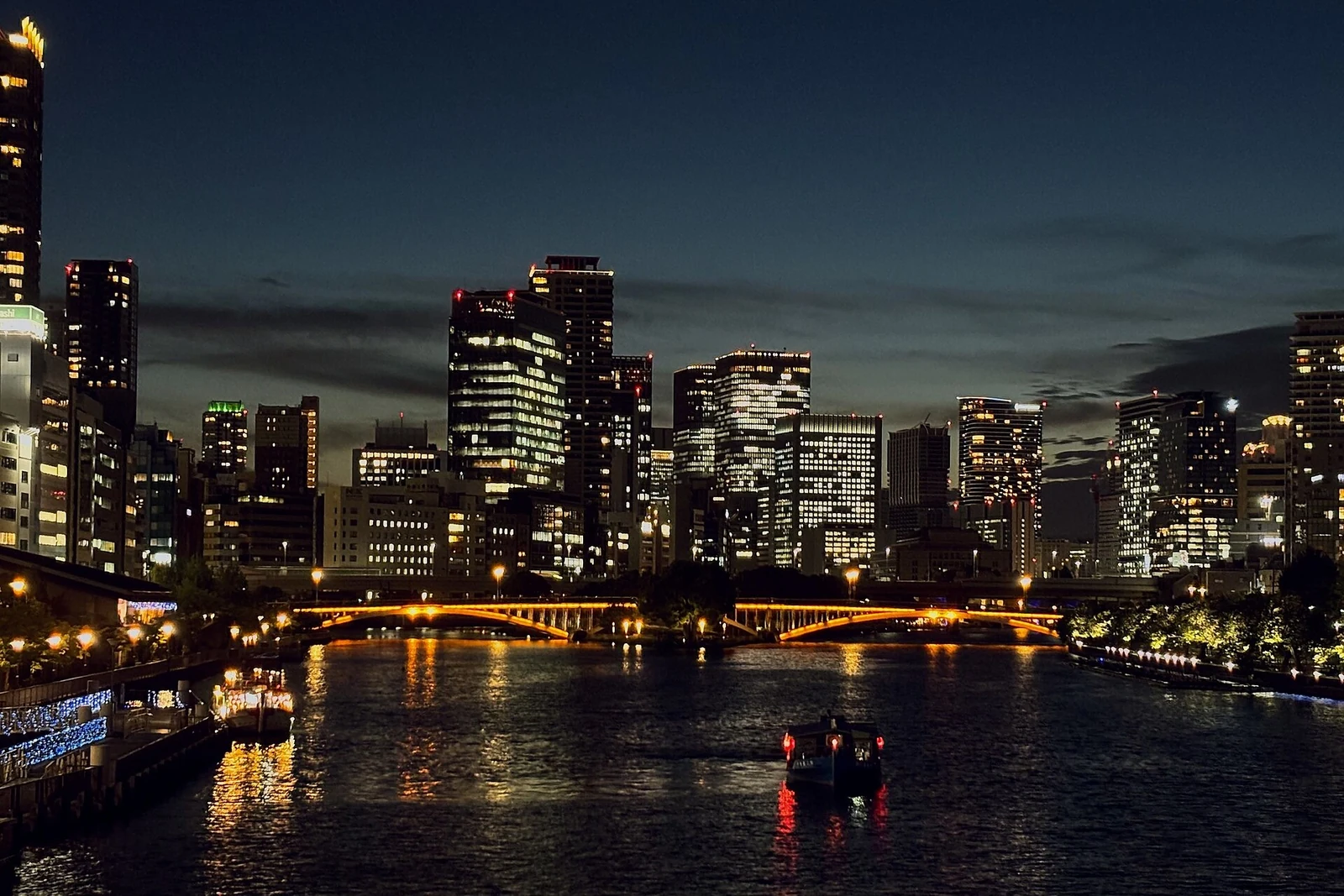
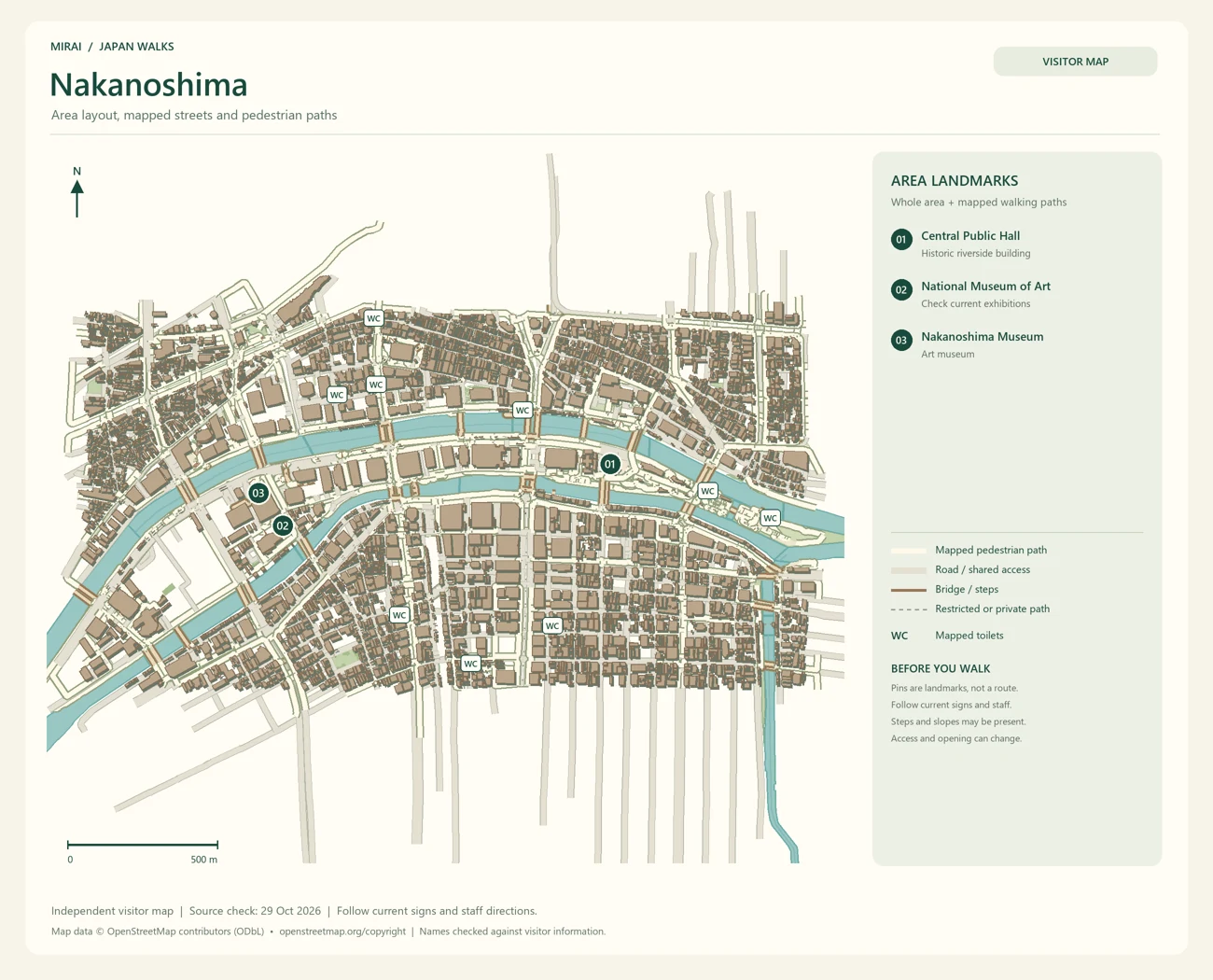
For an afternoon beside the water, turn towards Nakanoshima, between the Dojima and Tosabori rivers.
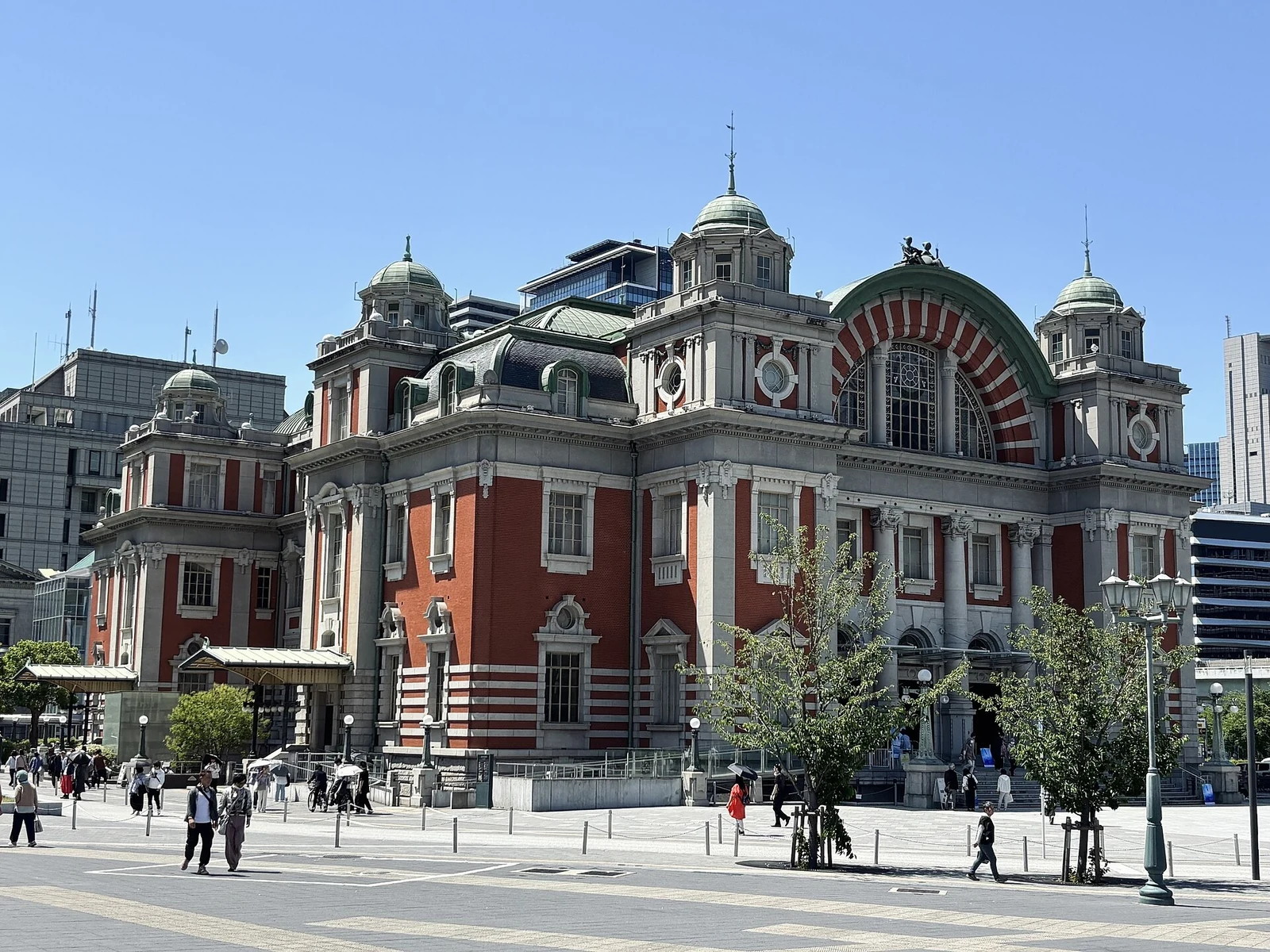
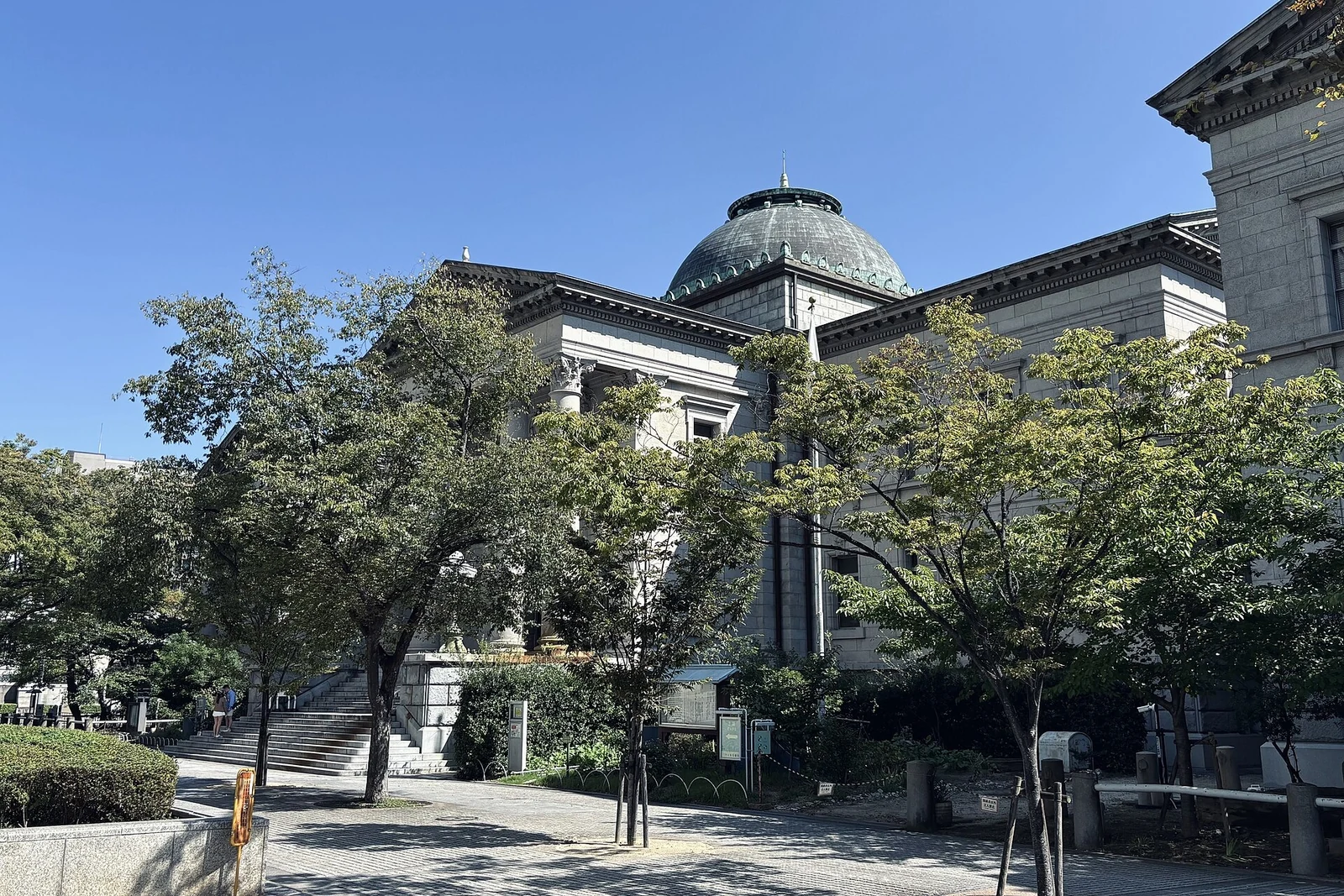
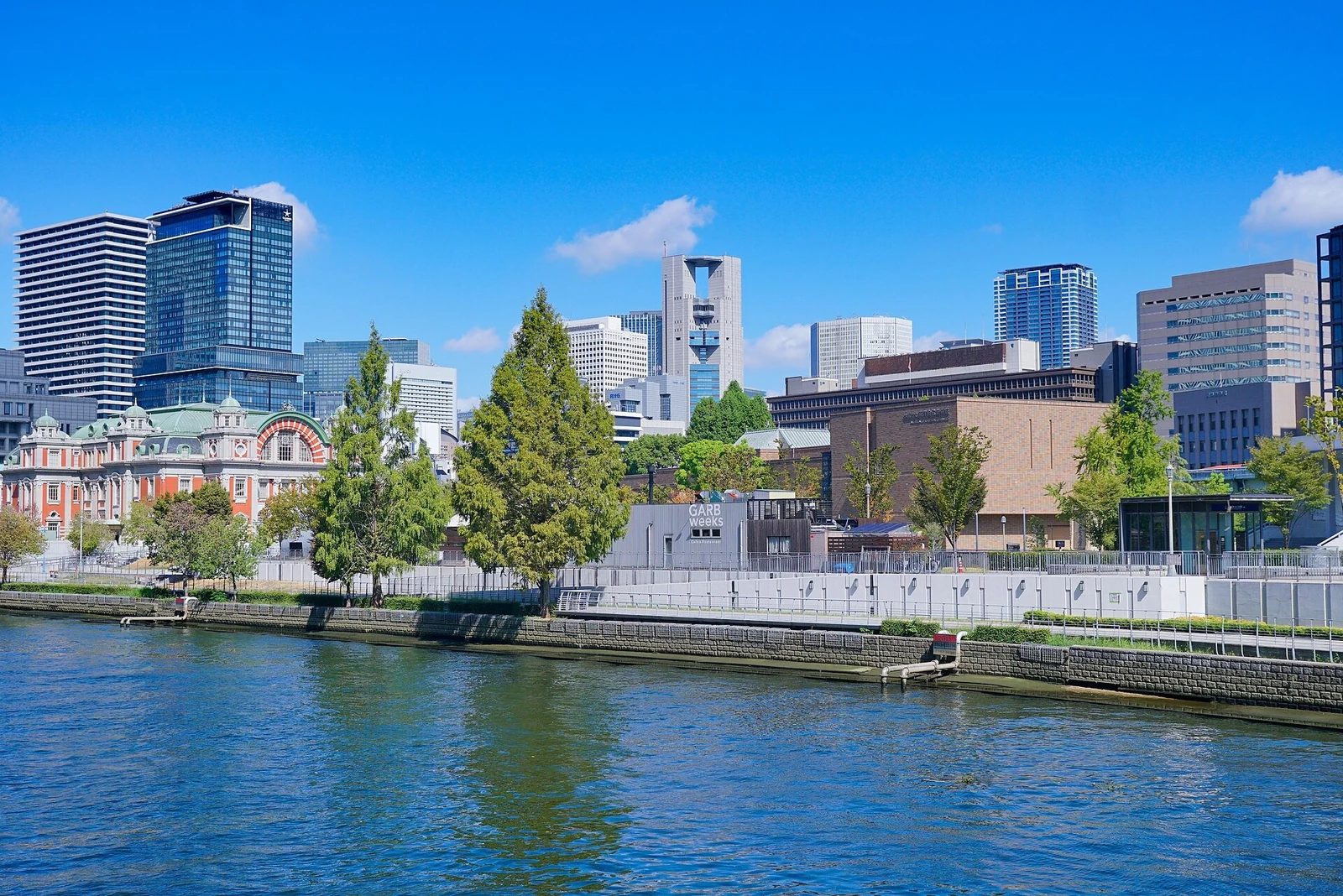
This was a centre of waterborne trade, with warehouse residences representing domains from around Japan. Buildings such as Osaka City Central Public Hall and Osaka Prefectural Nakanoshima Library reflect the people who helped support the city’s cultural life alongside its commerce.
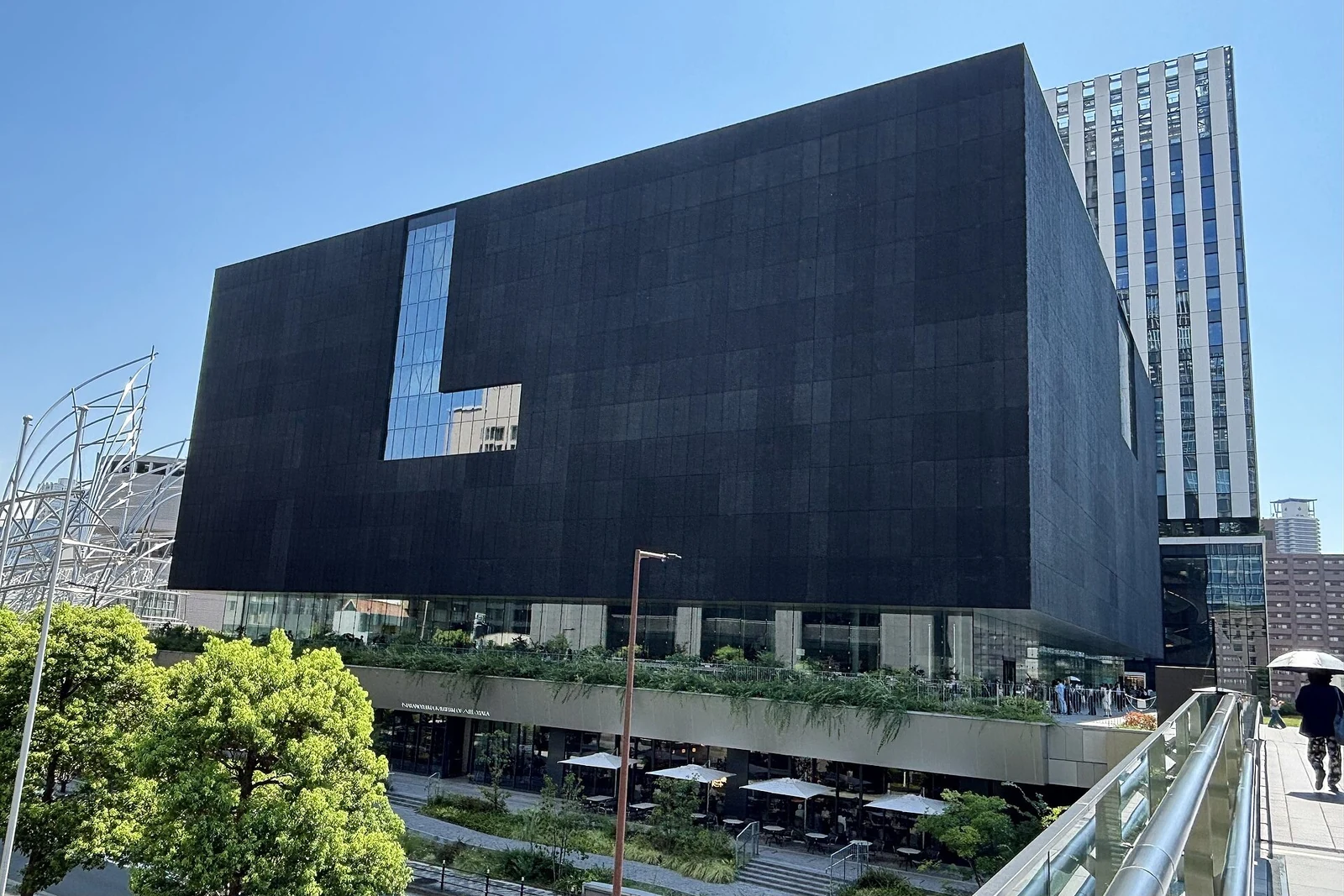
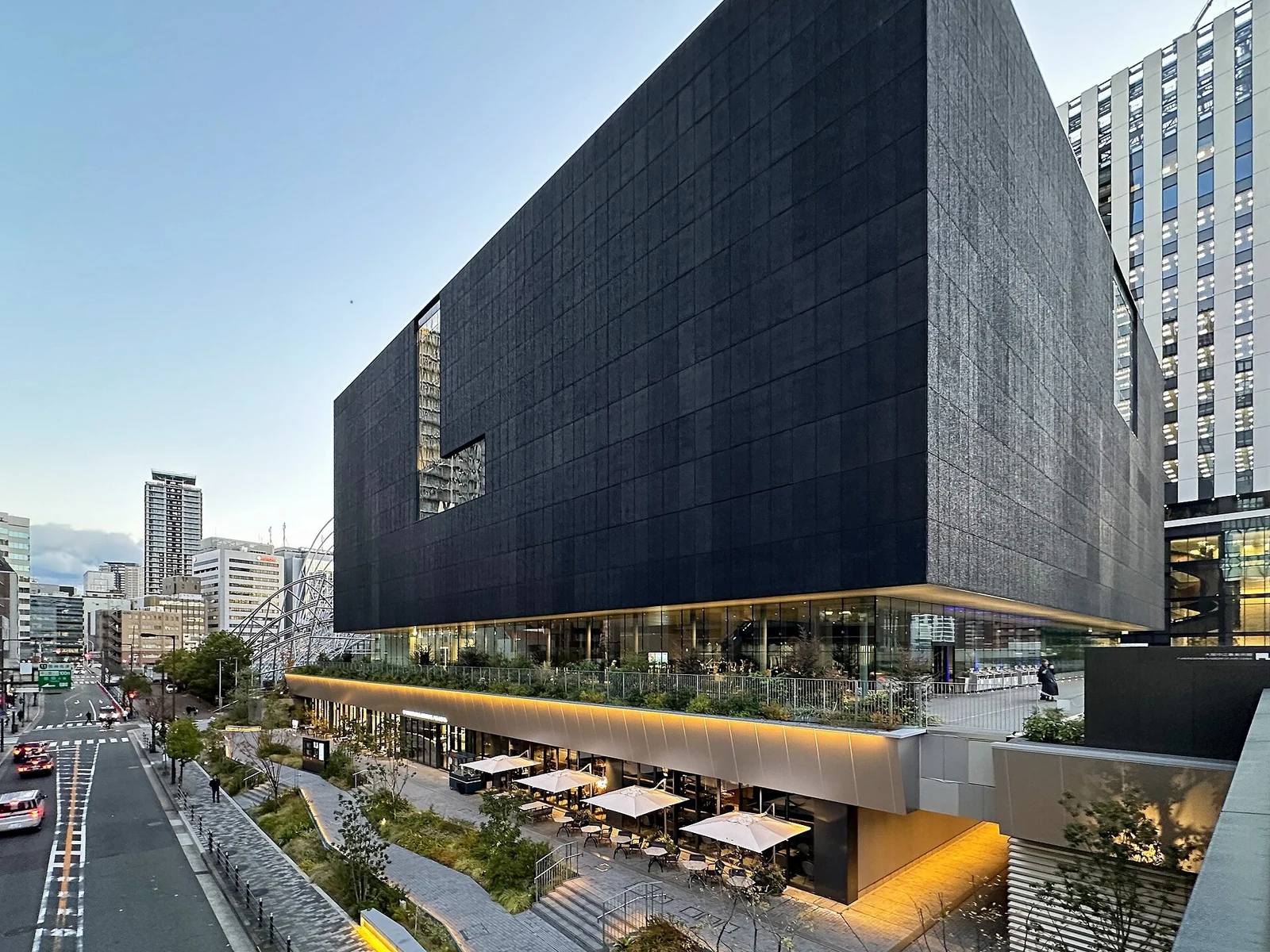
If art interests you, consider the National Museum of Art, Osaka, or Nakanoshima Museum of Art, Osaka. Choose one exhibition and leave time for the river before or afterwards. I would love to hear which work stayed with you over a quiet café break.
A little everyday Osaka on Tenjinbashi-suji
Prepared food, bread, household goods and coffee shops: Tenjinbashi-suji Shopping Street is a lovely place to browse those everyday discoveries.
The neighbourhood grew around Osaka Tenmangu Shrine, and shopping and daily life still overlap here. As people choose their lunch, we can look for a little something that catches our eye, too.
You do not need to walk the entire street. Start near the shops you want to see, using stations such as Tenjinbashisuji 6-chome, Ogimachi or Minami-morimachi.
File:Osaka Umeda Sky Building 2a.jpg — Zairon. https://commons.wikimedia.org/wiki/File:Osaka_Umeda_Sky_Building_2a.jpg | CC BY-SA 4.0 https://creativecommons.org/licenses/by-sa/4.0. Resized and re-encoded; no crop or retouch.
File:Osaka Umeda Sky Building 1.jpg — Brücke-Osteuropa. https://commons.wikimedia.org/wiki/File:Osaka_Umeda_Sky_Building_1.jpg | CC0 http://creativecommons.org/publicdomain/zero/1.0/deed.en. Resized and re-encoded; no crop or retouch.
File:Osaka Umeda Sky Building 10.jpg — Brücke-Osteuropa. https://commons.wikimedia.org/wiki/File:Osaka_Umeda_Sky_Building_10.jpg | CC0 http://creativecommons.org/publicdomain/zero/1.0/deed.en. Resized and re-encoded; no crop or retouch.
File:Osaka Umeda Sky Building 7.jpg — Brücke-Osteuropa. https://commons.wikimedia.org/wiki/File:Osaka_Umeda_Sky_Building_7.jpg | CC0 http://creativecommons.org/publicdomain/zero/1.0/deed.en. Resized and re-encoded; no crop or retouch.
File:Golden night view from Umeda Sky Building (southwest side) 20250830.jpg — 掬茶. https://commons.wikimedia.org/wiki/File:Golden_night_view_from_Umeda_Sky_Building_(southwest_side)_20250830.jpg | CC BY-SA 4.0 https://creativecommons.org/licenses/by-sa/4.0. Resized and re-encoded; no crop or retouch.
File:Osaka Nakanoshima Public Hall.jpg — Sakai Yayoi. https://commons.wikimedia.org/wiki/File:Osaka_Nakanoshima_Public_Hall.jpg | CC0 http://creativecommons.org/publicdomain/zero/1.0/deed.en. Resized and re-encoded; no crop or retouch.
File:Osaka Prefectural Nakanoshima Library ao.jpg — Sakai Yayoi. https://commons.wikimedia.org/wiki/File:Osaka_Prefectural_Nakanoshima_Library_ao.jpg | CC0 http://creativecommons.org/publicdomain/zero/1.0/deed.en. Resized and re-encoded; no crop or retouch.
File:Nakanoshima Museum of Art, Osaka.jpg — Sakai Yayoi. https://commons.wikimedia.org/wiki/File:Nakanoshima_Museum_of_Art,_Osaka.jpg | CC0 http://creativecommons.org/publicdomain/zero/1.0/deed.en. Resized and re-encoded; no crop or retouch.
File:Osaka Nakanoshima 2026 yoru.jpg — Sakai Yayoi. https://commons.wikimedia.org/wiki/File:Osaka_Nakanoshima_2026_yoru.jpg | CC0 http://creativecommons.org/publicdomain/zero/1.0/deed.en. Resized and re-encoded; no crop or retouch.
File:Cityscapes of Nakanoshima, Osaka from Naniwa Bridge 20250901.jpg — 掬茶. https://commons.wikimedia.org/wiki/File:Cityscapes_of_Nakanoshima,_Osaka_from_Naniwa_Bridge_20250901.jpg | CC BY-SA 4.0 https://creativecommons.org/licenses/by-sa/4.0. Resized and re-encoded; no crop or retouch.
File:Nakanoshima Museum of Art Osaka.jpg — Прикли. https://commons.wikimedia.org/wiki/File:Nakanoshima_Museum_of_Art_Osaka.jpg | CC BY 4.0 https://creativecommons.org/licenses/by/4.0. Resized and re-encoded; no crop or retouch.
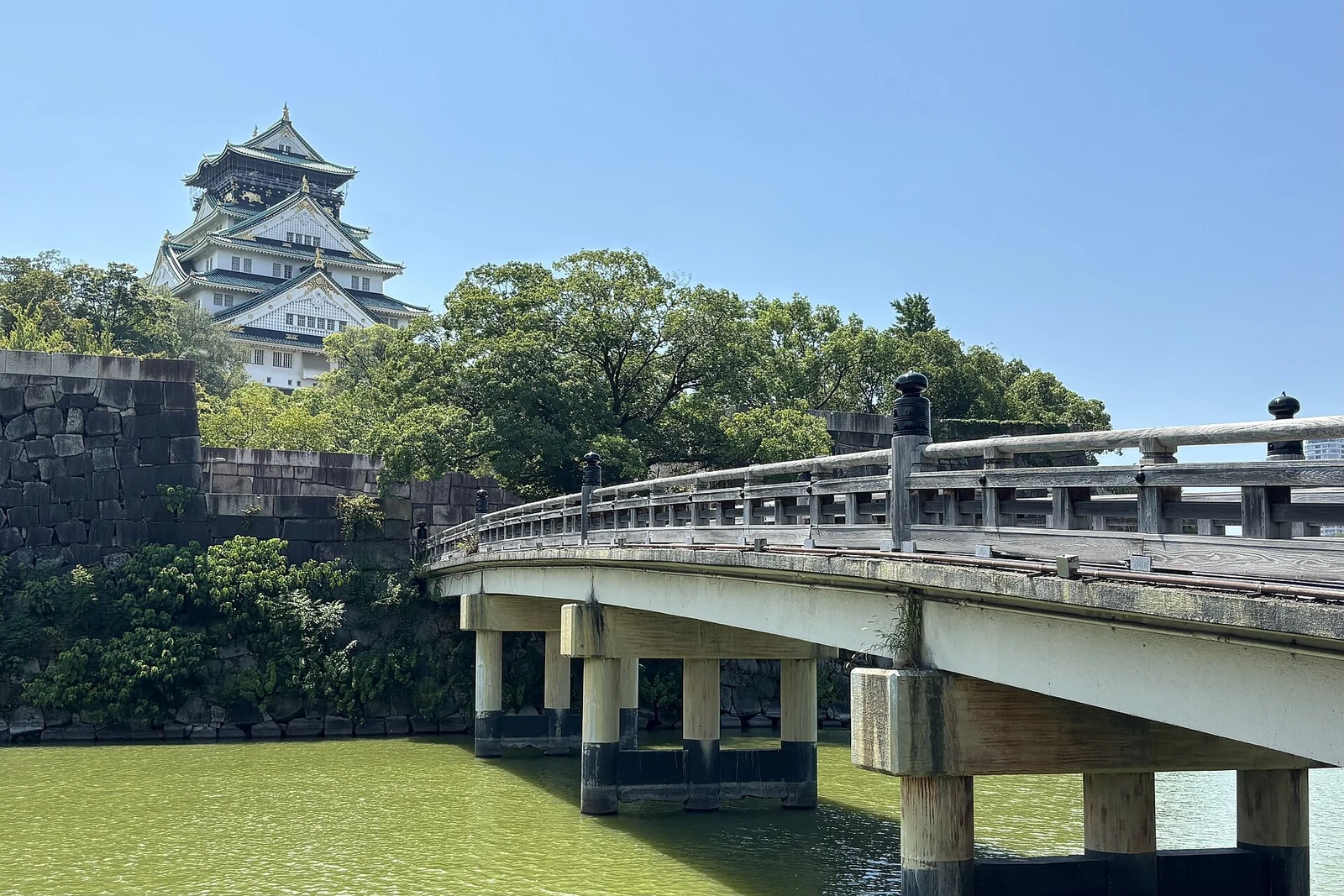
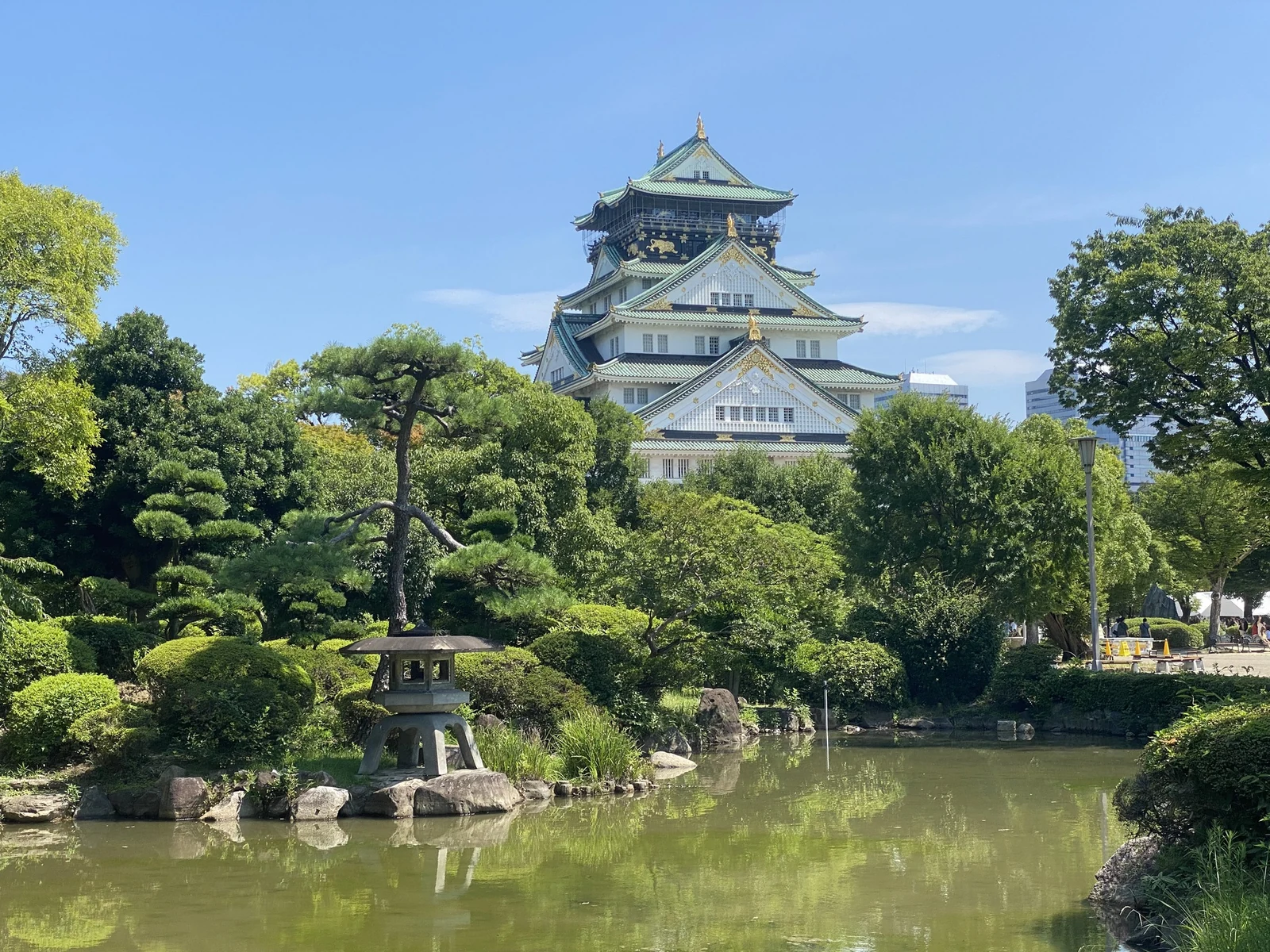
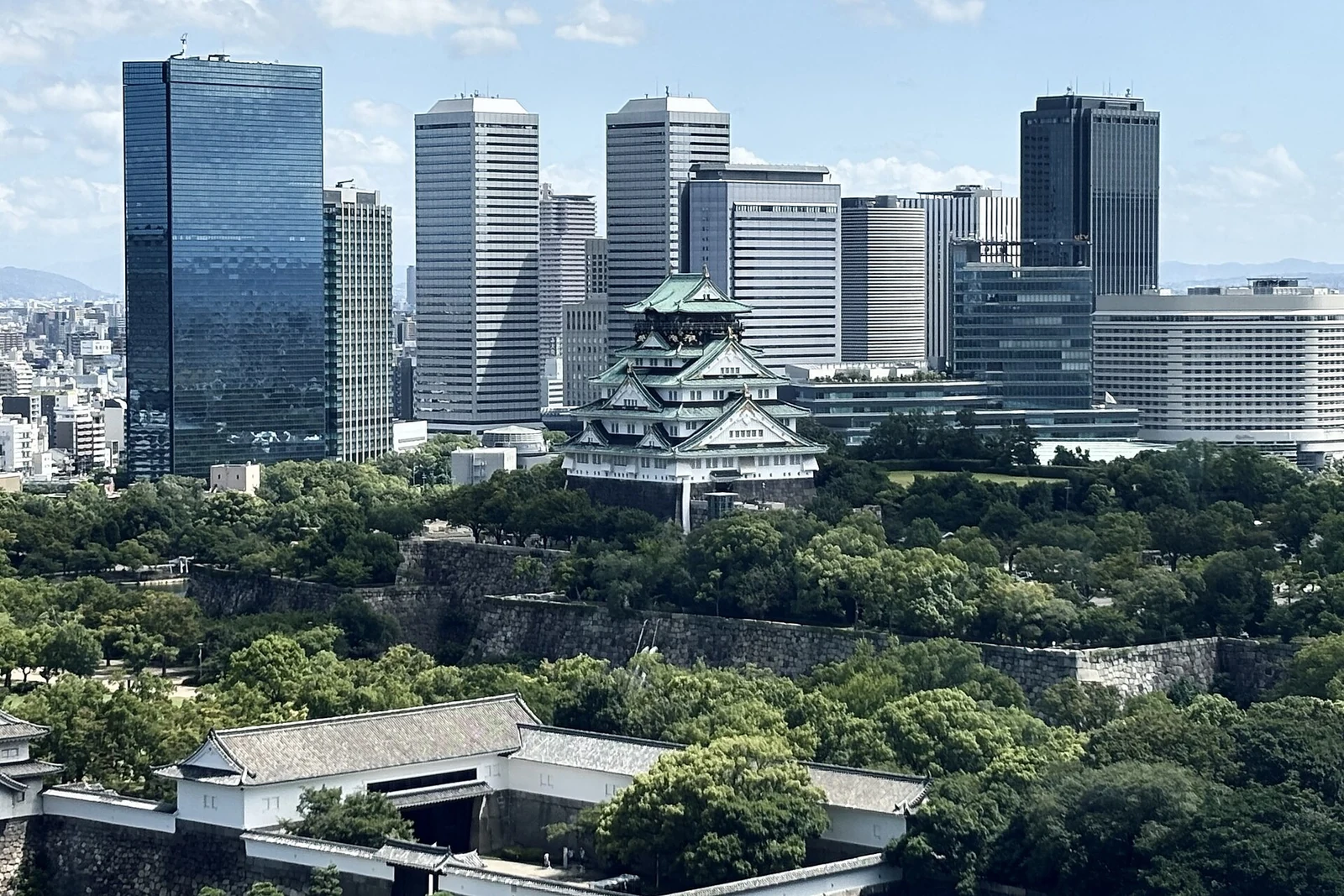
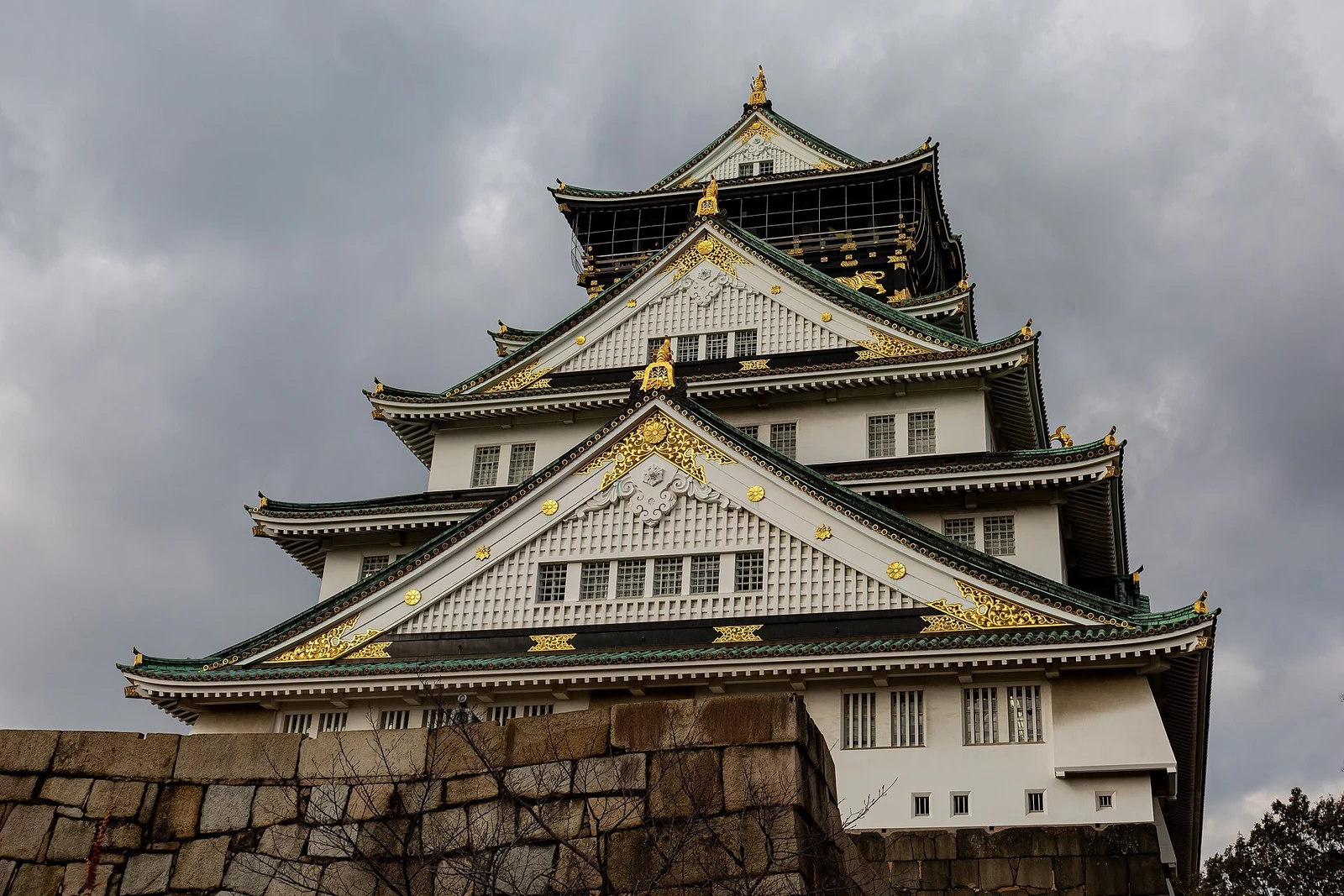
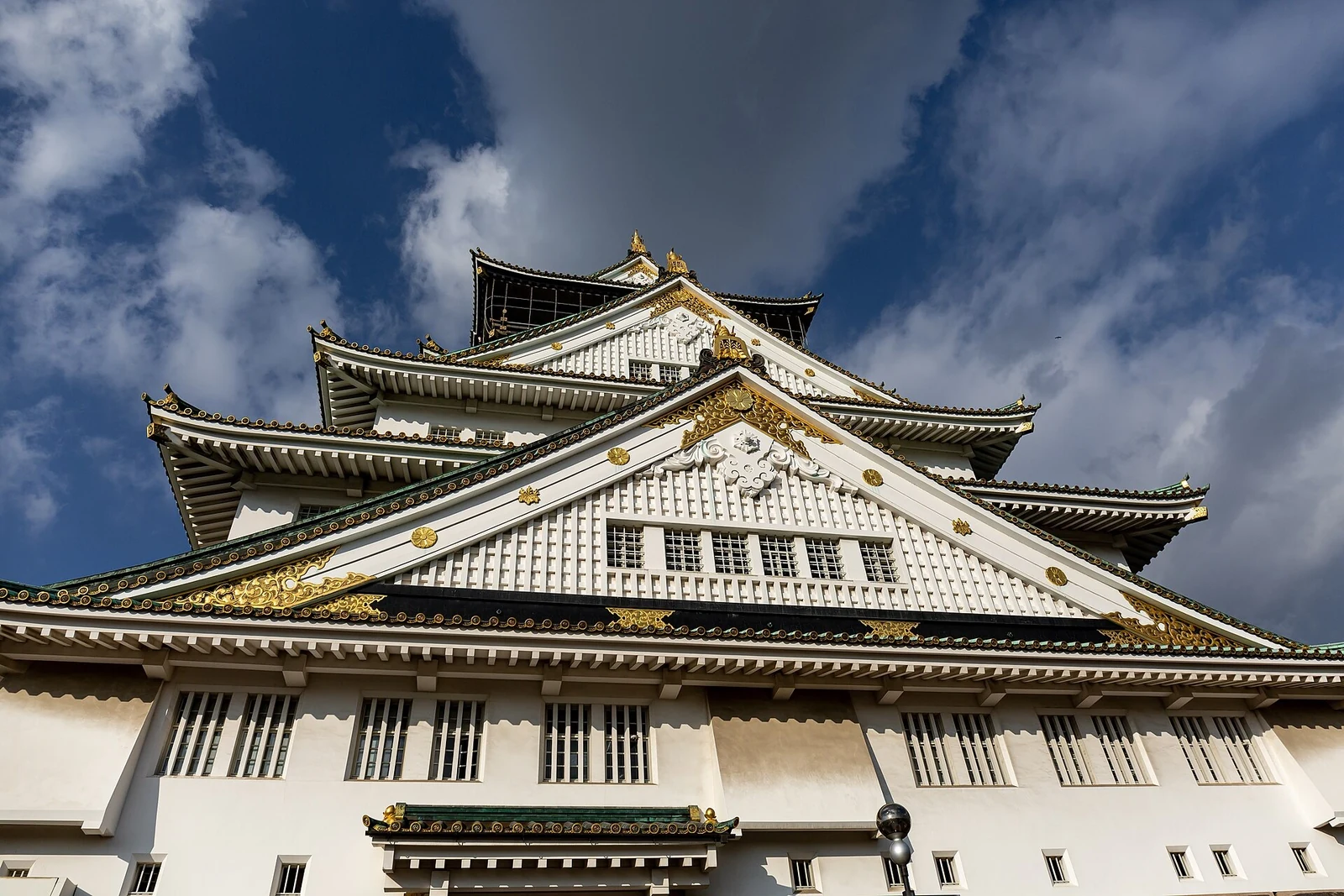
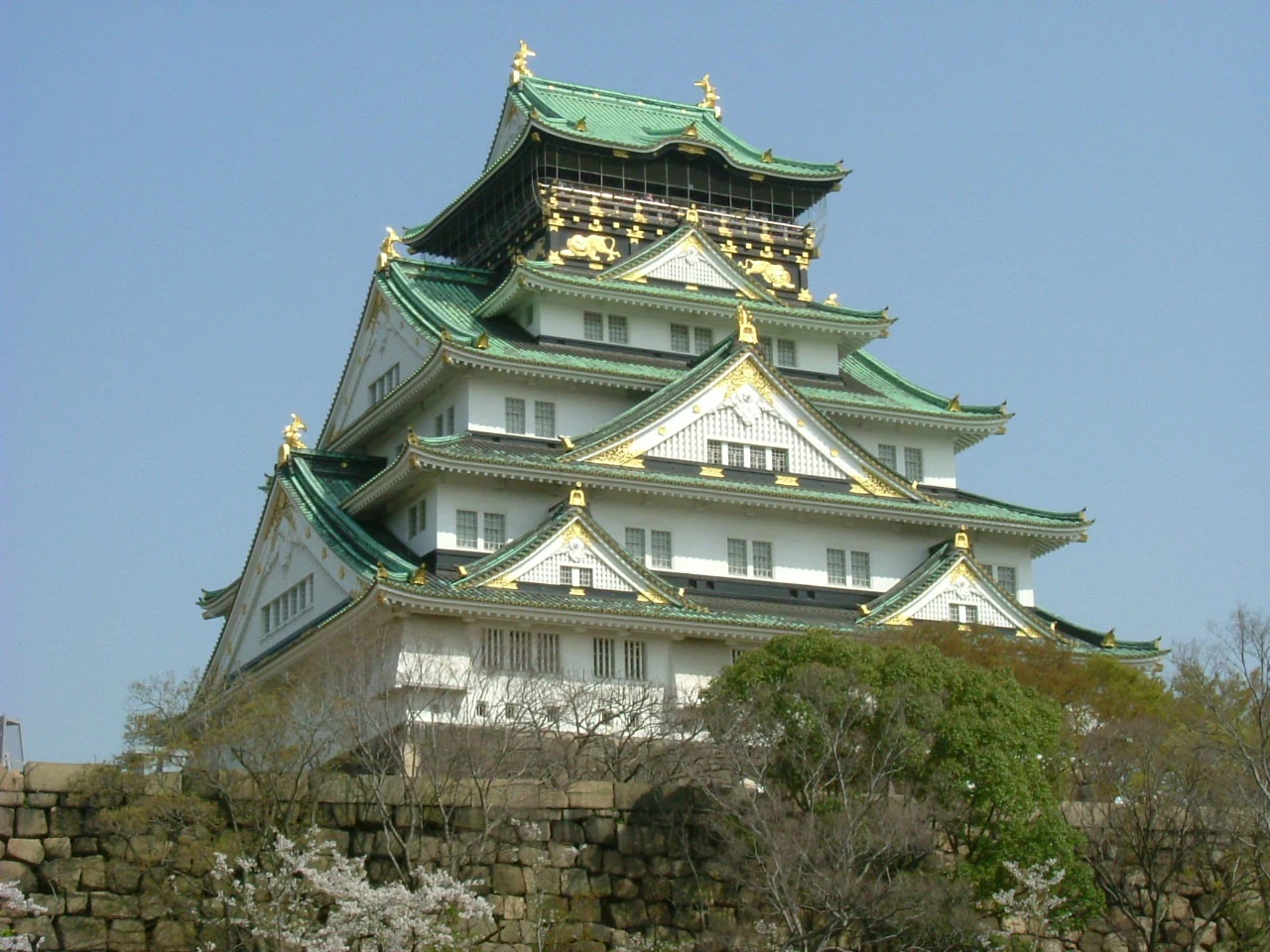
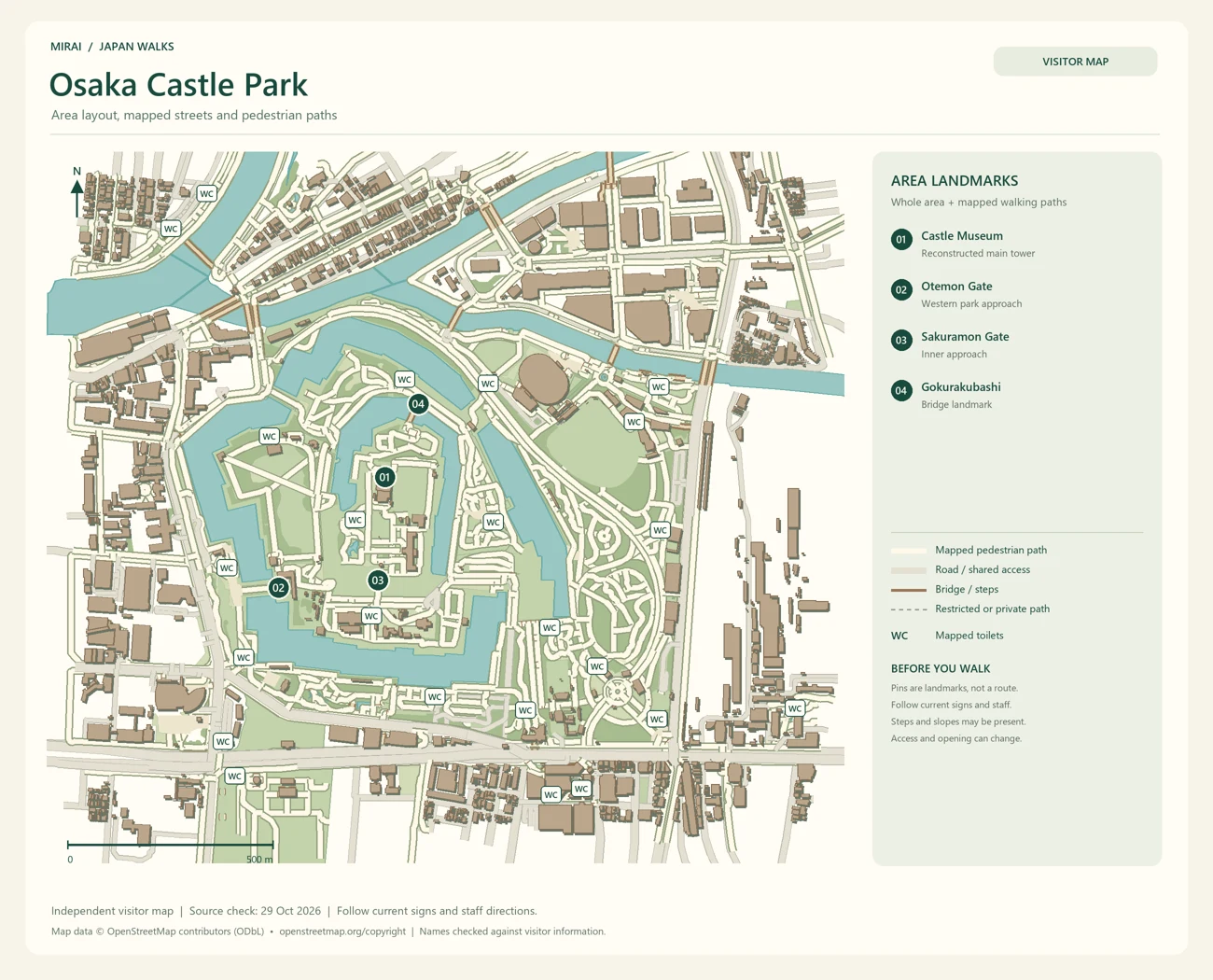
The castle tower naturally draws your eye, but look at the moats, gates and enormous stones on the way there, too.
“How did they move something that big?”
Standing beside the walls might make you wonder about a scale that photographs cannot quite convey.
Osaka Castle is associated with Toyotomi Hideyoshi, but the present main tower was reconstructed in 1931. Inside, exhibitions introduce the castle’s history and Hideyoshi’s world.
You could make the tower your main visit, or enjoy plum and cherry blossoms in the park. There is walking between the stations and the tower, so choose the parts you want to enjoy instead of hurrying around the entire park.
On a rainy day, or if you would like more historical context, nearby Osaka Museum of History is another possibility. It could be interesting to look back at the city through its exhibitions after seeing it outside.
File:Osaka Castle and Gokurakubashi Bridge.jpg — Sakai Yayoi. https://commons.wikimedia.org/wiki/File:Osaka_Castle_and_Gokurakubashi_Bridge.jpg | CC0 http://creativecommons.org/publicdomain/zero/1.0/deed.en. Resized and re-encoded; no crop or retouch.
File:Osaka Castle - 2024-07-21.png — AndrewTheWiki. https://commons.wikimedia.org/wiki/File:Osaka_Castle_-_2024-07-21.png | CC0 http://creativecommons.org/publicdomain/zero/1.0/deed.en. Resized and re-encoded; no crop or retouch.
File:Osaka Castle and OBP.jpg — Sakai Yayoi. https://commons.wikimedia.org/wiki/File:Osaka_Castle_and_OBP.jpg | CC0 http://creativecommons.org/publicdomain/zero/1.0/deed.en. Resized and re-encoded; no crop or retouch.
File:20190121 Osaka Castle-1.jpg — Balon Greyjoy. https://commons.wikimedia.org/wiki/File:20190121_Osaka_Castle-1.jpg | CC0 http://creativecommons.org/publicdomain/zero/1.0/deed.en. Resized and re-encoded; no crop or retouch.
File:20190121 Osaka Castle-2.jpg — Balon Greyjoy. https://commons.wikimedia.org/wiki/File:20190121_Osaka_Castle-2.jpg | CC0 http://creativecommons.org/publicdomain/zero/1.0/deed.en. Resized and re-encoded; no crop or retouch.
File:Osaka Castle Nishinomaru Garden April 2005.JPG — . https://commons.wikimedia.org/wiki/File:Osaka_Castle_Nishinomaru_Garden_April_2005.JPG | Public domain . Resized and re-encoded; no crop or retouch.
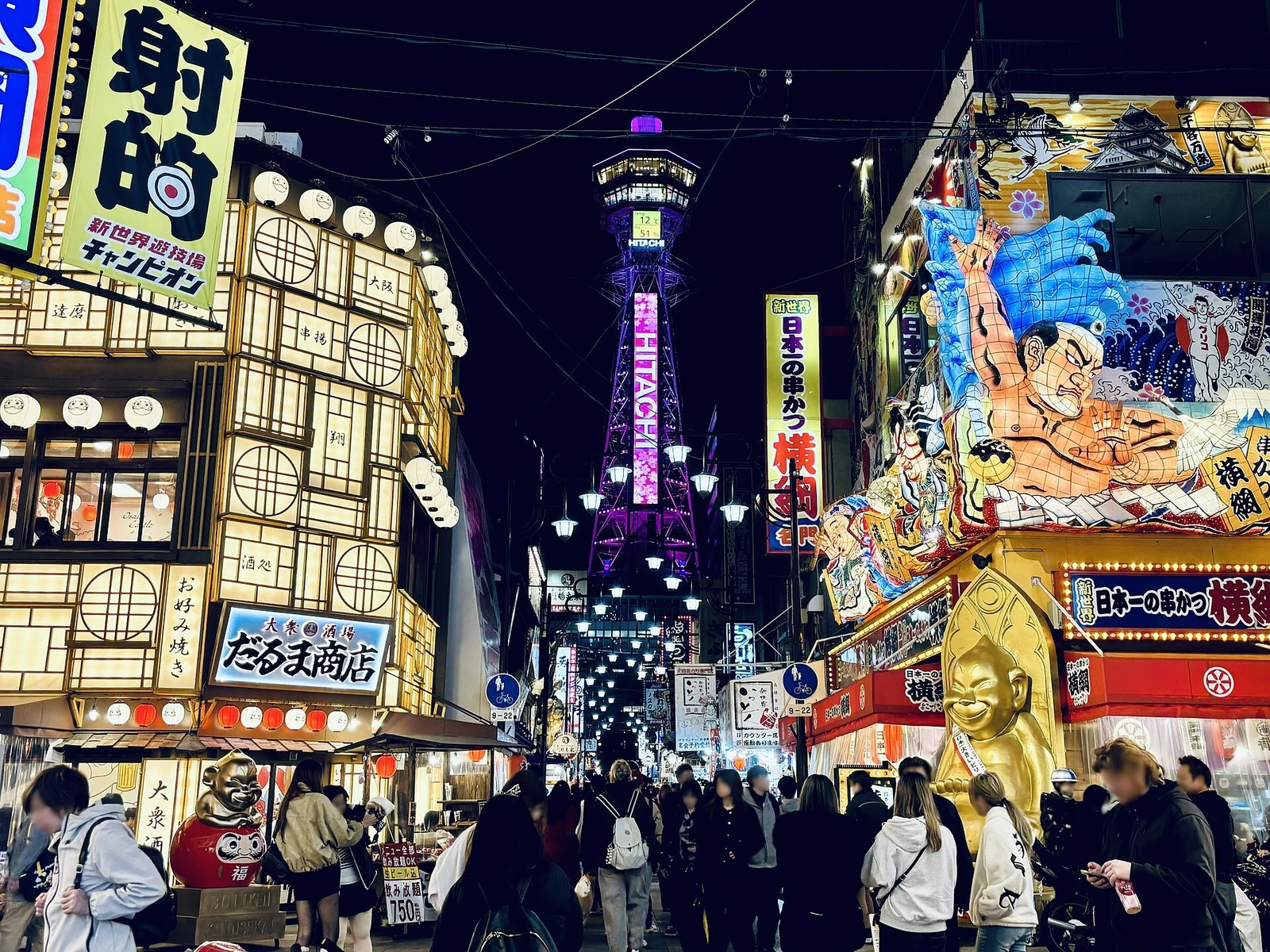
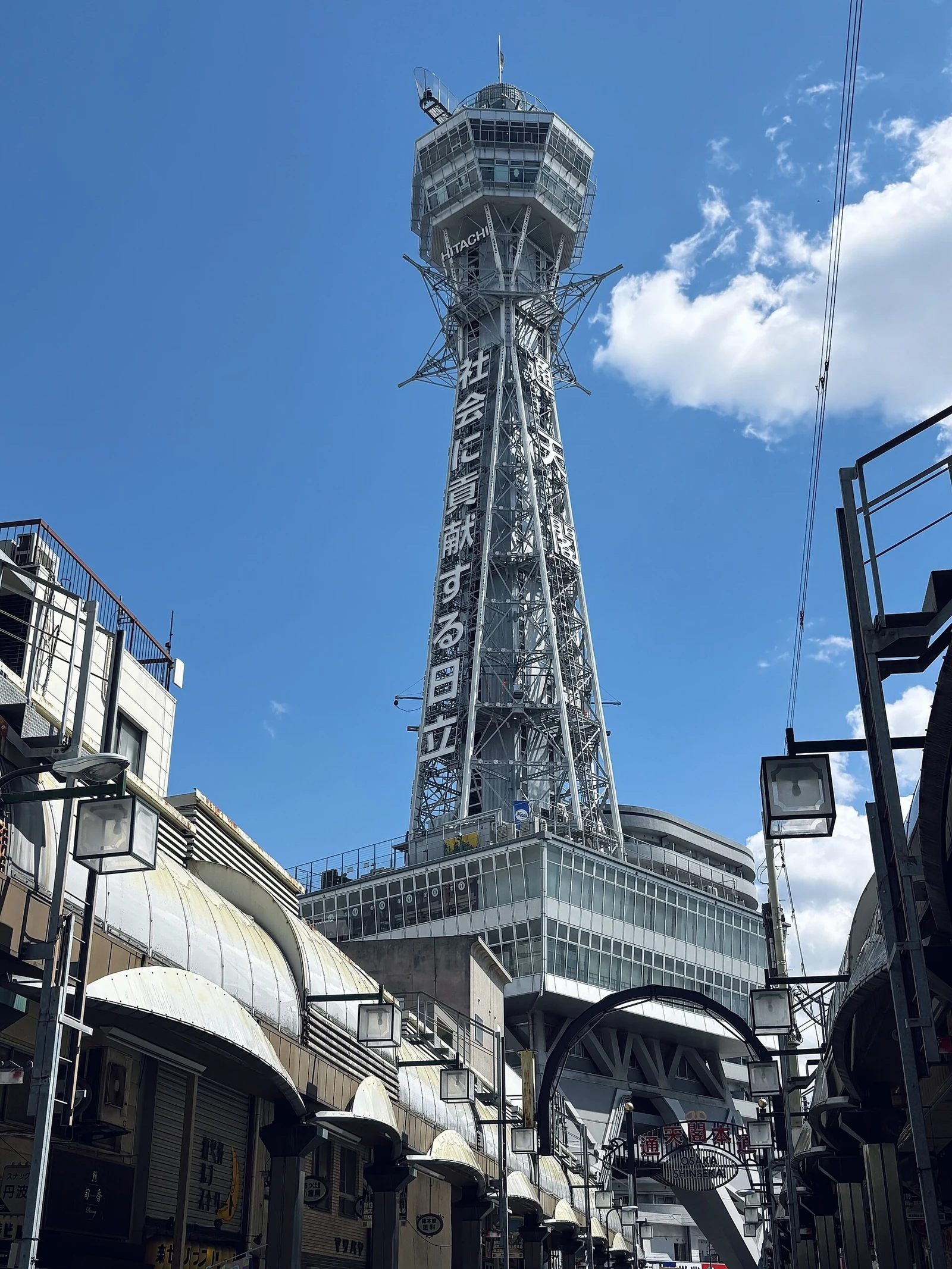
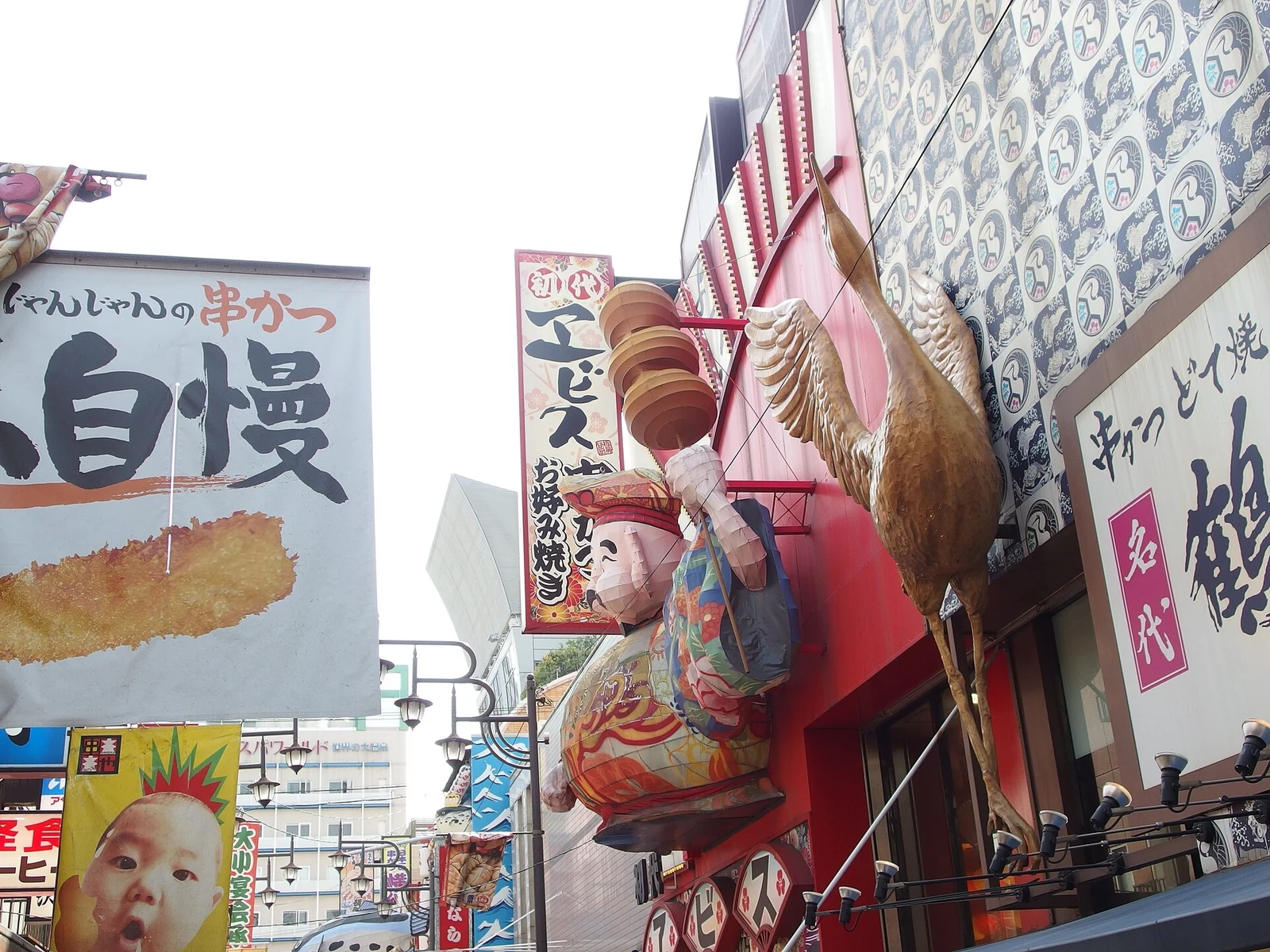
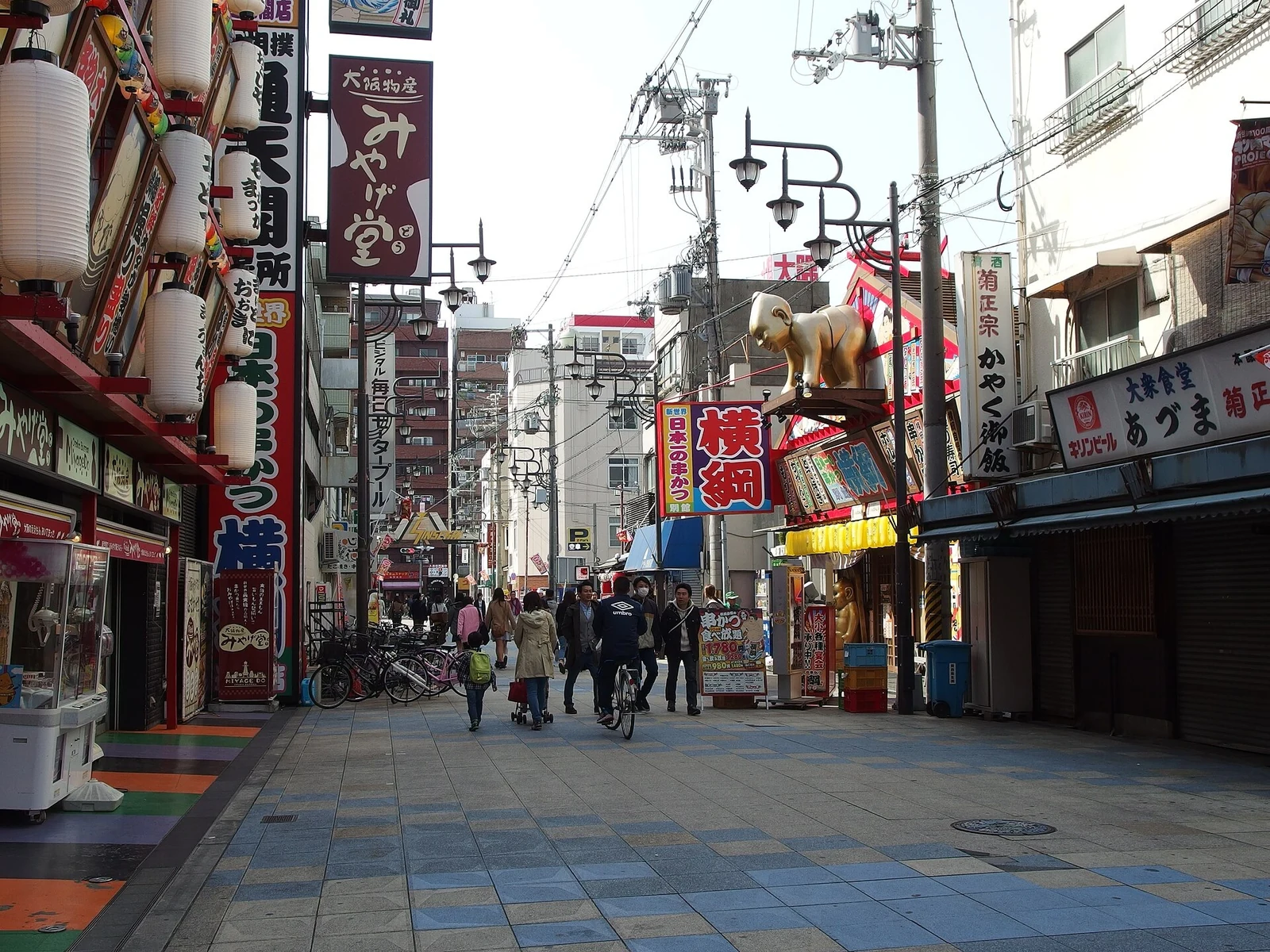
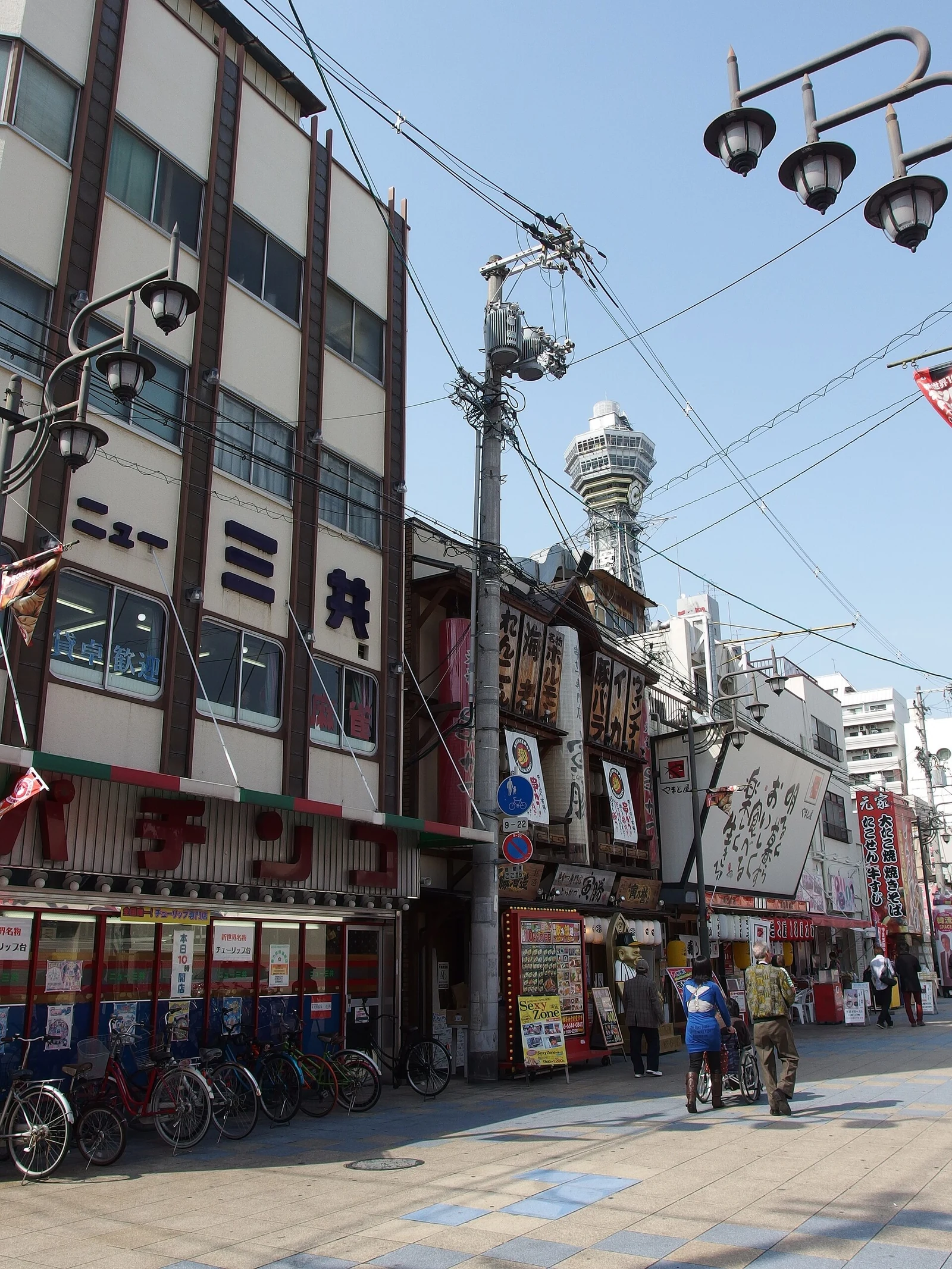
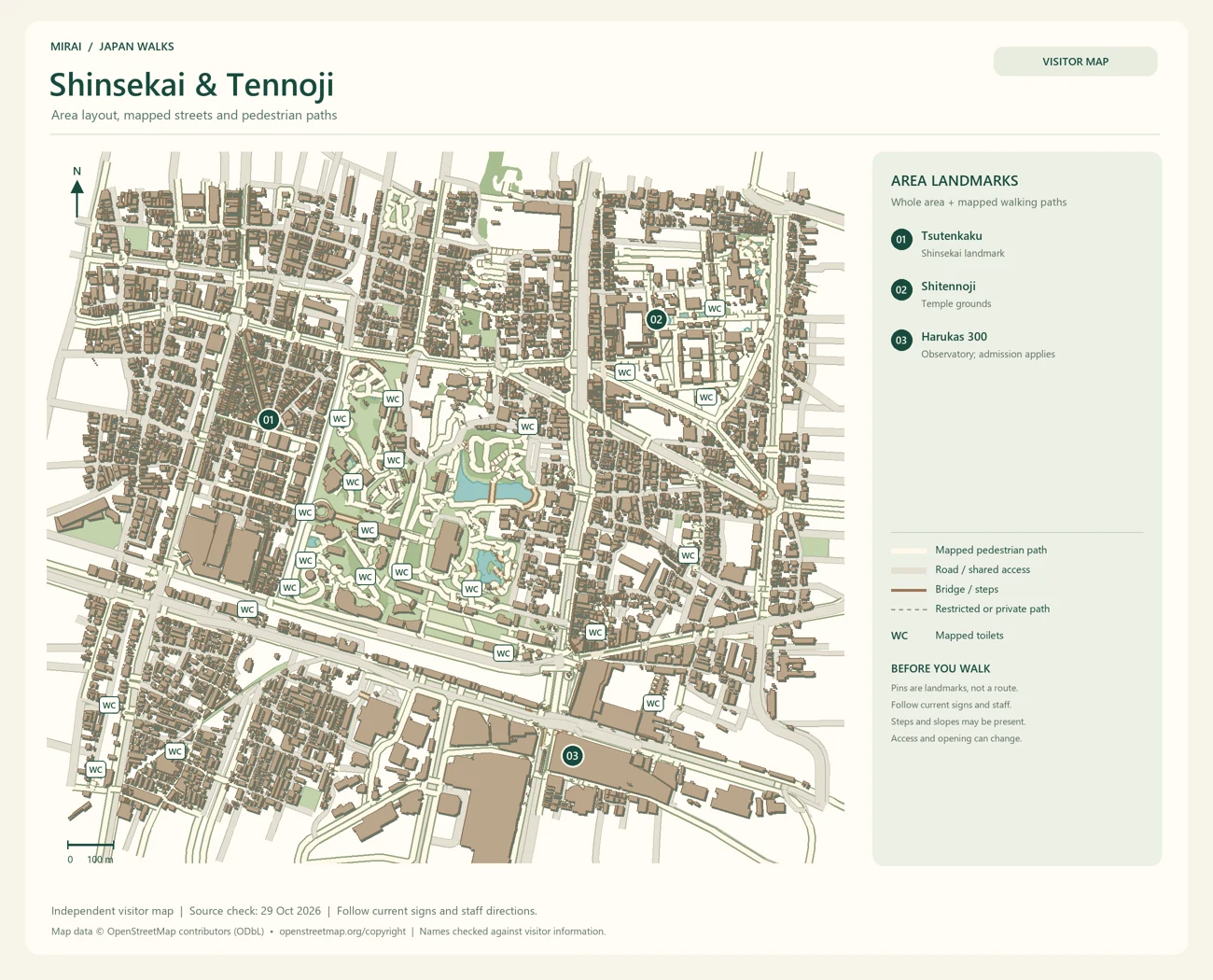
In Shinsekai, restaurant signs and older shopfronts line the streets beneath Tsutenkaku.
The area developed on the site of the 1903 exhibition, with the original Tsutenkaku and the Luna Park amusement park opening later. Today’s tower is the second one. Knowing that this has long been a place for entertainment adds another little layer to the streets.
If a kushikatsu restaurant catches your eye, compare the menu and decide what to try. Let’s leave time to sit down and eat as well as take photographs.
Towards Tennoji, the choices change again.
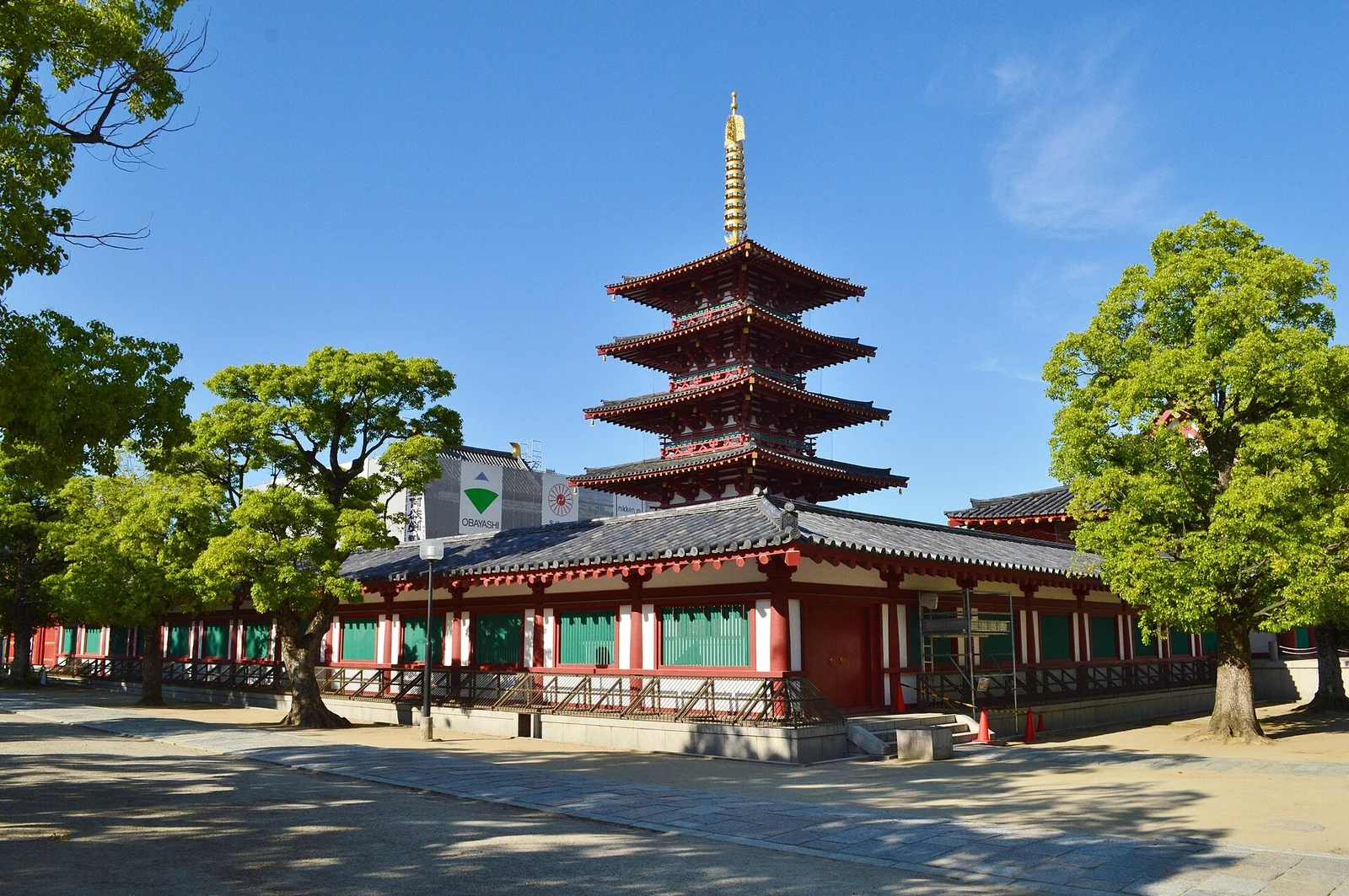
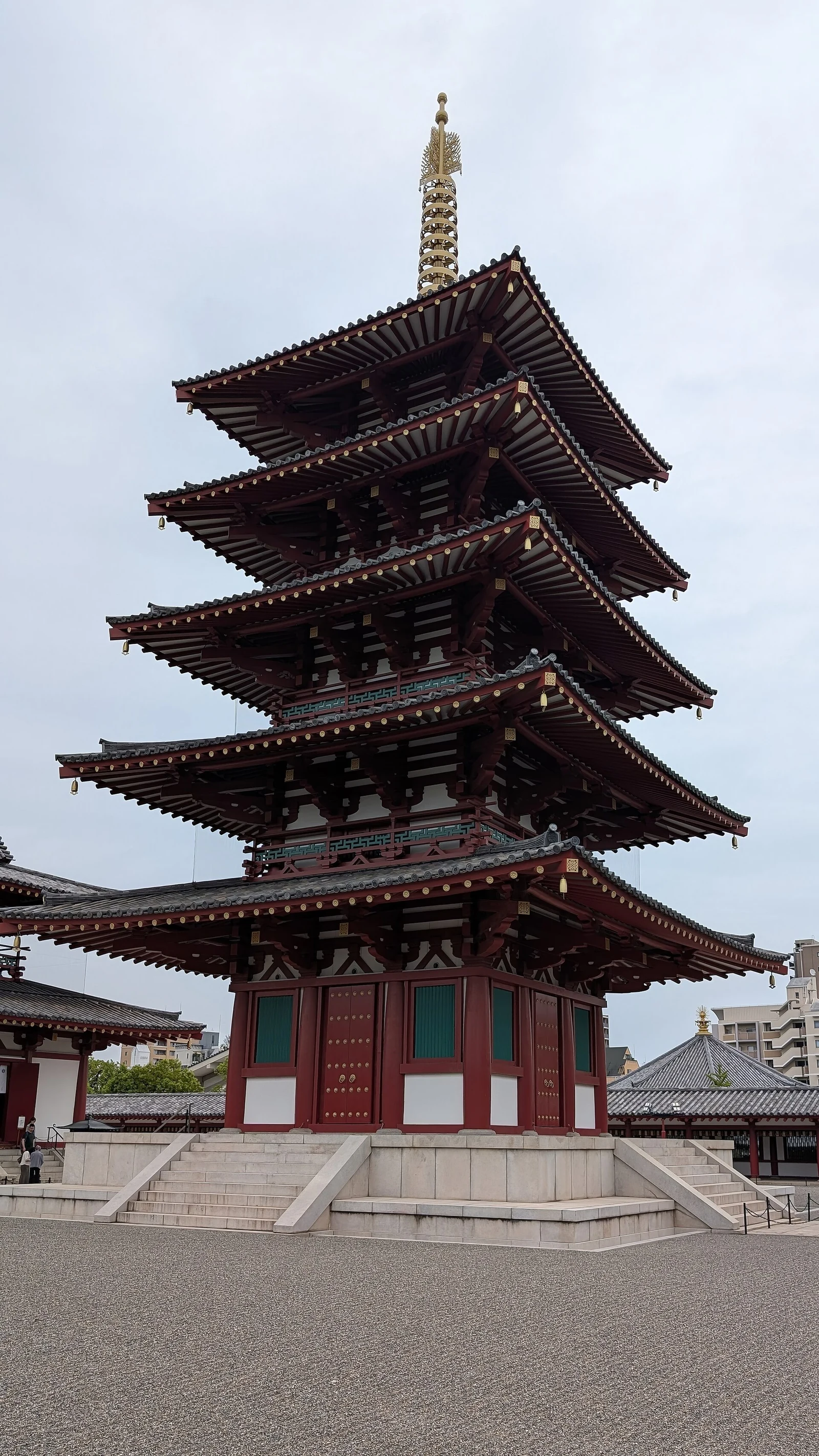
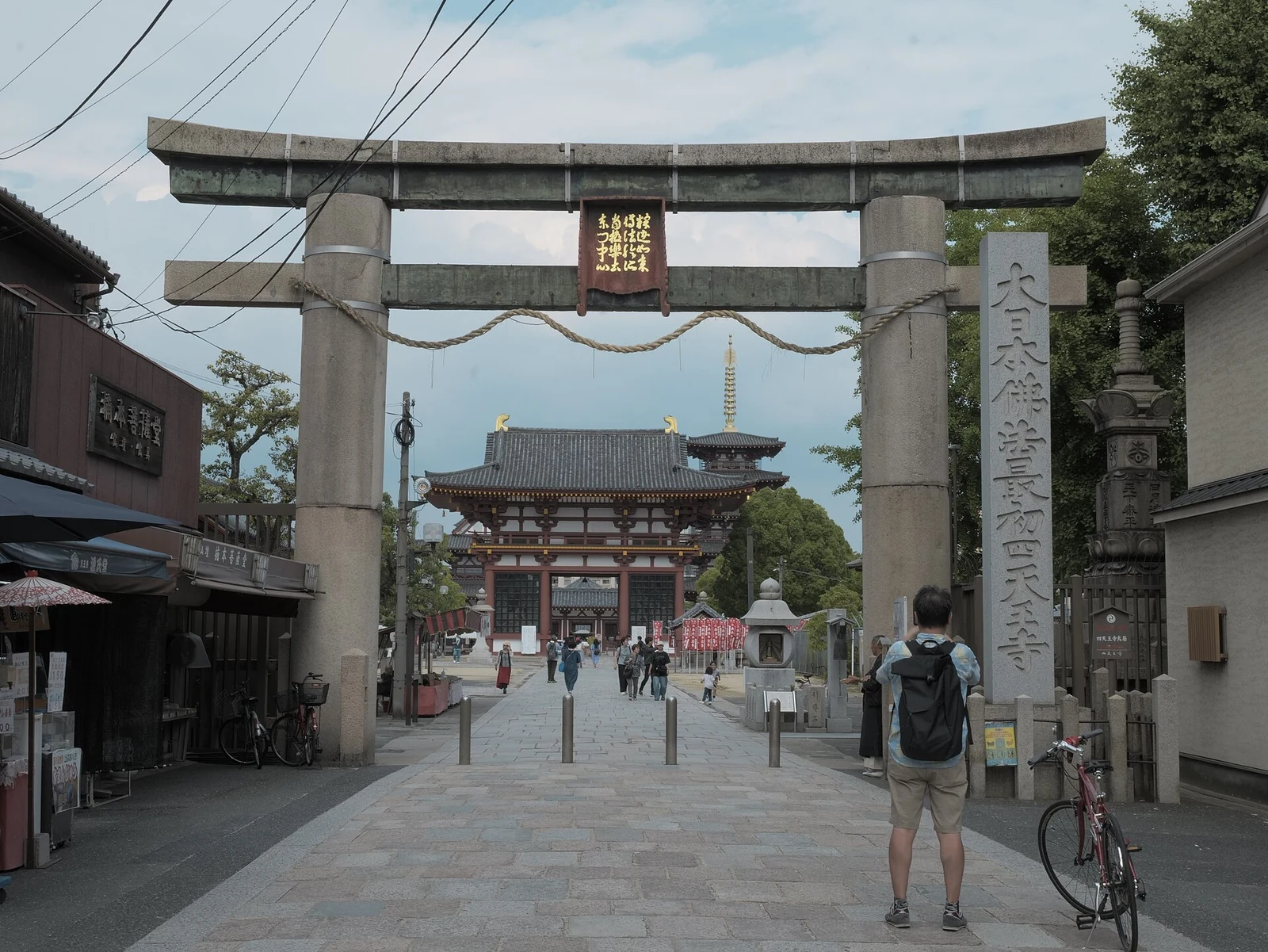
For history, visit Shitennoji, associated with Prince Shotoku. Take a little time with the view of its five-storey pagoda and main hall.
For a broad city panorama, there is Harukas 300, the observatory in Abeno Harukas. Walking among the streets and looking across them from above could make a lovely combination.
Shinsekai, a temple, an observatory: they are all tempting, but we do not have to fit everything into one outing. What would you most like to enjoy today?
File:Shinsekai and Tsutenkaku Tower.jpg — Sakai Yayoi. https://commons.wikimedia.org/wiki/File:Shinsekai_and_Tsutenkaku_Tower.jpg | CC0 http://creativecommons.org/publicdomain/zero/1.0/deed.en. Resized and re-encoded; no crop or retouch.
File:New Tsutenkaku, Osaka.jpg — Sakai Yayoi. https://commons.wikimedia.org/wiki/File:New_Tsutenkaku,_Osaka.jpg | CC0 http://creativecommons.org/publicdomain/zero/1.0/deed.en. Resized and re-encoded; no crop or retouch.
File:Shinsekai @ Osaka (13382384655).jpg — Guilhem Vellut from Annecy, France. https://commons.wikimedia.org/wiki/File:Shinsekai_@_Osaka_(13382384655).jpg | CC BY 2.0 https://creativecommons.org/licenses/by/2.0. Resized and re-encoded; no crop or retouch.
File:Shinsekai @ Osaka (13382764384).jpg — Guilhem Vellut from Annecy, France. https://commons.wikimedia.org/wiki/File:Shinsekai_@_Osaka_(13382764384).jpg | CC BY 2.0 https://creativecommons.org/licenses/by/2.0. Resized and re-encoded; no crop or retouch.
File:Shinsekai @ Osaka (13382786164).jpg — Guilhem Vellut from Annecy, France. https://commons.wikimedia.org/wiki/File:Shinsekai_@_Osaka_(13382786164).jpg | CC BY 2.0 https://creativecommons.org/licenses/by/2.0. Resized and re-encoded; no crop or retouch.
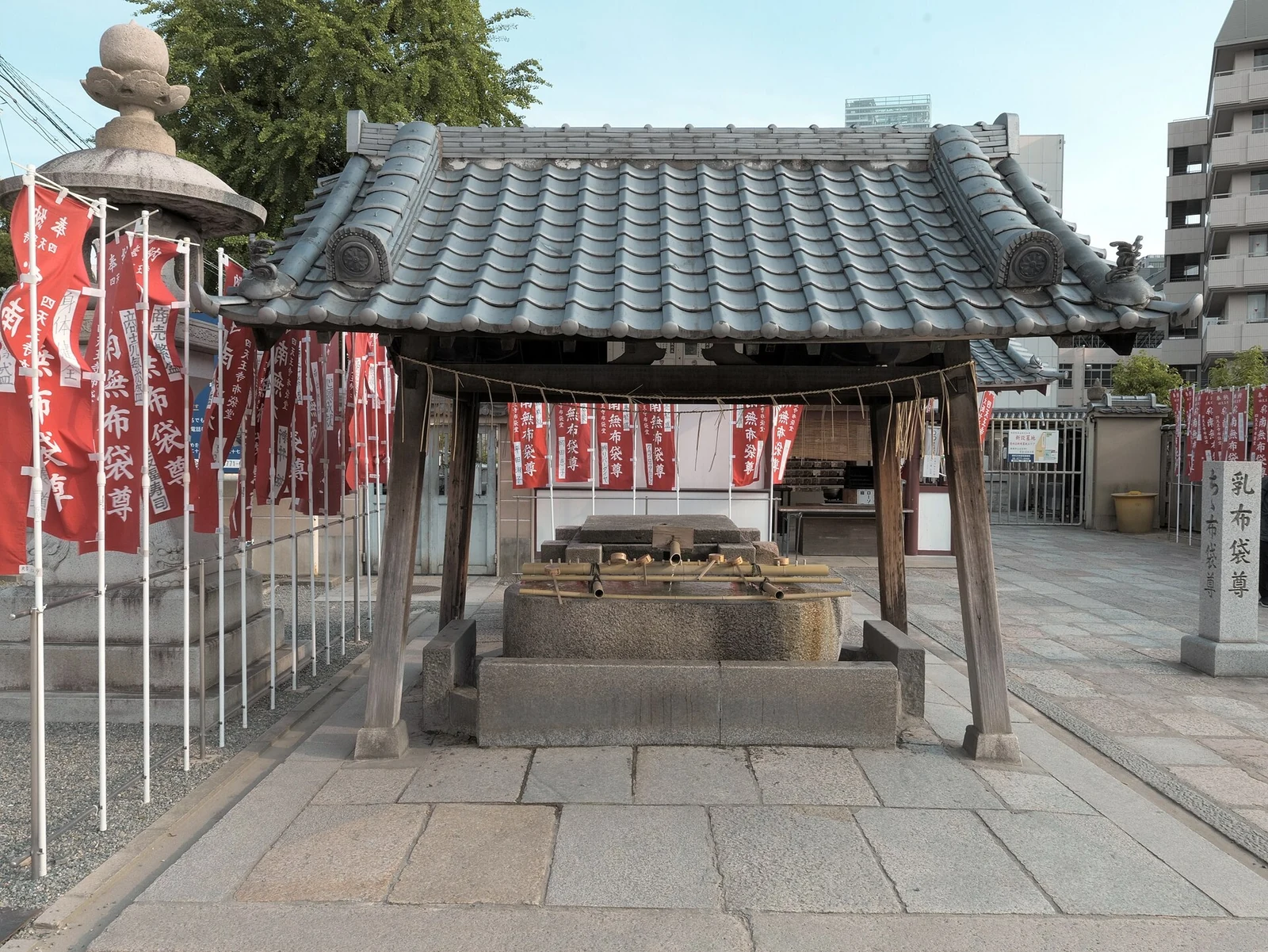
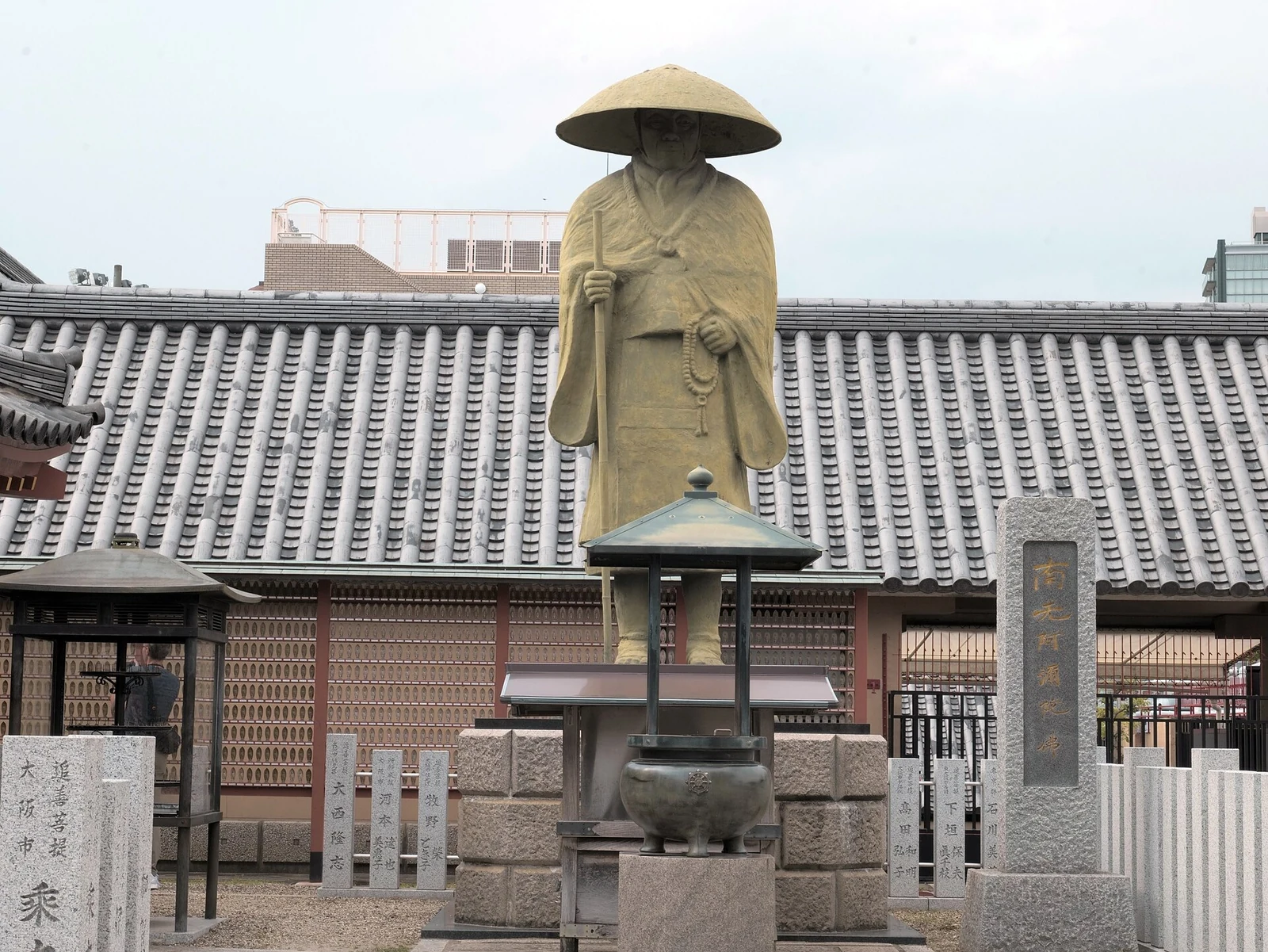
Shitennoji’s main hall and five-storey pagoda.Photo date: 2017-05-28 16:38:34 · Saigen Jiro · CC0Looking up at the five-storey pagoda.Photo date: 2025-10-03 12:35:44 · Pufacz · CC0The stone torii and approach into Shitennoji.Photo date: 2024-06-02 09:04:39 · Hyppolyte de Saint-Rambert · CC BY 4.0A small roofed structure within the temple grounds.Photo date: 2024-06-02 09:50:02 · Hyppolyte de Saint-Rambert · CC BY 4.0A statue and temple building within Shitennoji.Photo date: 2024-06-02 09:14:21 · Hyppolyte de Saint-Rambert · CC BY 4.0
Photo & map credits
File:Shitenno-ji, garan.jpg — Saigen Jiro. https://commons.wikimedia.org/wiki/File:Shitenno-ji,_garan.jpg | CC0 http://creativecommons.org/publicdomain/zero/1.0/deed.en. Resized and re-encoded; no crop or retouch.
File:Shitennoji-pagoda.jpg — Pufacz. https://commons.wikimedia.org/wiki/File:Shitennoji-pagoda.jpg | CC0 http://creativecommons.org/publicdomain/zero/1.0/deed.en. Resized and re-encoded; no crop or retouch.
File:Shitennoji (Osaka Tennoji-ku) Temple hdsr S5 i02.jpg — Hyppolyte de Saint-Rambert. https://commons.wikimedia.org/wiki/File:Shitennoji_(Osaka_Tennoji-ku)_Temple_hdsr_S5_i02.jpg | CC BY 4.0 https://creativecommons.org/licenses/by/4.0. Resized and re-encoded; no crop or retouch.
File:Shitennoji (Osaka Tennoji-ku) Temple hdsr S5 ch04.jpg — Hyppolyte de Saint-Rambert. https://commons.wikimedia.org/wiki/File:Shitennoji_(Osaka_Tennoji-ku)_Temple_hdsr_S5_ch04.jpg | CC BY 4.0 https://creativecommons.org/licenses/by/4.0. Resized and re-encoded; no crop or retouch.
File:Shitennoji (Osaka Tennoji-ku) Temple hdsr S5 s03.jpg — Hyppolyte de Saint-Rambert. https://commons.wikimedia.org/wiki/File:Shitennoji_(Osaka_Tennoji-ku)_Temple_hdsr_S5_s03.jpg | CC BY 4.0 https://creativecommons.org/licenses/by/4.0. Resized and re-encoded; no crop or retouch.
The bay area: make time to play
Would you like to step into the world of a favourite story, or linger beside a huge aquarium tank?
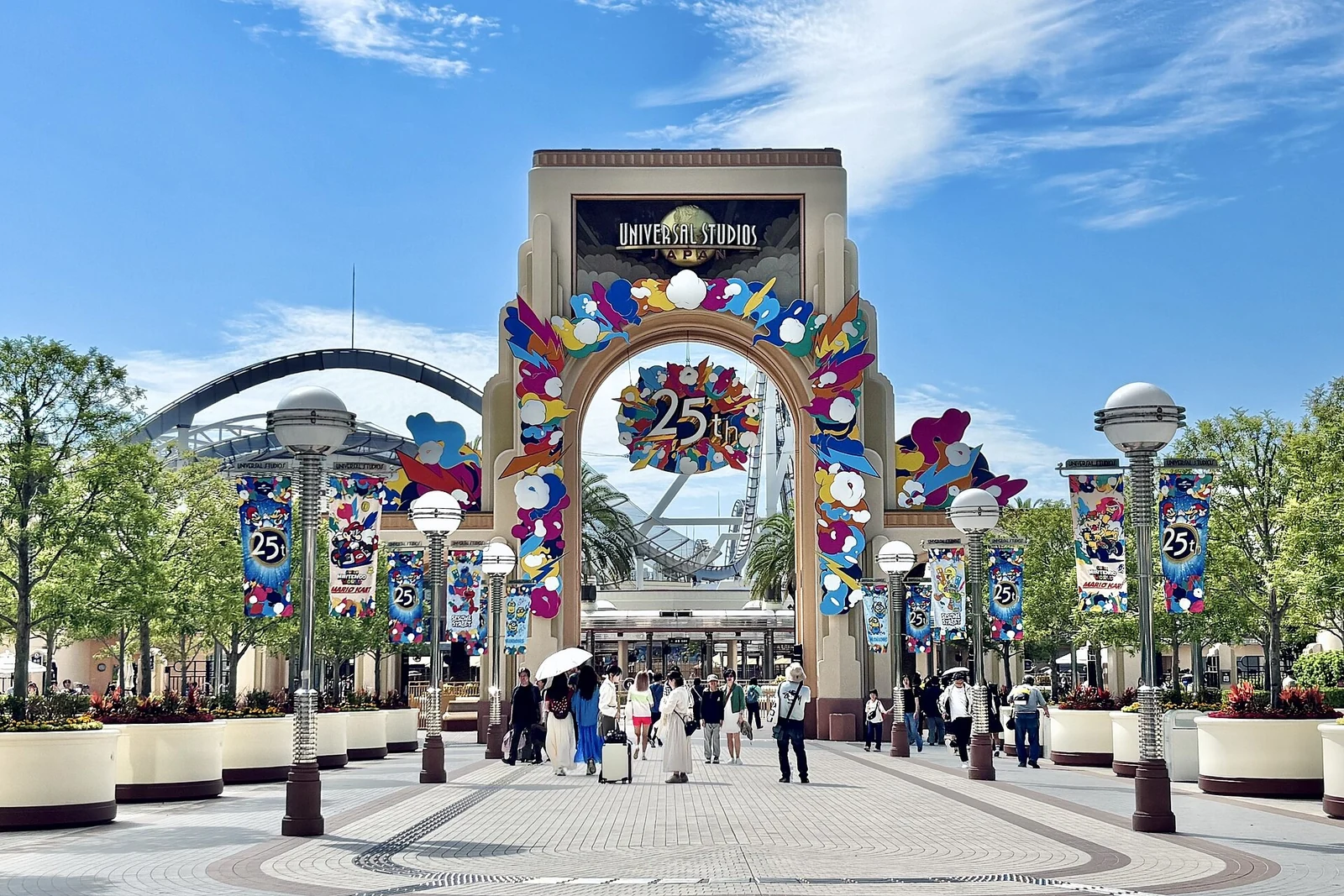
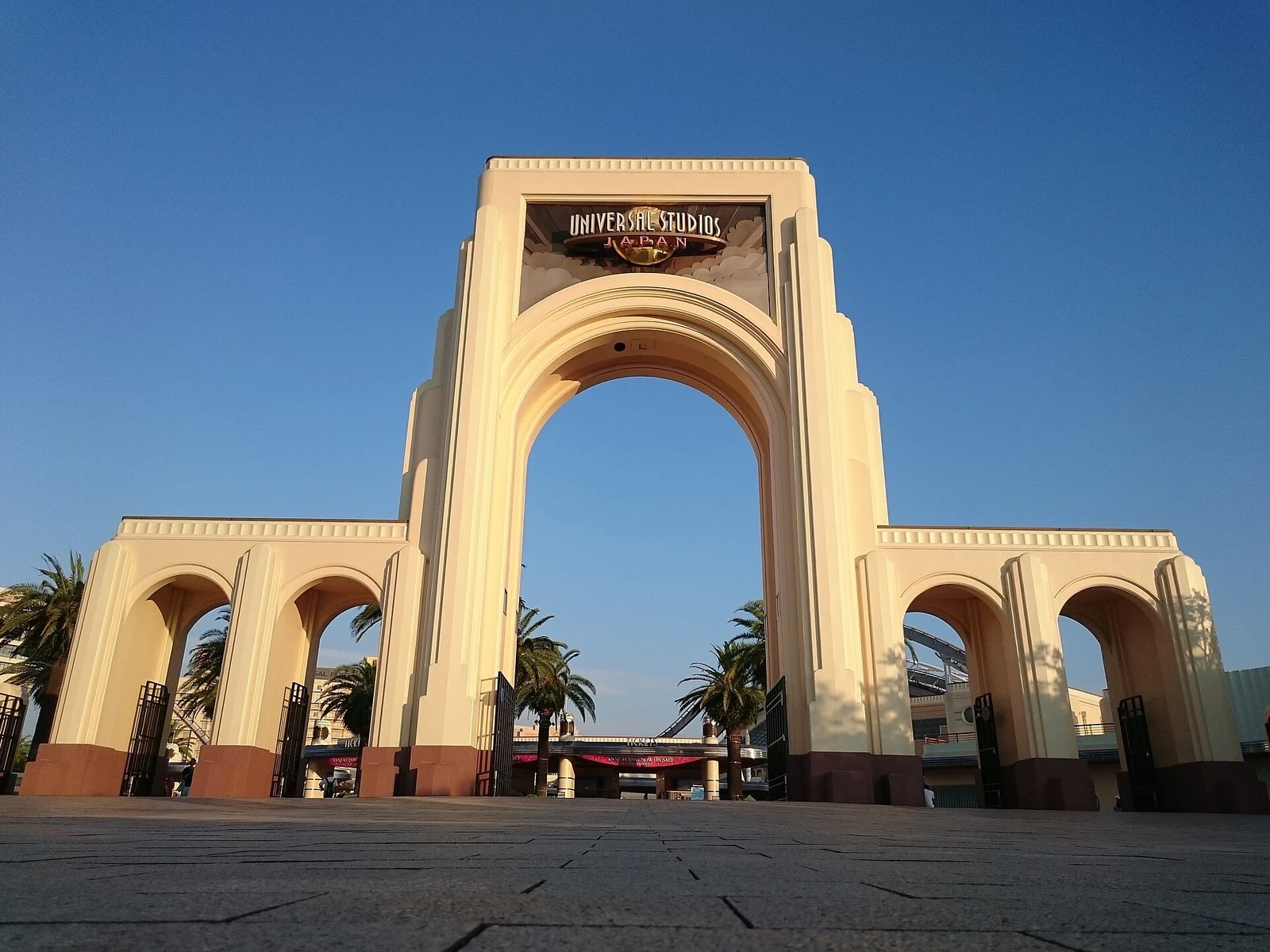
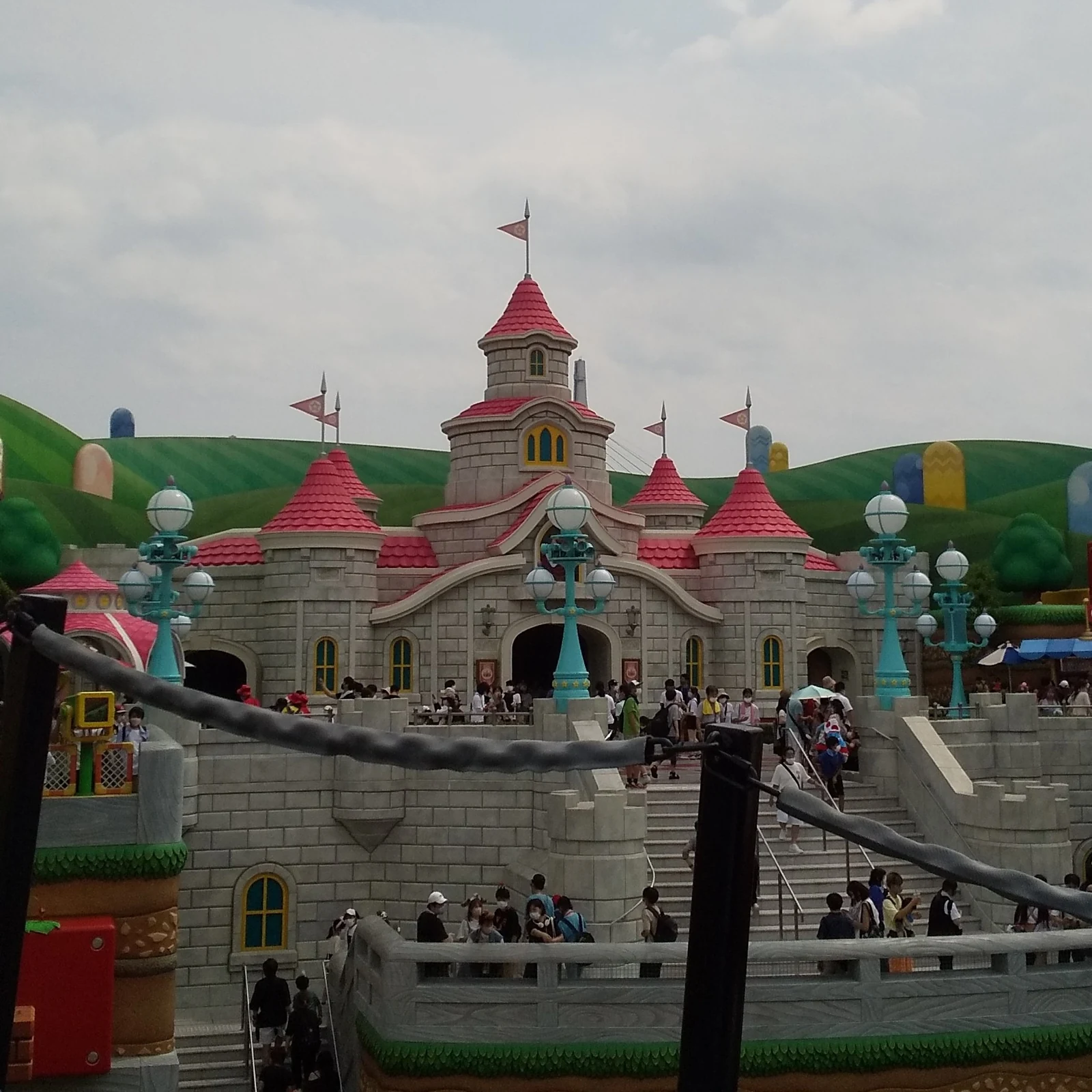
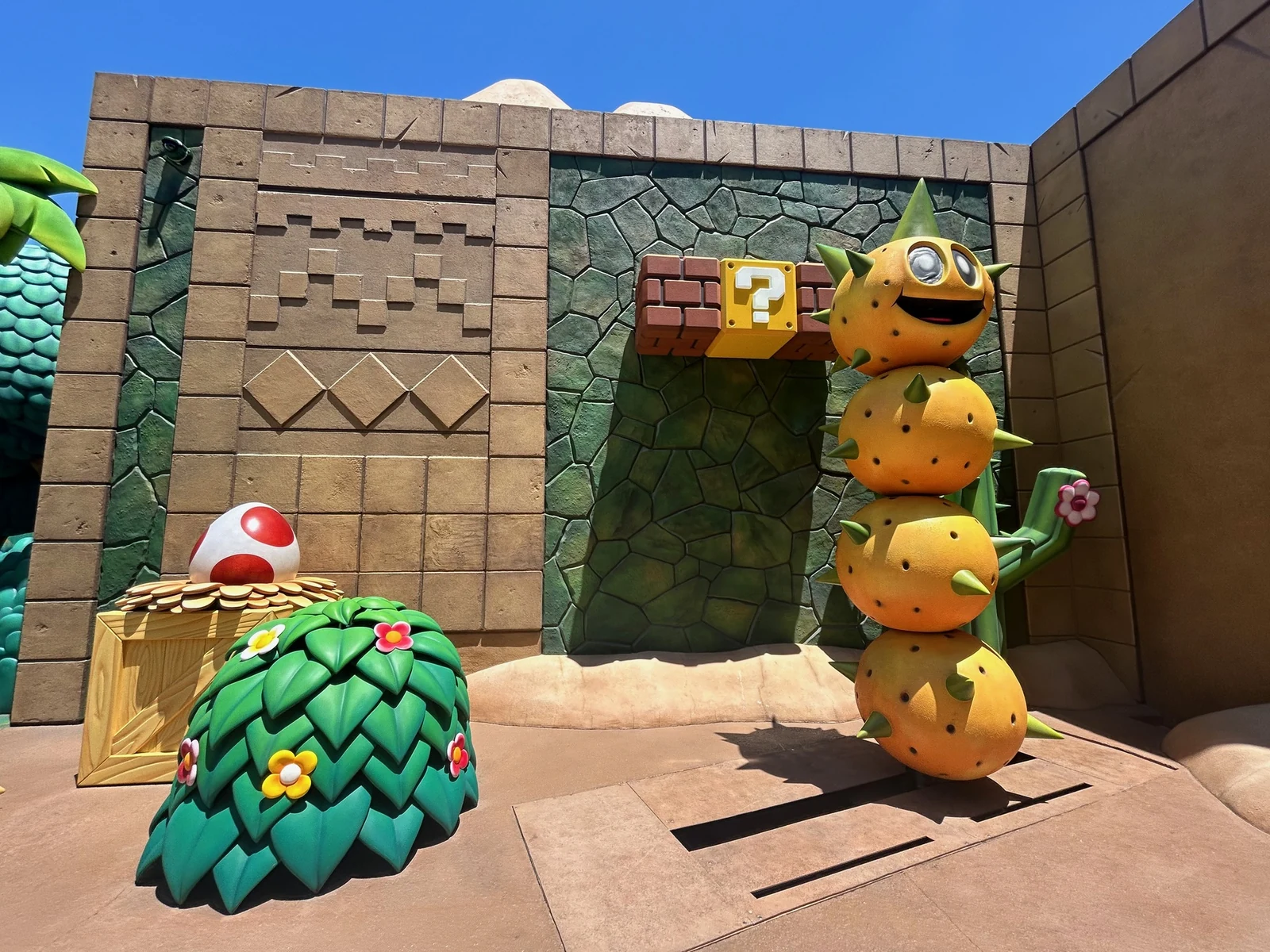
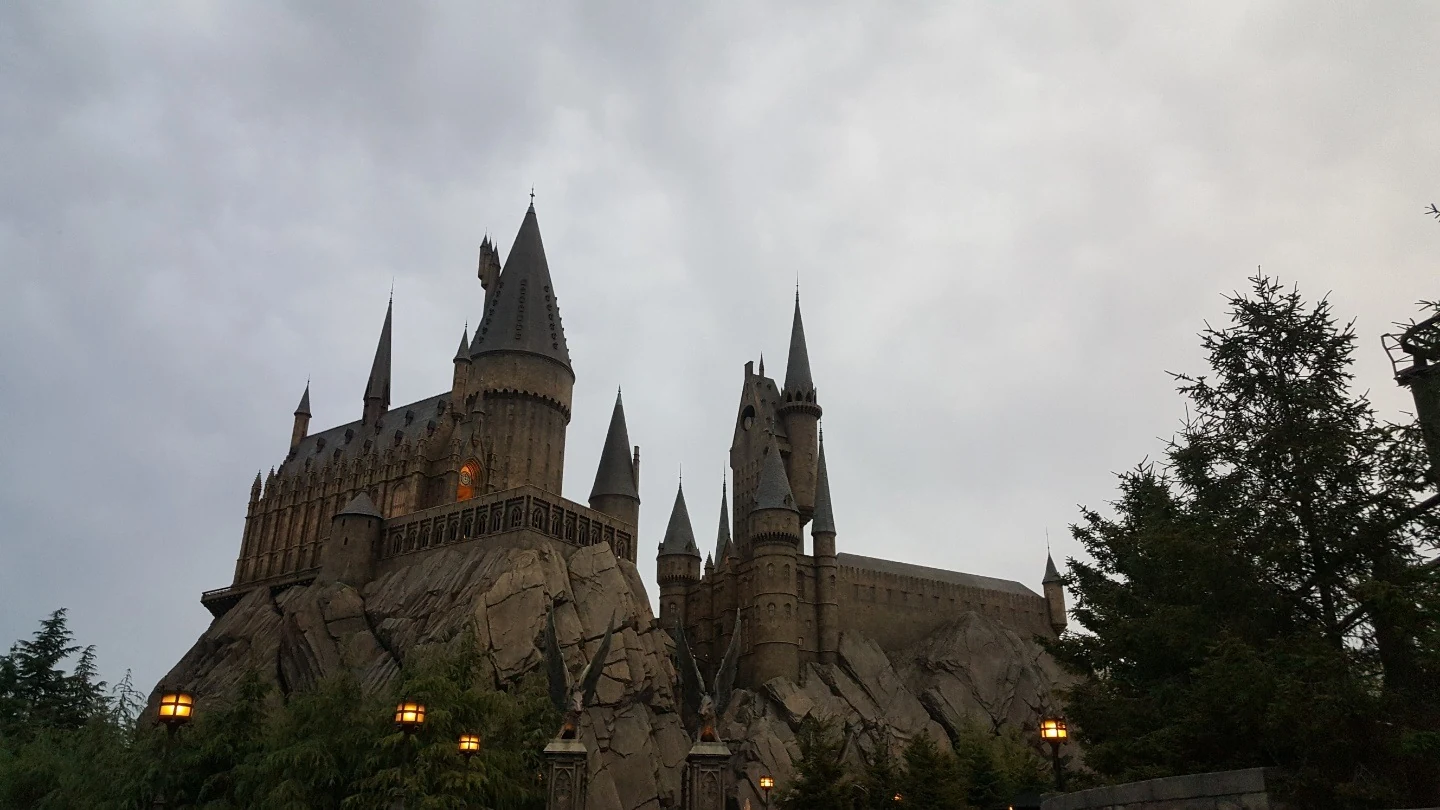
Universal Studios Japan brings together areas, attractions and shows inspired by films and games. You can plan around the streets you would like to explore and the characters you hope to meet, as well as the rides.
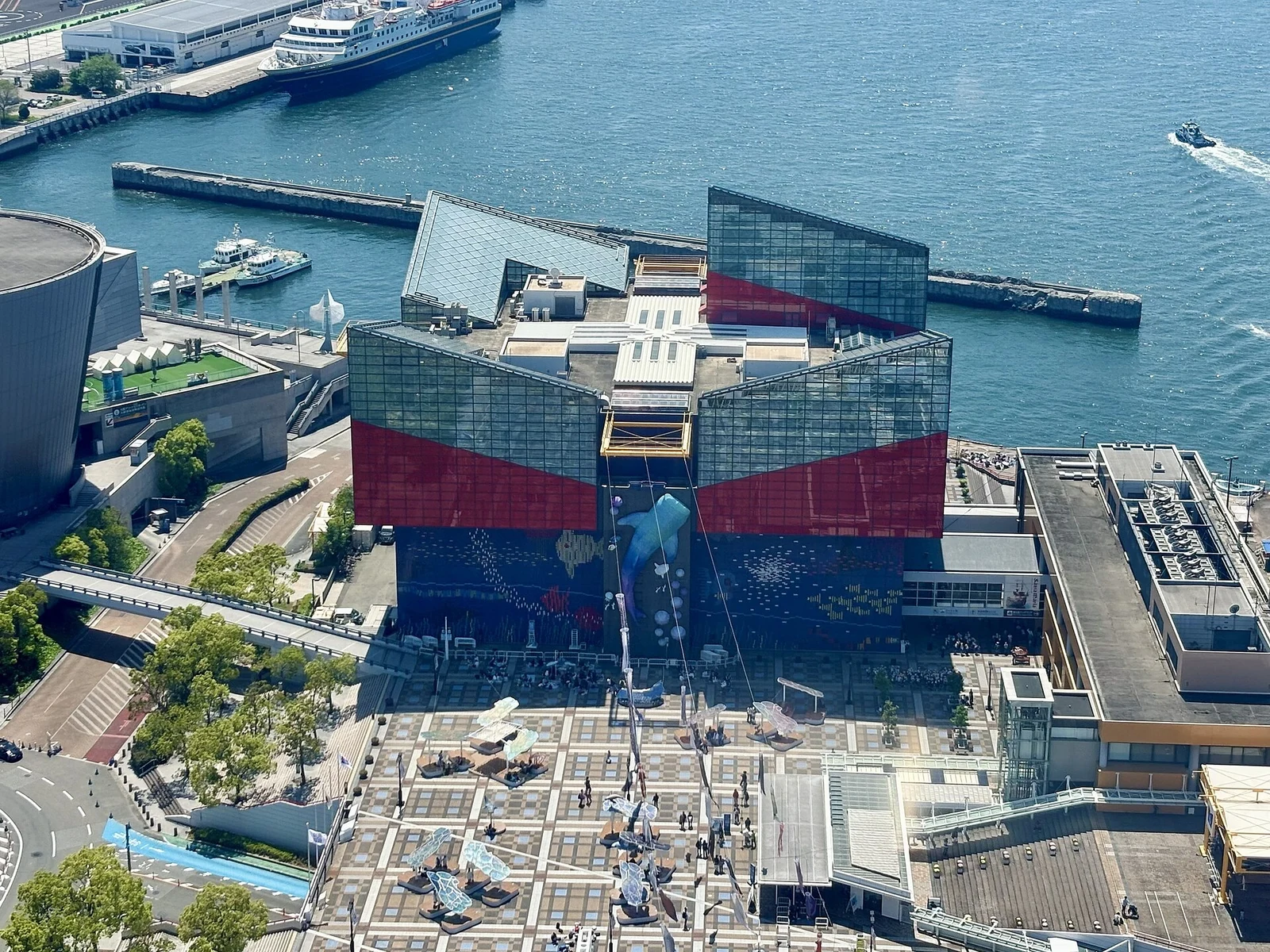
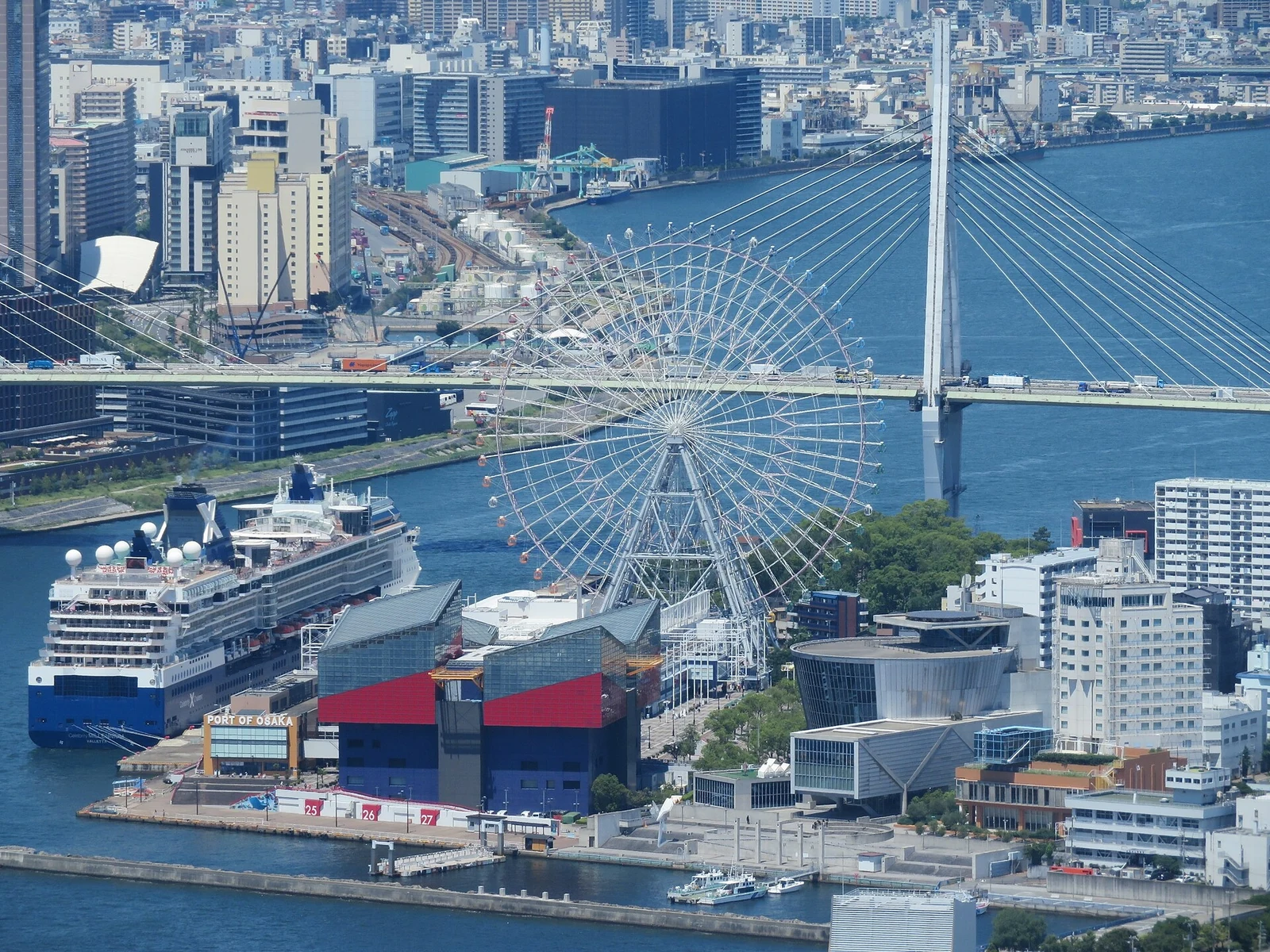
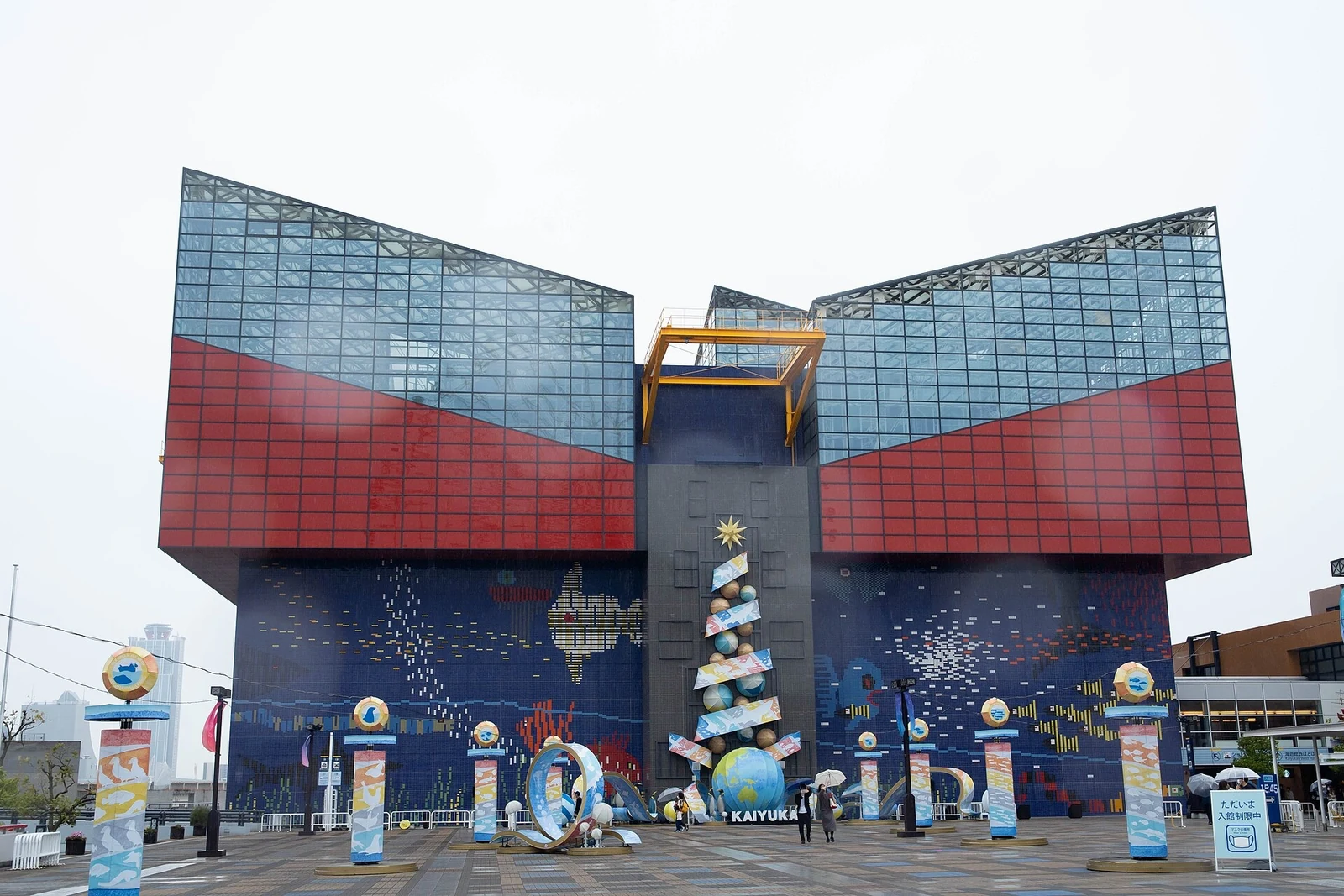
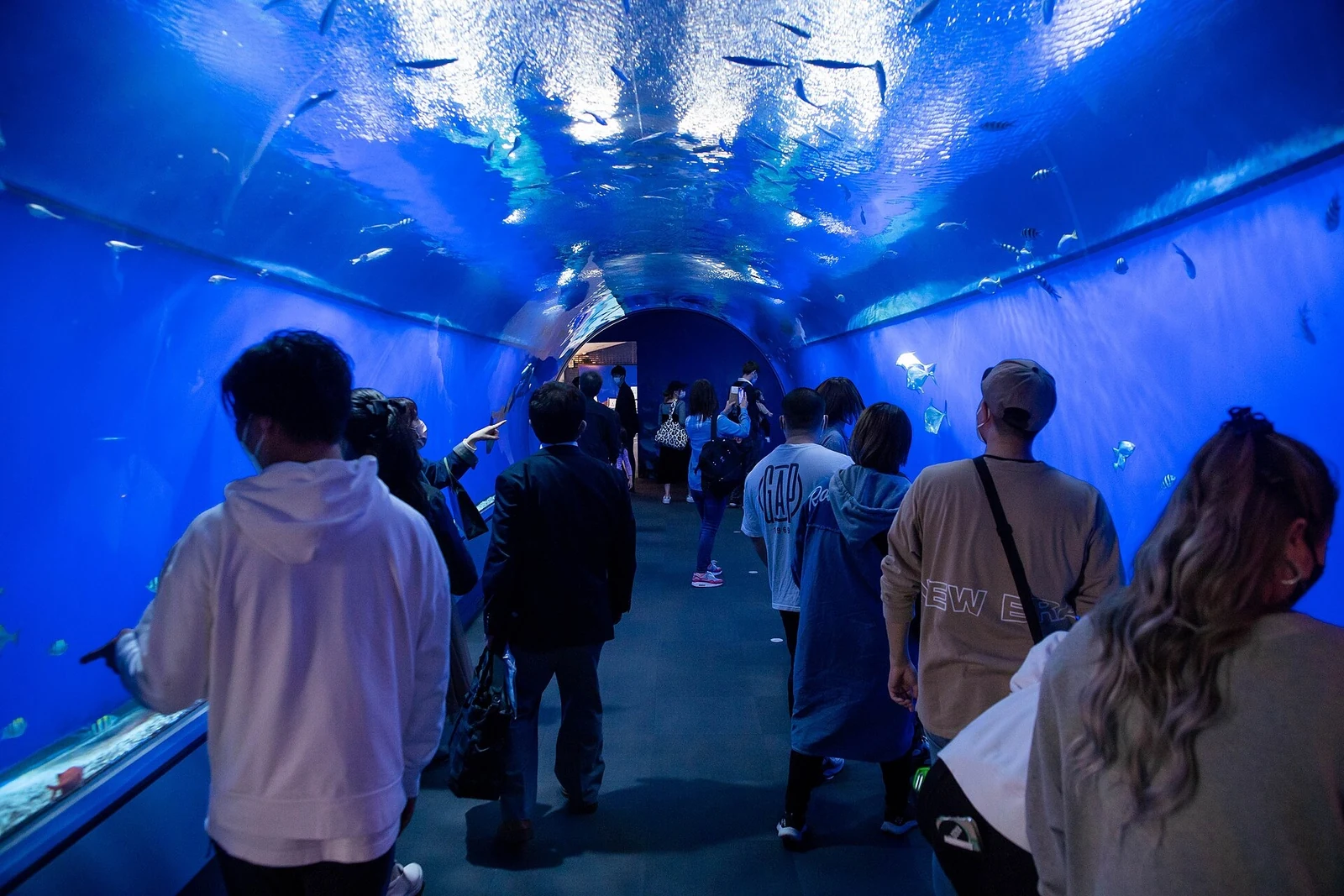
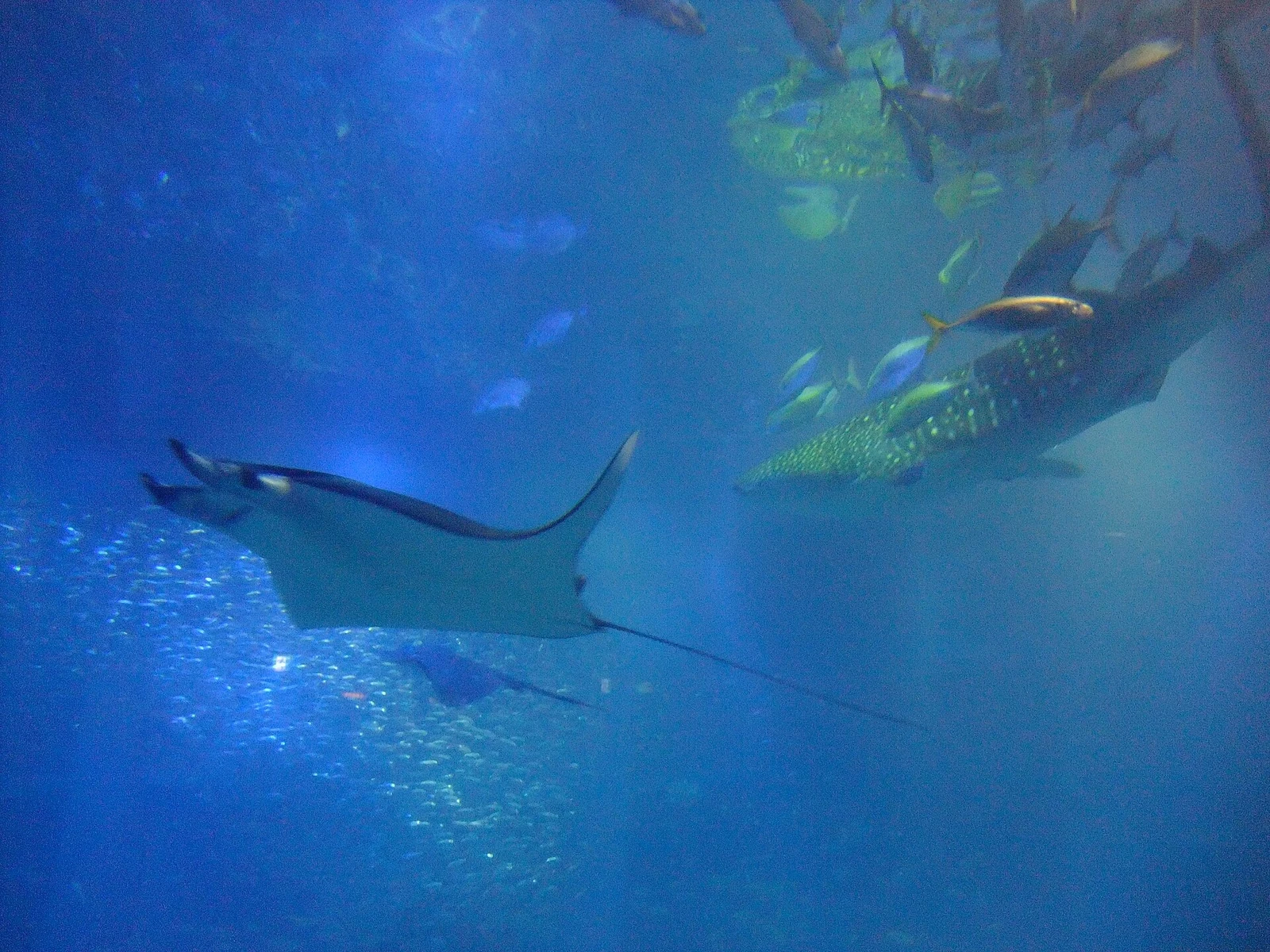
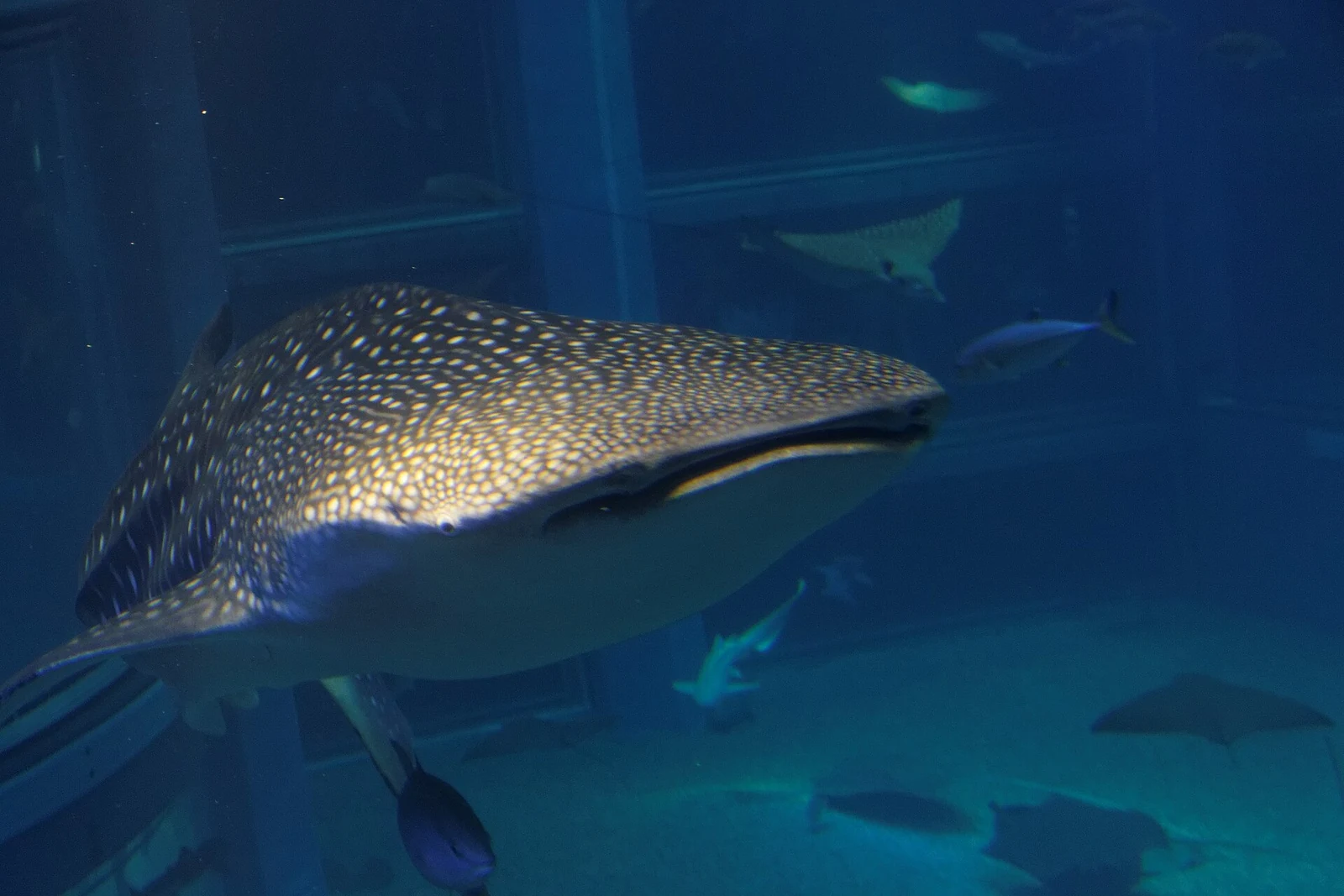
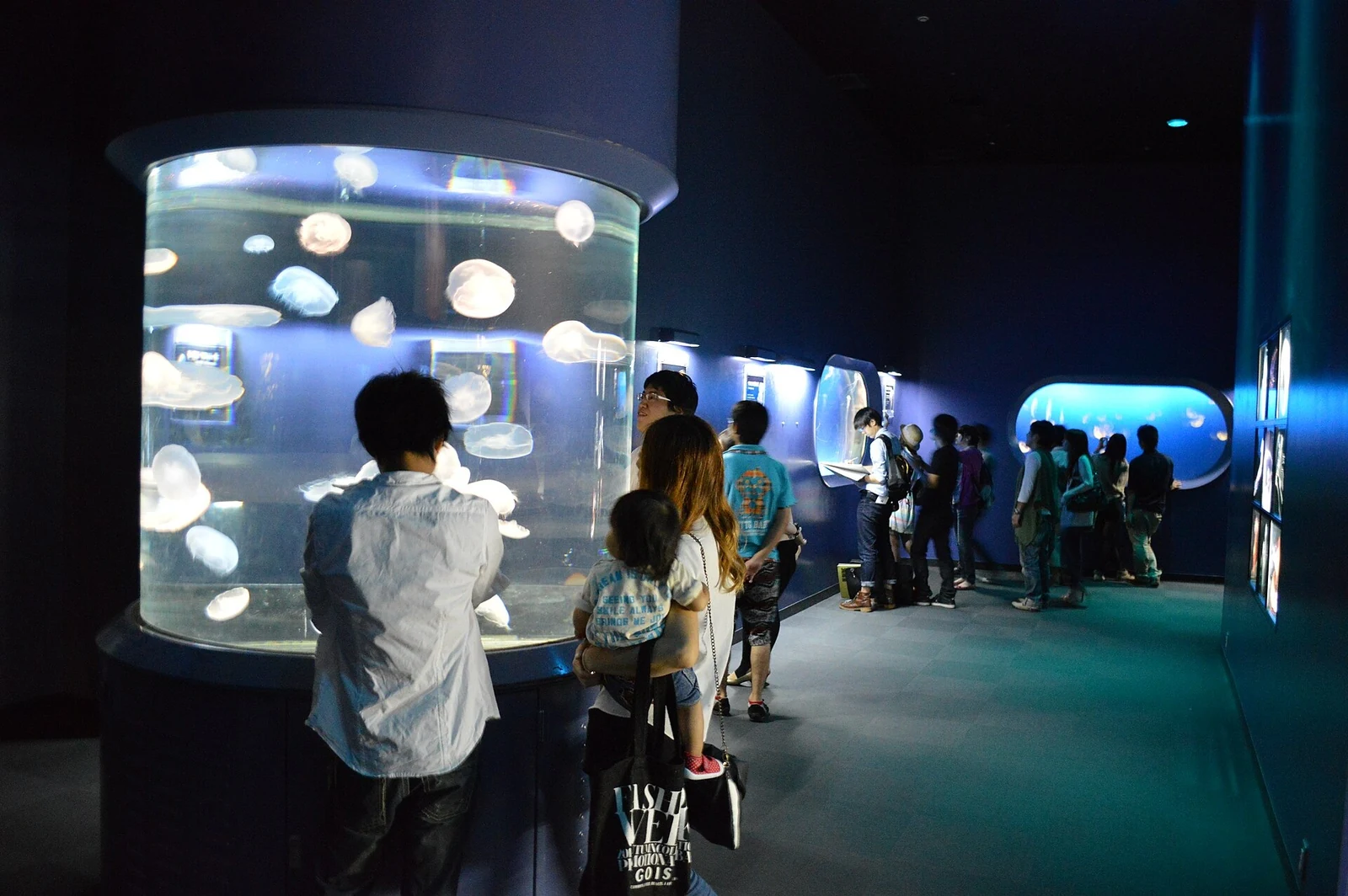
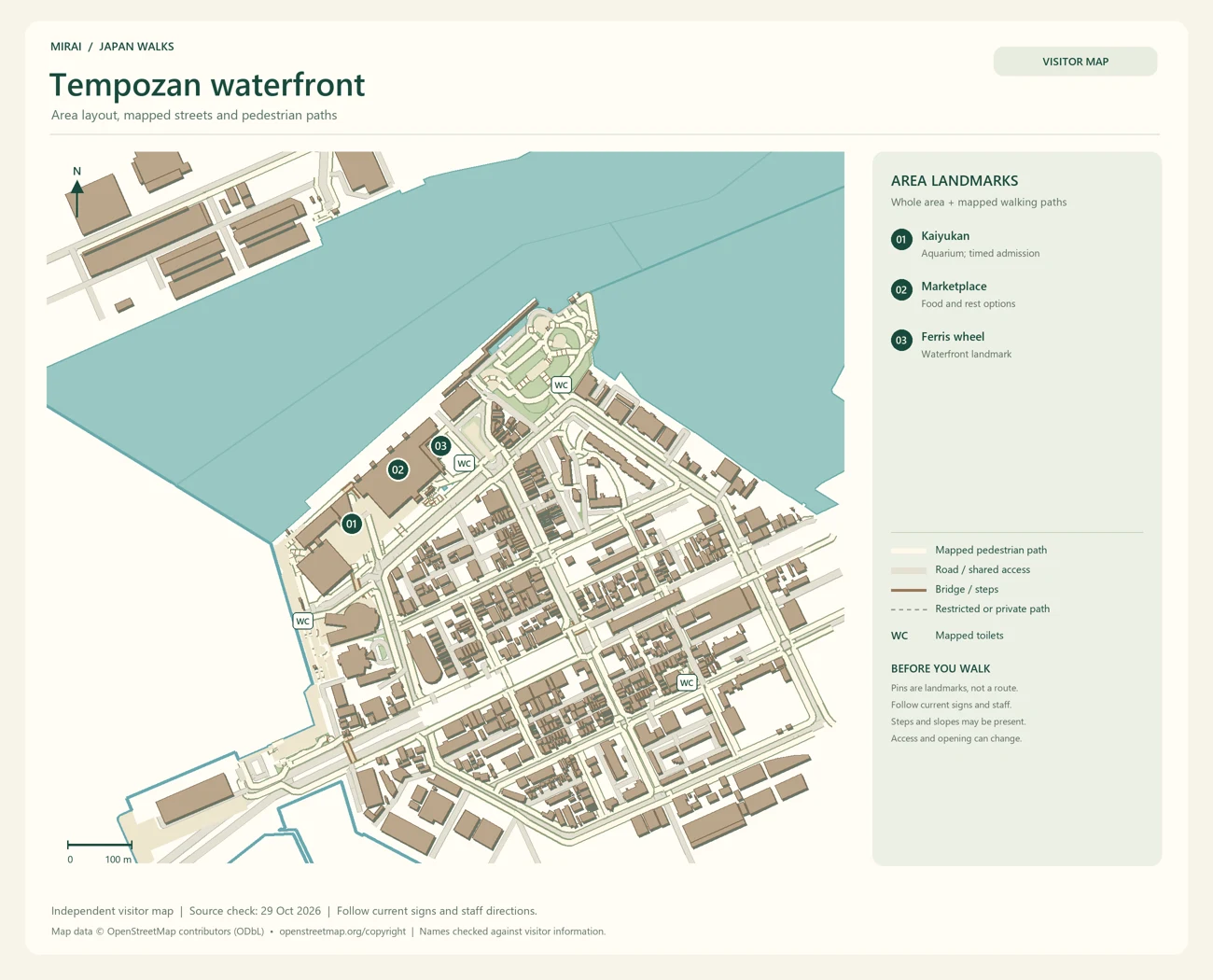
For sea creatures, there is Osaka Aquarium Kaiyukan in Tempozan.
The whale shark in the large Pacific Ocean tank is an intriguing presence. As the route takes you past the tank at different levels, see which creatures become your favourites. It is fun when everyone in the group finds something different to watch.
Before or after your visit, Tempozan Marketplace is an option for a meal or a rest.
Think of USJ and Kaiyukan as the focus of separate days. Even at Kaiyukan, buying a same-day ticket does not necessarily mean immediate entry. Let’s make room for both the things you want to see and a proper sit-down break.
Universal Studios Japan
Universal Studios Japan’s entrance with 25th-anniversary decorations in October 2026.Photo date: 1 October 2026 12:34:29 · Sakai Yayoi · CC0The park entrance arch in summer 2019.Photo date: 2019-08-17 17:57:52 · Rebirth10 · CC0Peach’s Castle in Super Nintendo World in August 2022.Photo date: 2022-08-14 · 高砂の浦 · CC0Themed scenery along Yoshi’s Adventure in August 2024.Photo date: 2024-08-11 · Jonathan Deamer · CC BY-SA 4.0Hogwarts Castle in the park in October 2022.Photo date: 2022-10-28 · Leeyj0401 · CC BY-SA 4.0
Photo & map credits
File:USJ Entrance 2026.jpg — Sakai Yayoi. https://commons.wikimedia.org/wiki/File:USJ_Entrance_2026.jpg | CC0 http://creativecommons.org/publicdomain/zero/1.0/deed.en. Resized and re-encoded; no crop or retouch.
File:Universal Studios Japan 2019,08.jpg — Rebirth10. https://commons.wikimedia.org/wiki/File:Universal_Studios_Japan_2019,08.jpg | CC0 http://creativecommons.org/publicdomain/zero/1.0/deed.en. Resized and re-encoded; no crop or retouch.
File:Peach'sCastle at Universal Studios Japan 20220814.jpg — 高砂の浦. https://commons.wikimedia.org/wiki/File:Peach%27sCastle_at_Universal_Studios_Japan_20220814.jpg | CC0 http://creativecommons.org/publicdomain/zero/1.0/deed.en. Resized and re-encoded; no crop or retouch.
File:Pokey and Yoshi egg on Yoshi's Adventure (Universal Studios Japan).png — Jonathan Deamer. https://commons.wikimedia.org/wiki/File:Pokey_and_Yoshi_egg_on_Yoshi%27s_Adventure_(Universal_Studios_Japan).png | CC BY-SA 4.0 https://creativecommons.org/licenses/by-sa/4.0. Resized and re-encoded; no crop or retouch.
File:Hogwarts in Universal Studios Japan.jpg — Leeyj0401. https://commons.wikimedia.org/wiki/File:Hogwarts_in_Universal_Studios_Japan.jpg | CC BY-SA 4.0 https://creativecommons.org/licenses/by-sa/4.0. Resized and re-encoded; no crop or retouch.
File:Kaiyūkan.jpg — Sakai Yayoi. https://commons.wikimedia.org/wiki/File:Kaiy%C5%ABkan.jpg | CC0 http://creativecommons.org/publicdomain/zero/1.0/deed.en. Resized and re-encoded; no crop or retouch.
File:Osaka Aquarium KAIYUKAN and Ferris wheel.jpg — KishujiRapid. https://commons.wikimedia.org/wiki/File:Osaka_Aquarium_KAIYUKAN_and_Ferris_wheel.jpg | CC BY 4.0 https://creativecommons.org/licenses/by/4.0. Resized and re-encoded; no crop or retouch.
File:Osaka Aquarium Kaiyukan 2022-04-24.jpg — Dick Thomas Johnson. https://commons.wikimedia.org/wiki/File:Osaka_Aquarium_Kaiyukan_2022-04-24.jpg | CC BY 2.0 https://creativecommons.org/licenses/by/2.0. Resized and re-encoded; no crop or retouch.
File:Osaka Aquarium Kaiyukan 2022-04-24 - 52479183129.jpg — Dick Thomas Johnson. https://commons.wikimedia.org/wiki/File:Osaka_Aquarium_Kaiyukan_2022-04-24_-_52479183129.jpg | CC BY 2.0 https://creativecommons.org/licenses/by/2.0. Resized and re-encoded; no crop or retouch.
File:Kaiyukan Manta and Whale shark.JPG — SR EXR. https://commons.wikimedia.org/wiki/File:Kaiyukan_Manta_and_Whale_shark.JPG | CC0 http://creativecommons.org/publicdomain/zero/1.0/deed.en. Resized and re-encoded; no crop or retouch.
File:Osaka Aquarium Kaiyukan 3-24 (25886298453).jpg — KimonBerlin. https://commons.wikimedia.org/wiki/File:Osaka_Aquarium_Kaiyukan_3-24_(25886298453).jpg | CC BY-SA 2.0 https://creativecommons.org/licenses/by-sa/2.0. Resized and re-encoded; no crop or retouch.
File:Osaka Aquarium Kaiyukan 2013-09A.JPG — At by At. https://commons.wikimedia.org/wiki/File:Osaka_Aquarium_Kaiyukan_2013-09A.JPG | CC BY-SA 3.0 https://creativecommons.org/licenses/by-sa/3.0. Resized and re-encoded; no crop or retouch.
Nipponbashi and Osaka’s stages: follow what you love
Find your favourite shops in Nipponbashi
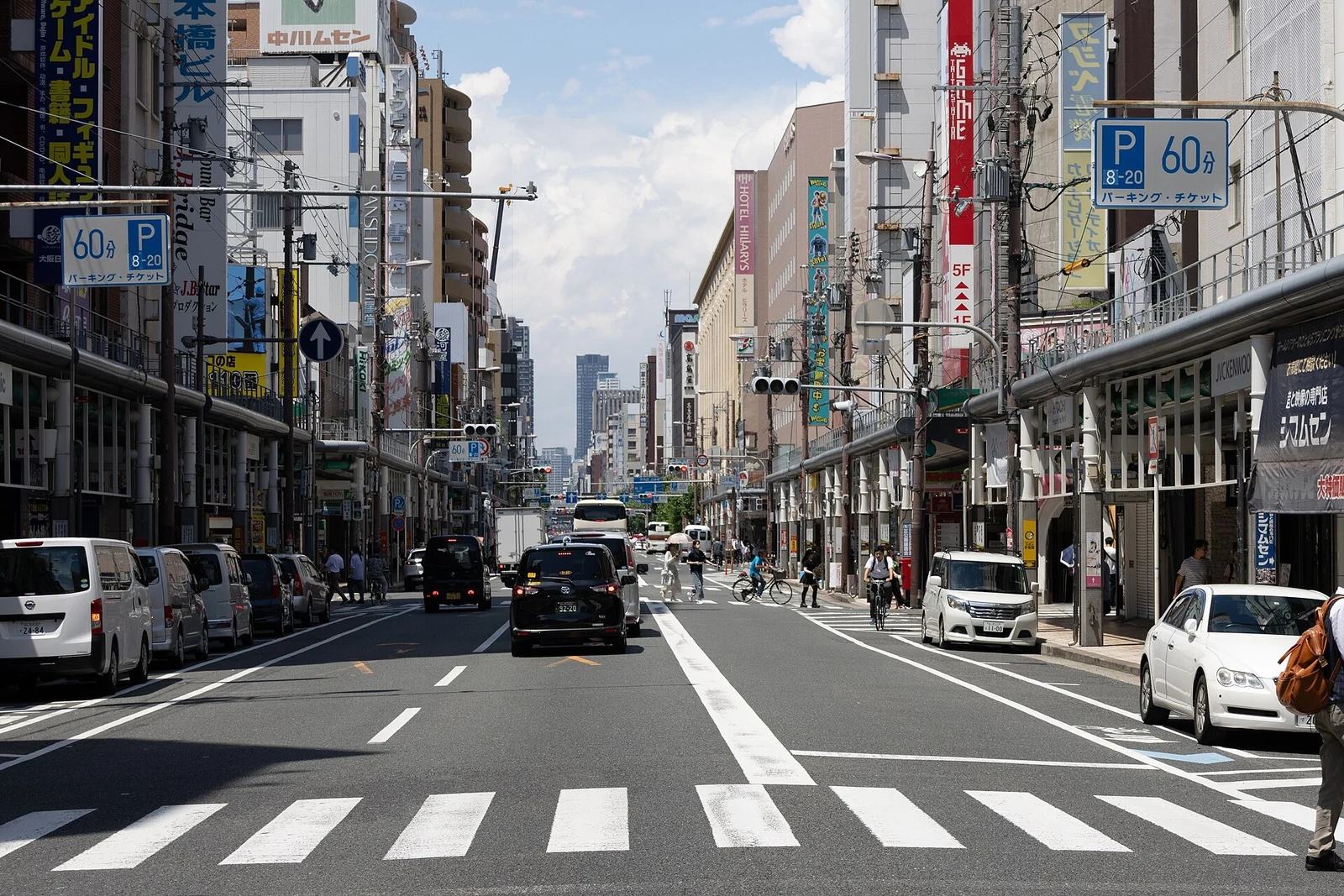
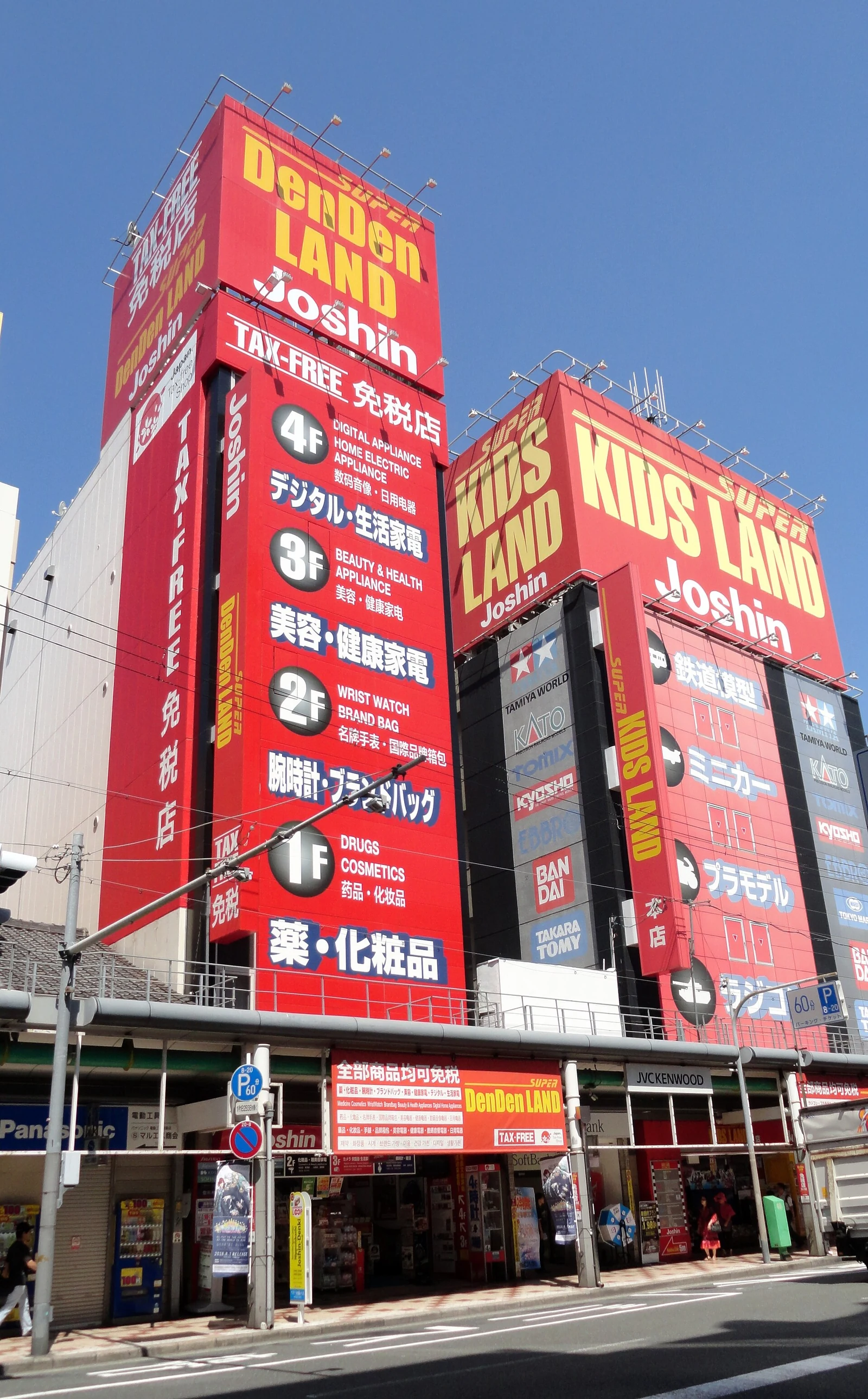
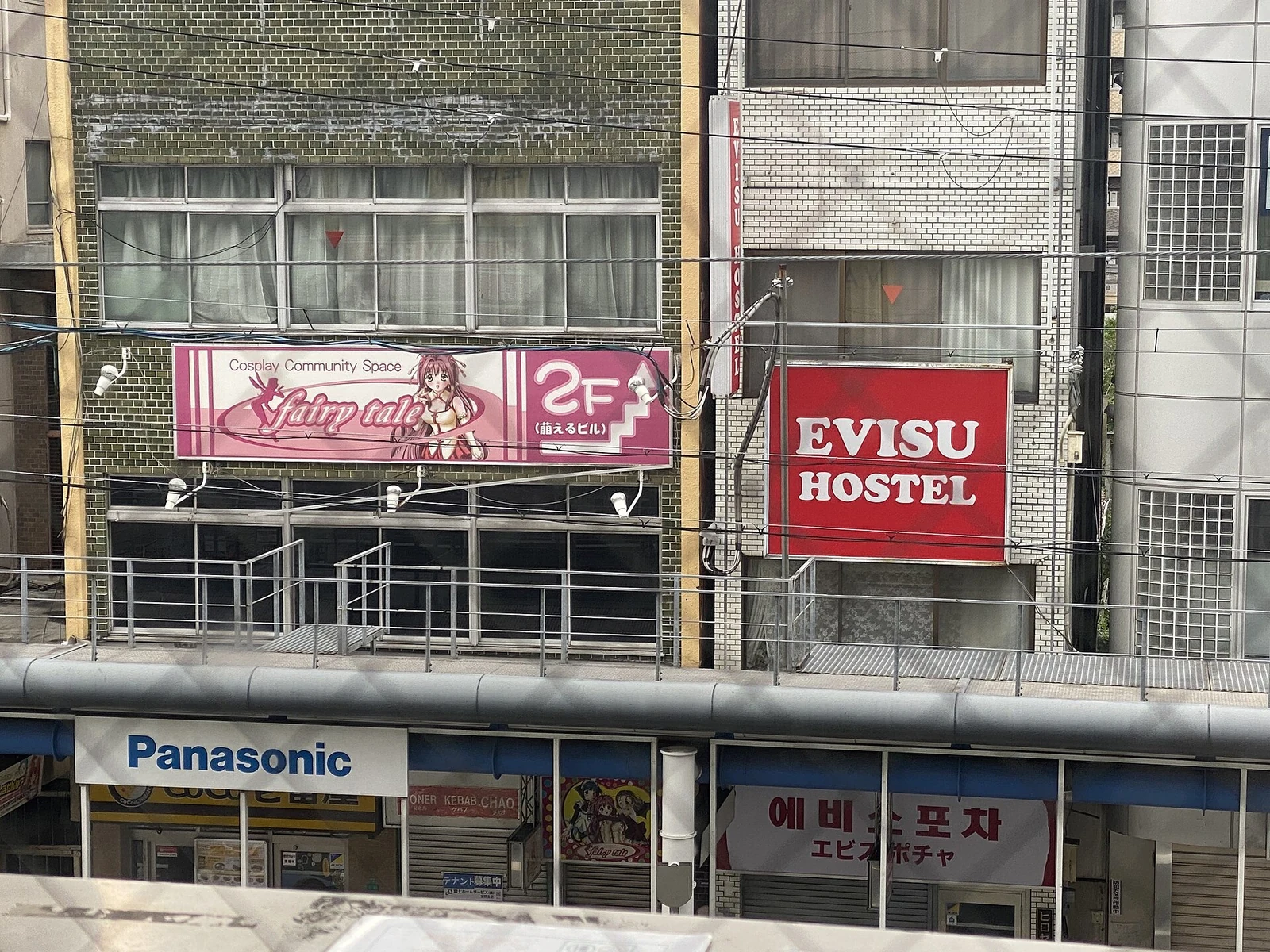
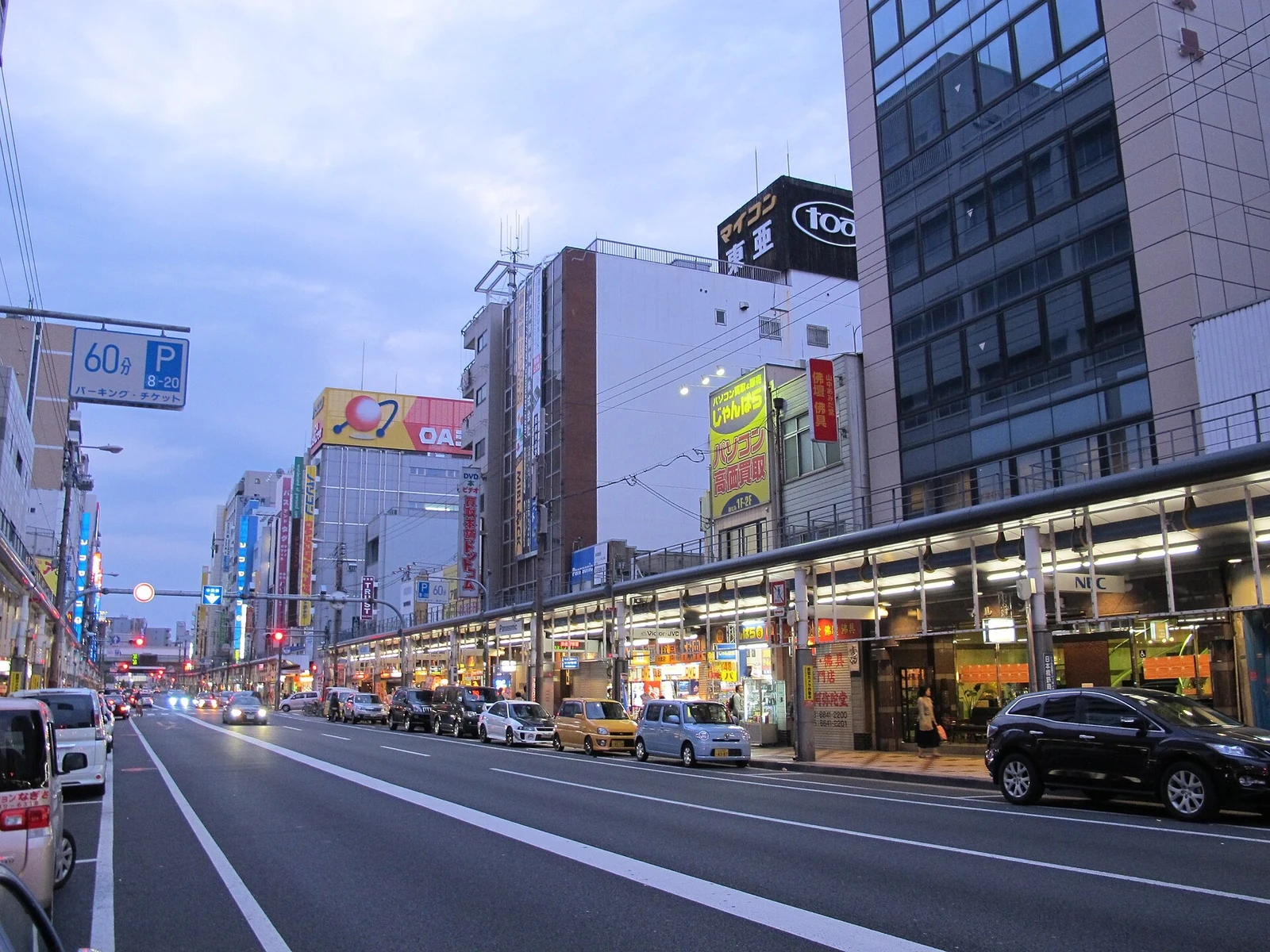
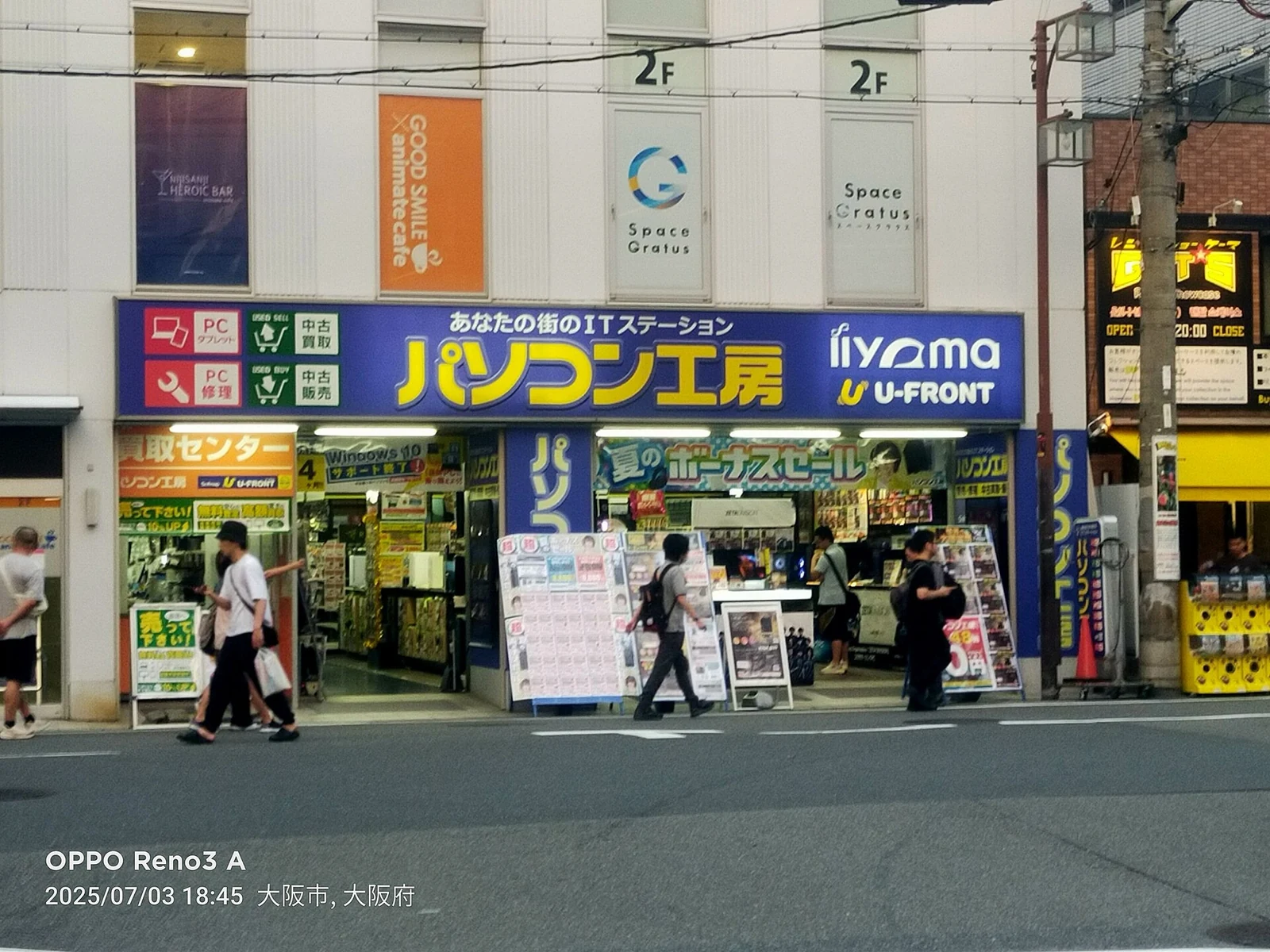
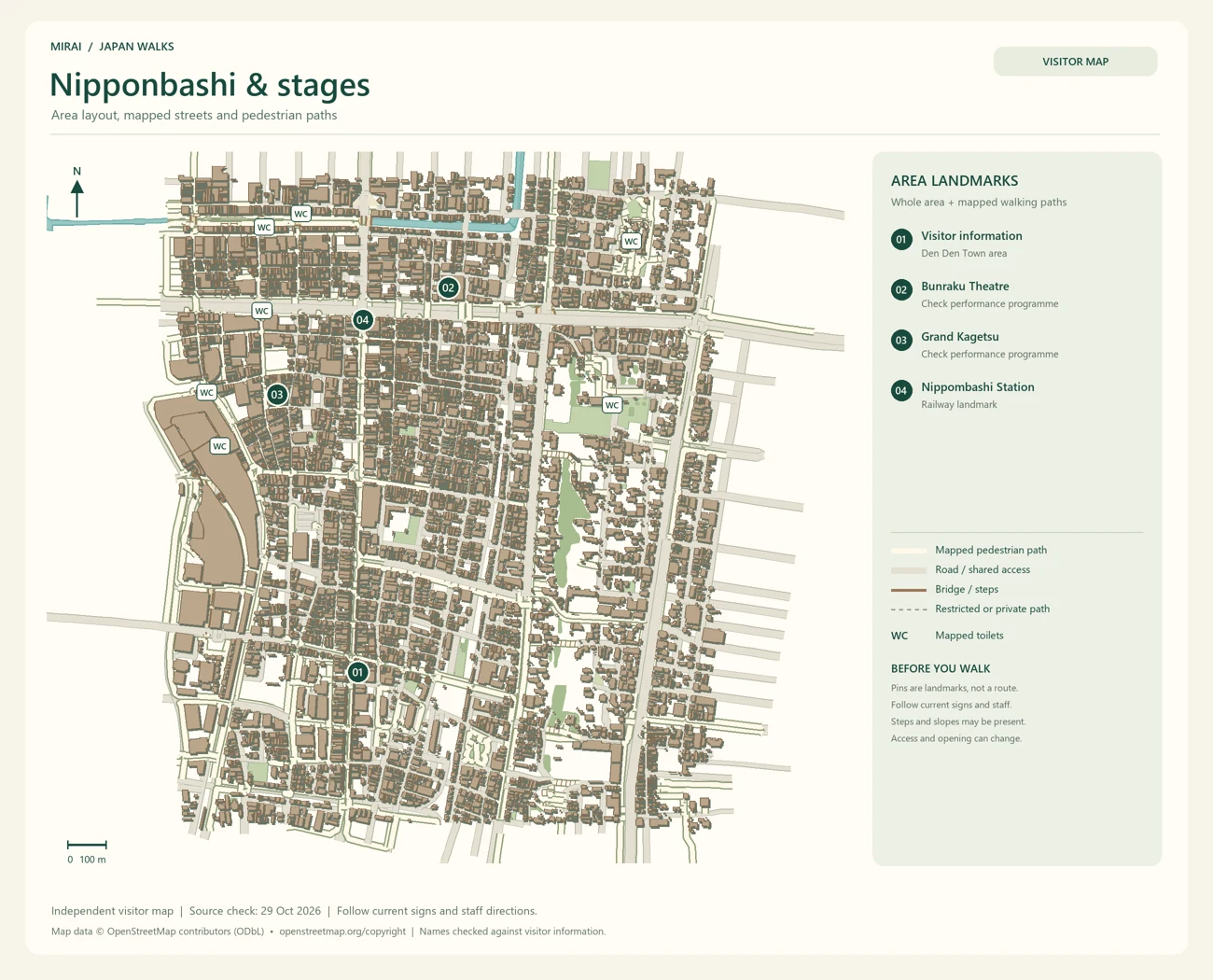
Anime, games, models and electronic components: if you are following a particular interest, Nipponbashi’s Den Den Town is worth a look.
Osaka’s 日本橋 is pronounced “Nipponbashi”. A district known for radios and household electronics grew to include games, anime and hobby shops, too.
“I want to find something from this series.” “I would love to look inside that specialist shop.” One small aim can make browsing even more enjoyable. If a shelf catches your interest, give yourself a little longer there.
Live laughter at Namba Grand Kagetsu
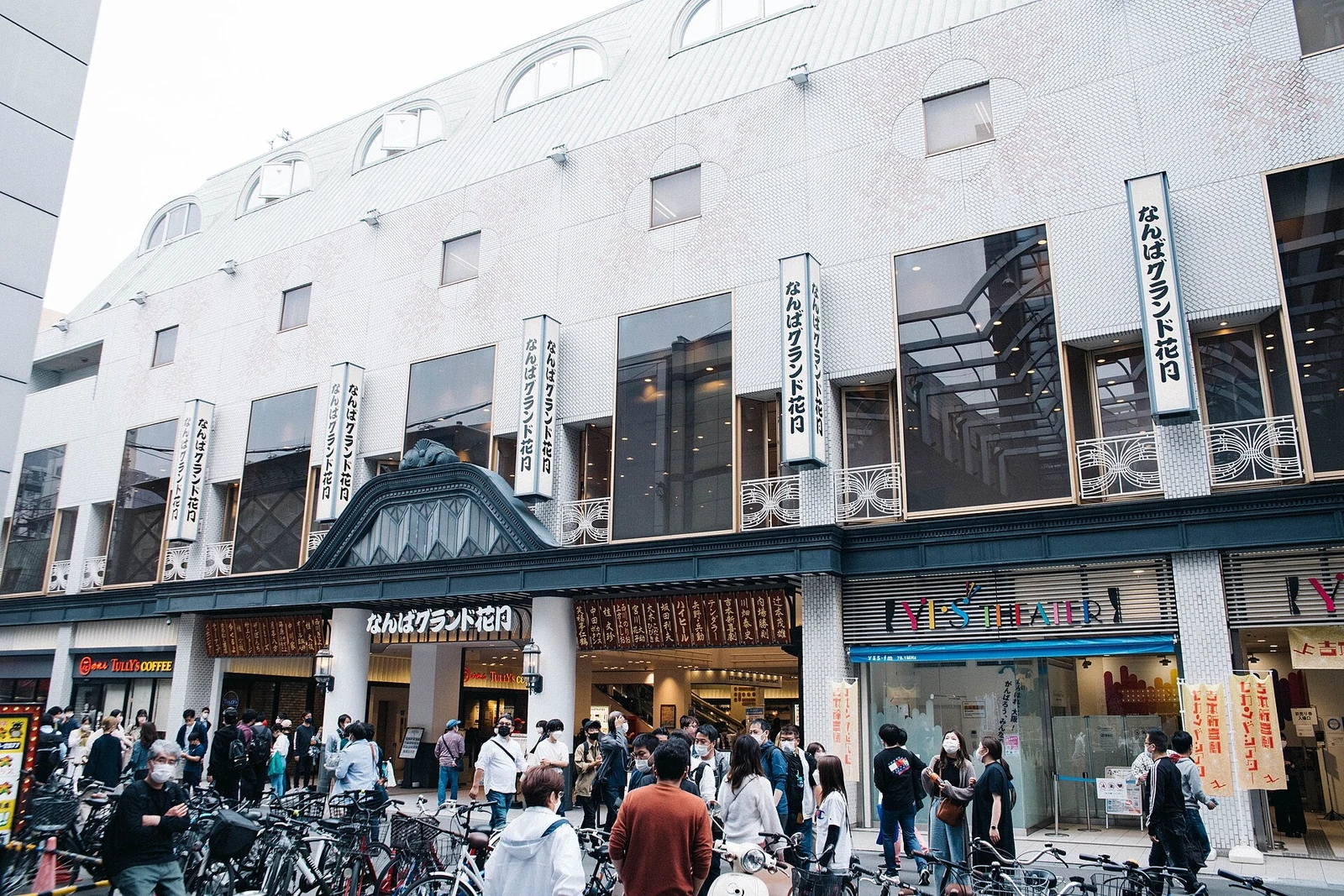
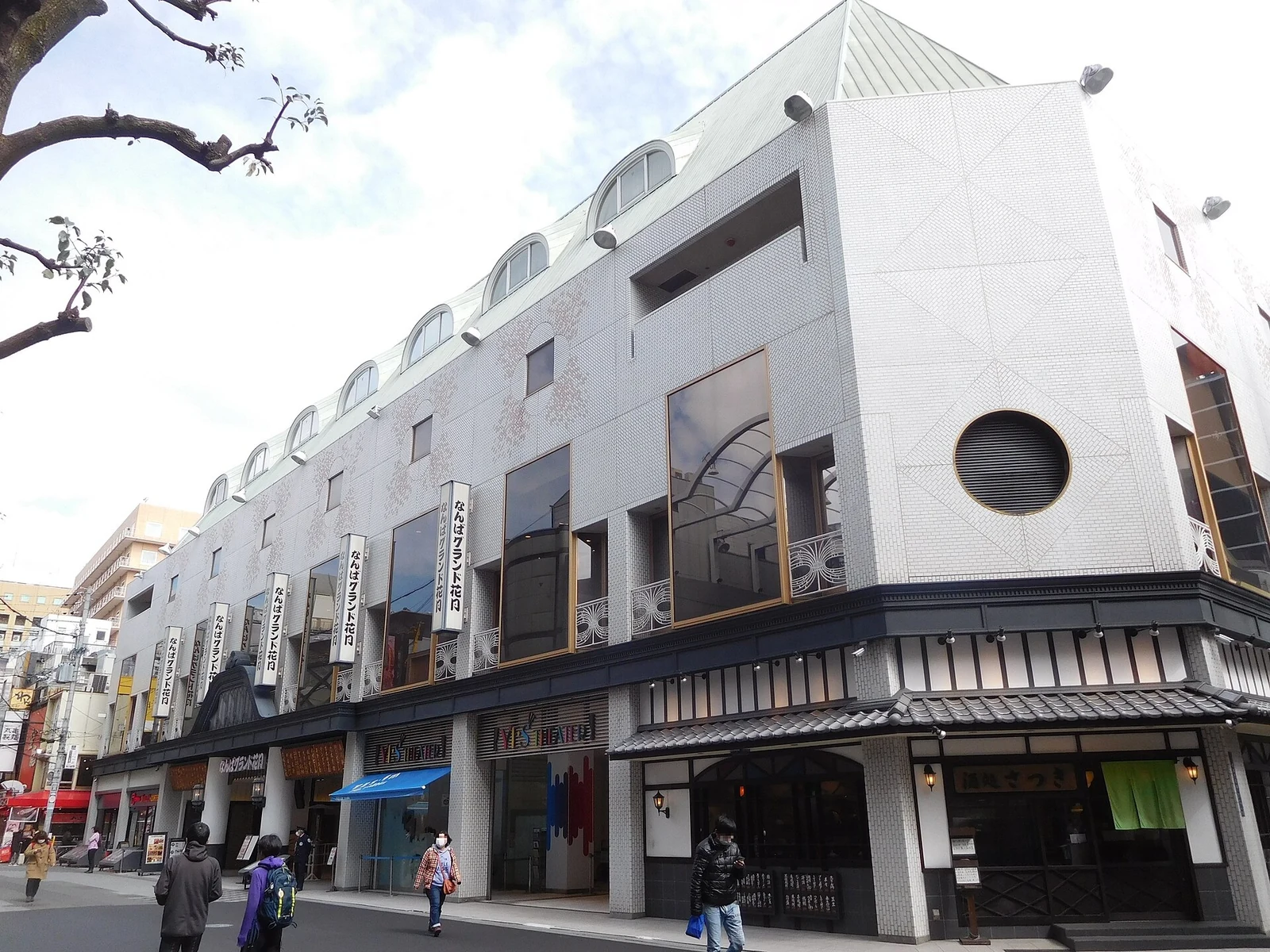
Namba Grand Kagetsu is one way to add a performance to your day.
Manzai comedy, rakugo storytelling and Yoshimoto Shinkigeki are among its offerings. The performers’ exchanges, timing and the audience’s reactions are part of the experience of being in a theatre.
Performers and programmes vary, so choose a show that interests you. You do not need to know everything about comedy to begin with “I would like to see it live.”
Stories told through puppets at the National Bunraku Theatre
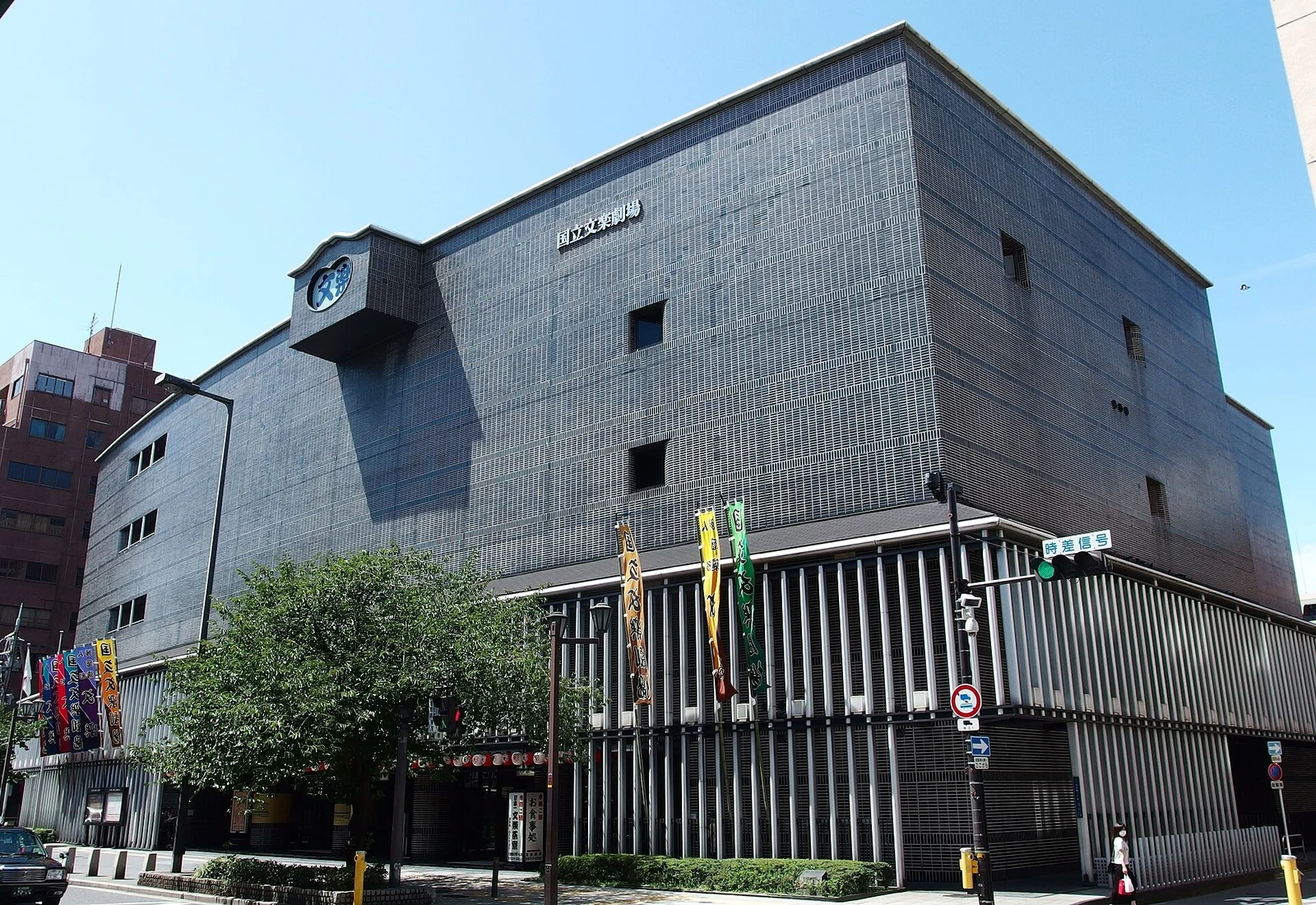
For another performance tradition, consider the National Bunraku Theatre.
Bunraku tells stories through more than puppets alone. The tayu narrator, shamisen music and puppeteers’ movements work together to express emotions and scenes.
You could follow a tiny gesture, or listen closely to a voice or a phrase of music. I wonder which part would draw you in.
Reading a synopsis beforehand can help you follow the story. Commentary and foreign-language support depend on the programme, so check the arrangements for the performance you choose.
A little Osaka language
“Ookini” means thank you; “meccha” means very.
It is nice to recognise a word when you hear it. Still, language varies with the person, generation and area.
Enjoy the conversation in front of you rather than looking for a fixed set of Osaka expressions. Your usual way of saying thank you is welcome, too.
File:Den-Den Town, Nipponbashi, Osaka - Jul 12, 2023.jpg — Clemens Vasters. https://commons.wikimedia.org/wiki/File:Den-Den_Town,_Nipponbashi,_Osaka_-_Jul_12,_2023.jpg | CC BY 2.0 https://creativecommons.org/licenses/by/2.0. Resized and re-encoded; no crop or retouch.
File:Den Den Town, Osaka (44195719941).jpg — Fabio Achilli from Milano, Italy. https://commons.wikimedia.org/wiki/File:Den_Den_Town,_Osaka_(44195719941).jpg | CC BY 2.0 https://creativecommons.org/licenses/by/2.0. Resized and re-encoded; no crop or retouch.
File:Den Den Town view.jpg — Immanuelle. https://commons.wikimedia.org/wiki/File:Den_Den_Town_view.jpg | CC BY 4.0 https://creativecommons.org/licenses/by/4.0. Resized and re-encoded; no crop or retouch.
File:Den den town, osaka.JPG — sailko. https://commons.wikimedia.org/wiki/File:Den_den_town,_osaka.JPG | CC BY-SA 3.0 https://creativecommons.org/licenses/by-sa/3.0. Resized and re-encoded; no crop or retouch.
File:Pasocon Kobo Osaka Nipponbashi.jpg — Mr.ちゅらさん. https://commons.wikimedia.org/wiki/File:Pasocon_Kobo_Osaka_Nipponbashi.jpg | CC BY 4.0 https://creativecommons.org/licenses/by/4.0. Resized and re-encoded; no crop or retouch.
Exterior views of Namba Grand Kagetsu and the National Bunraku Theatre.
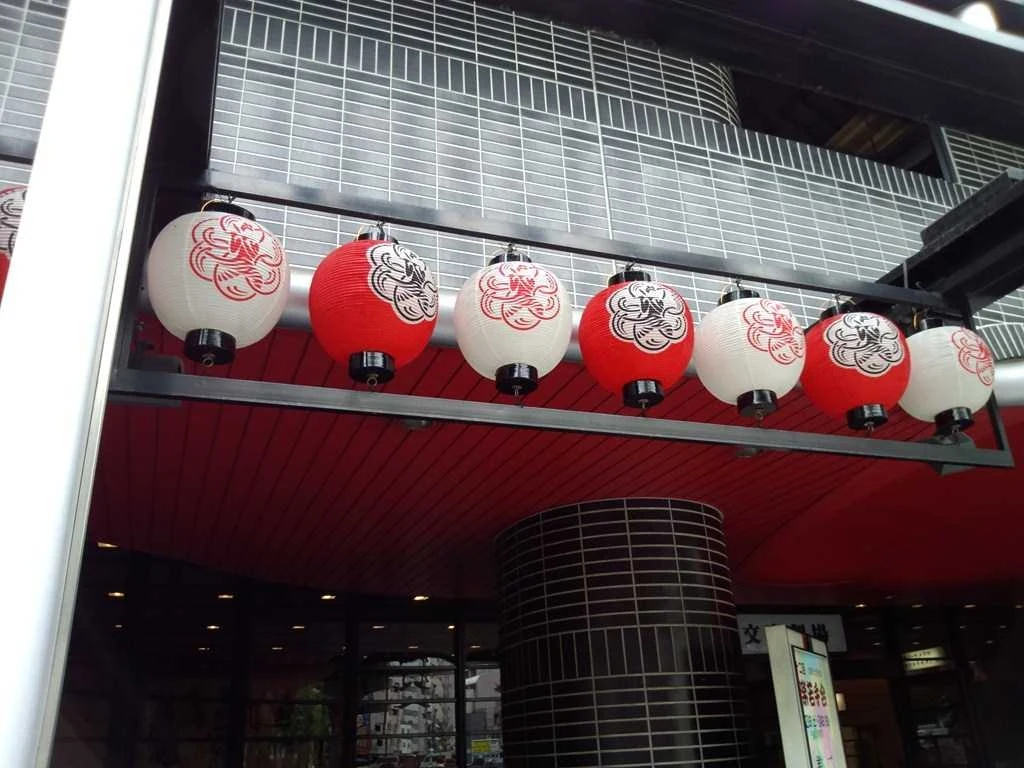
Namba Grand Kagetsu’s entrance in April 2022.Photo date: 2022-04-23 15:37:38 · Dick Thomas Johnson · CC BY 2.0Another exterior view of Namba Grand Kagetsu in March 2020.Photo date: 2020-03-03 · Miyuki Meinaka · CC BY-SA 4.0The National Bunraku Theatre seen from outside in August 2014.Photo date: 2014-08-05 16:02:51 · Mc681 · CC BY-SA 4.0Lanterns outside the National Bunraku Theatre in June 2012.Photo date: 15 June 2012 13:19:00 · Rush Austria · CC BY-SA 3.0
Photo & map credits
File:Namba Grand Kagetsu 2022-04-23.jpg — Dick Thomas Johnson. https://commons.wikimedia.org/wiki/File:Namba_Grand_Kagetsu_2022-04-23.jpg | CC BY 2.0 https://creativecommons.org/licenses/by/2.0. Resized and re-encoded; no crop or retouch.
File:Namba Grand Kagetsu Mar. 2020.jpg — Miyuki Meinaka. https://commons.wikimedia.org/wiki/File:Namba_Grand_Kagetsu_Mar._2020.jpg | CC BY-SA 4.0 https://creativecommons.org/licenses/by-sa/4.0. Resized and re-encoded; no crop or retouch.
File:National Bunraku Theatre in 201408.JPG — Mc681. https://commons.wikimedia.org/wiki/File:National_Bunraku_Theatre_in_201408.JPG | CC BY-SA 4.0 https://creativecommons.org/licenses/by-sa/4.0. Resized and re-encoded; no crop or retouch.
File:Chochin at National Bunraku Theatre in Osaka.jpg — Rush Austria. https://commons.wikimedia.org/wiki/File:Chochin_at_National_Bunraku_Theatre_in_Osaka.jpg | CC BY-SA 3.0 https://creativecommons.org/licenses/by-sa/3.0. Resized and re-encoded; no crop or retouch.
What shall we eat in Osaka?
Choosing a neighbourhood seems to bring more food ideas with it, doesn’t it?
Takoyaki, okonomiyaki and kushikatsu: start with the dish you have been curious about.
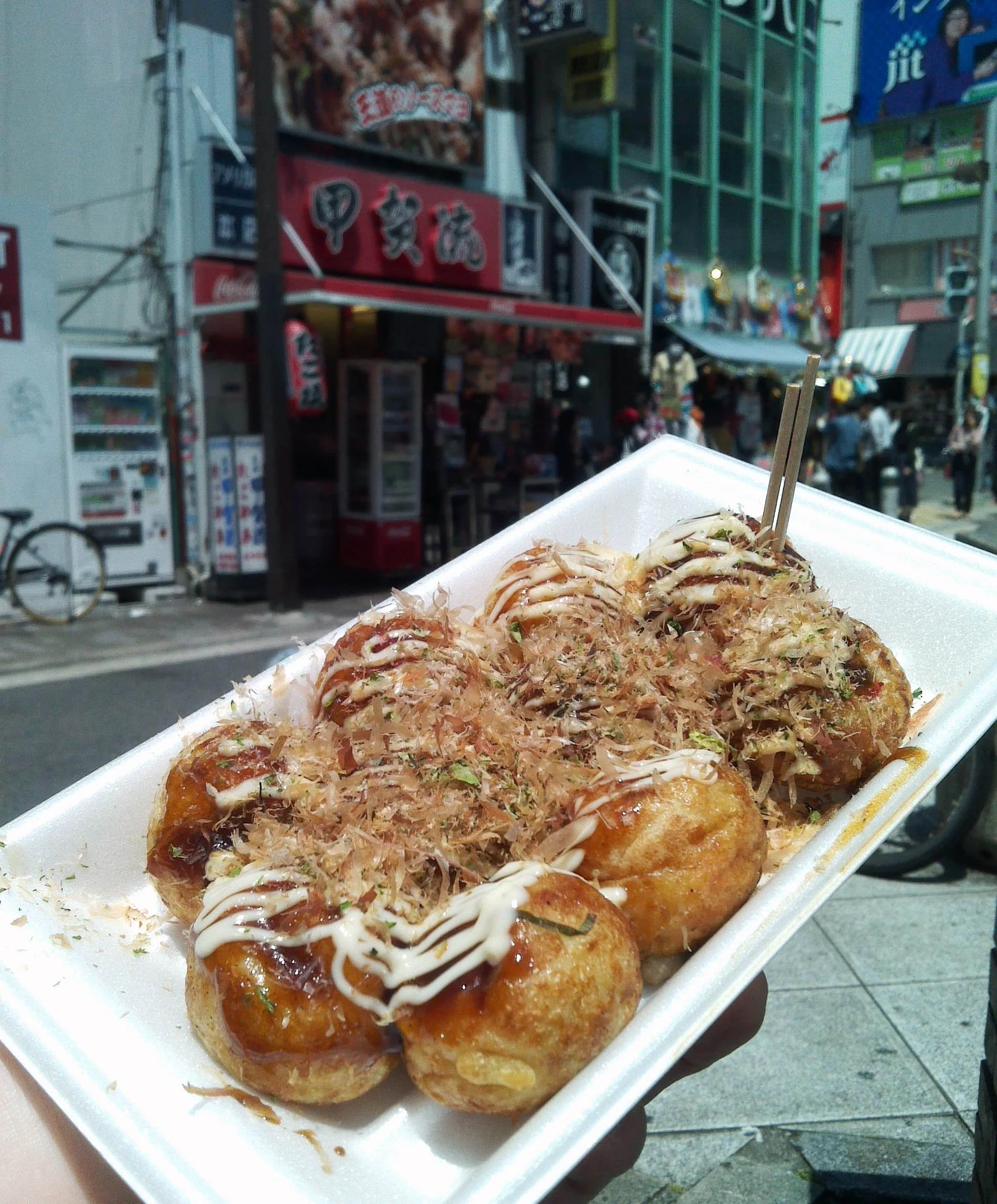
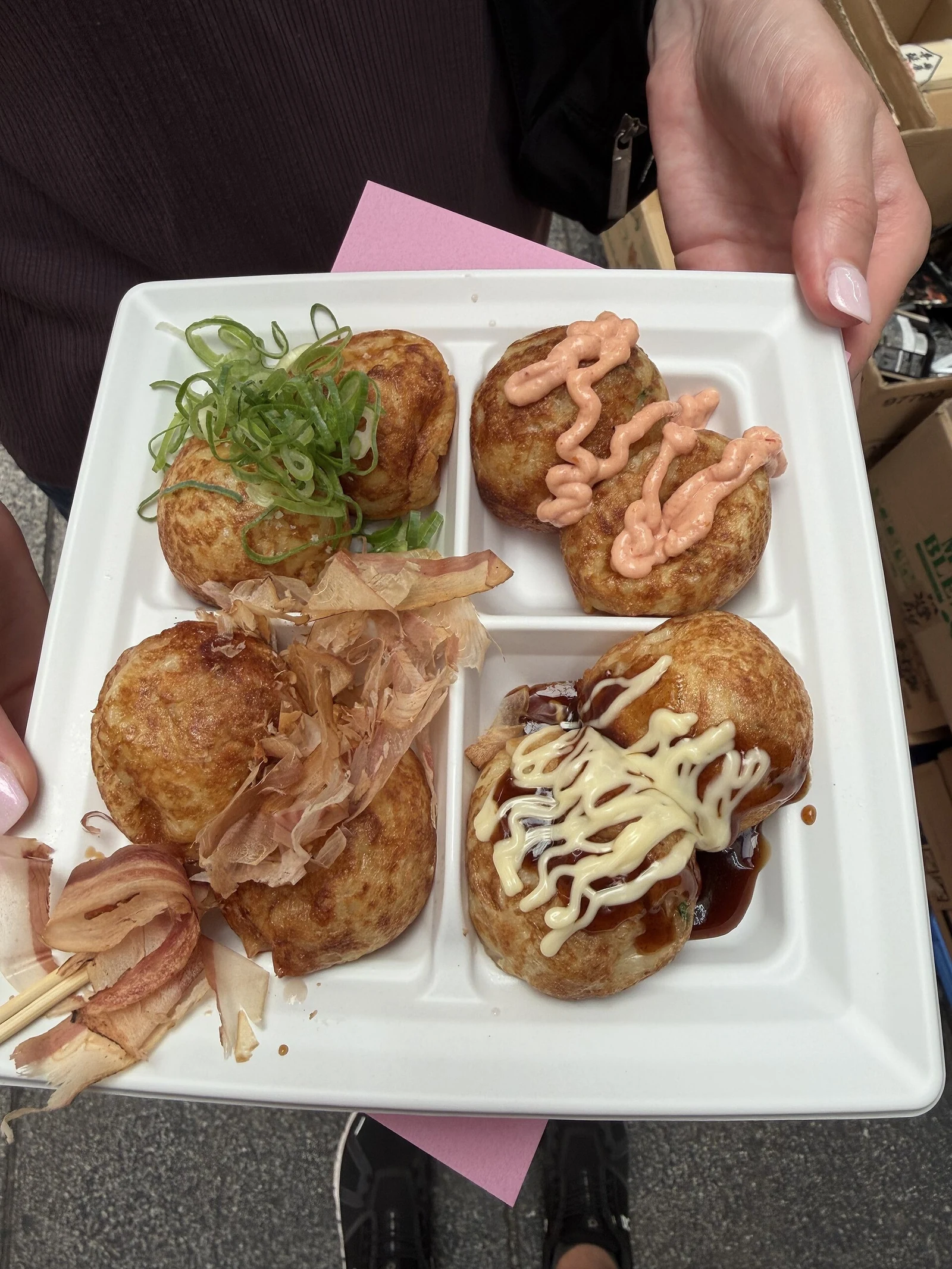
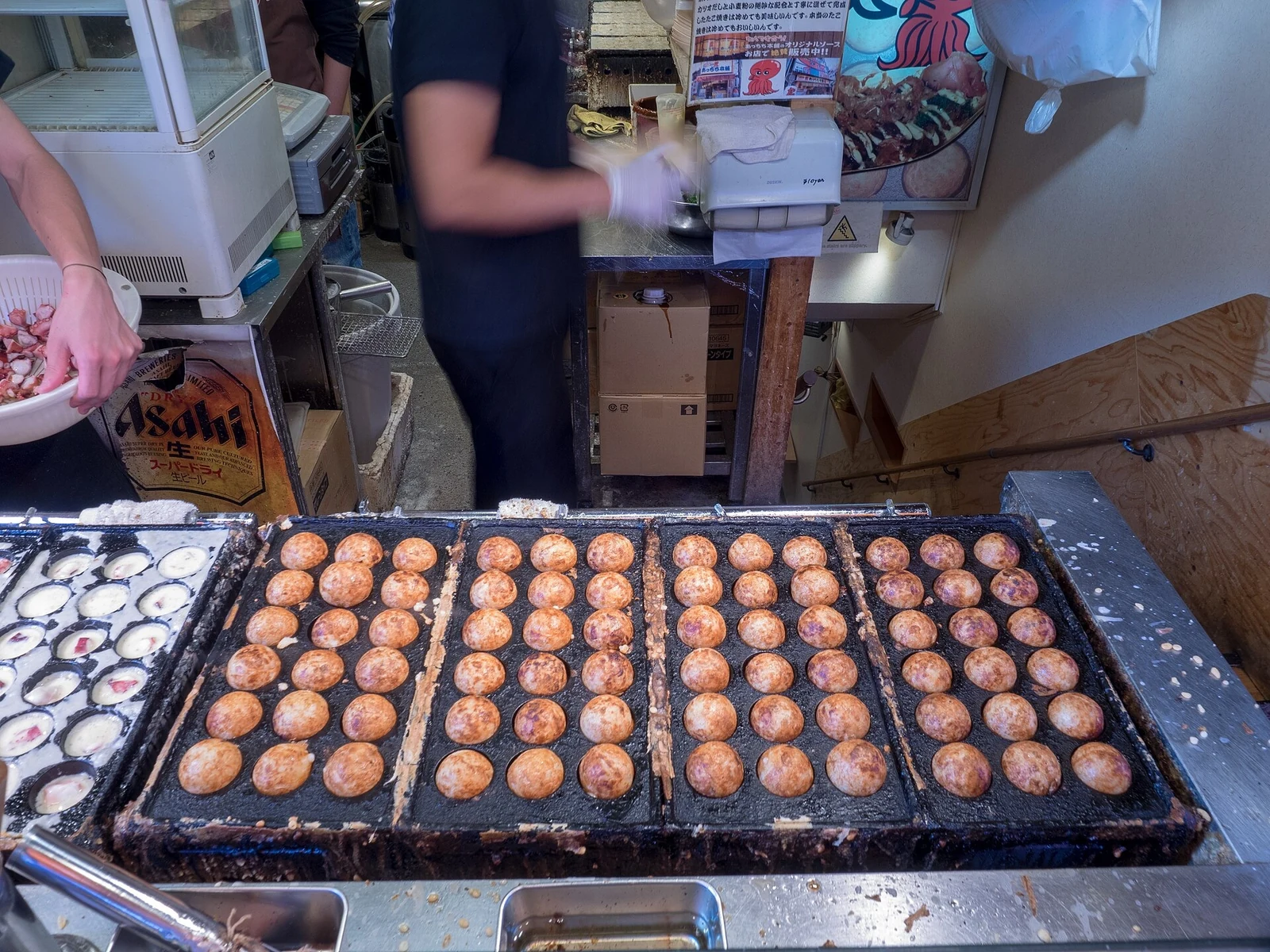
Some takoyaki shops offer flavours such as dashi, salt or soy sauce as well as sauce. The texture outside and softness inside differ between shops, too. Finding your own favourite sounds like a delicious little project.
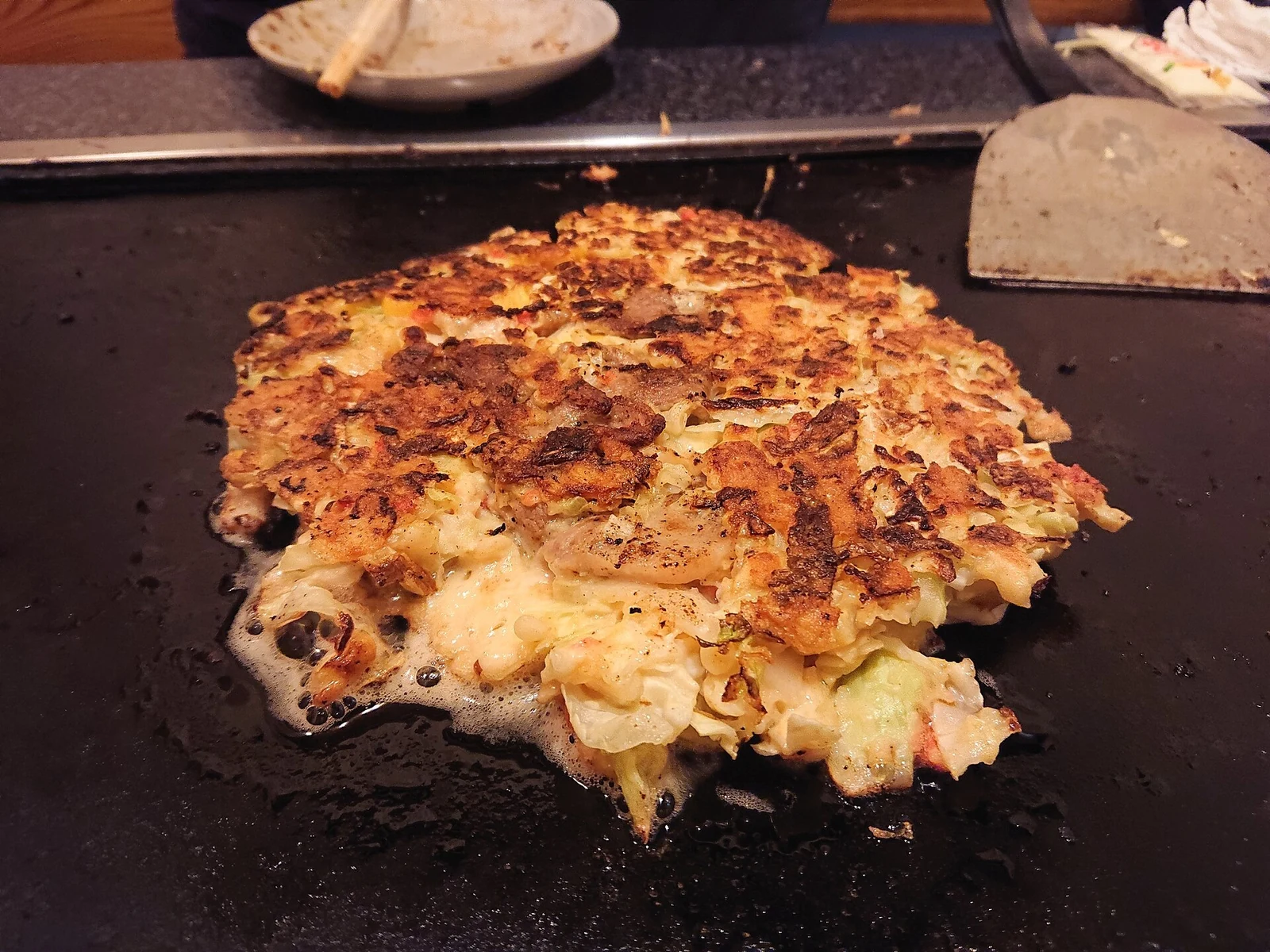
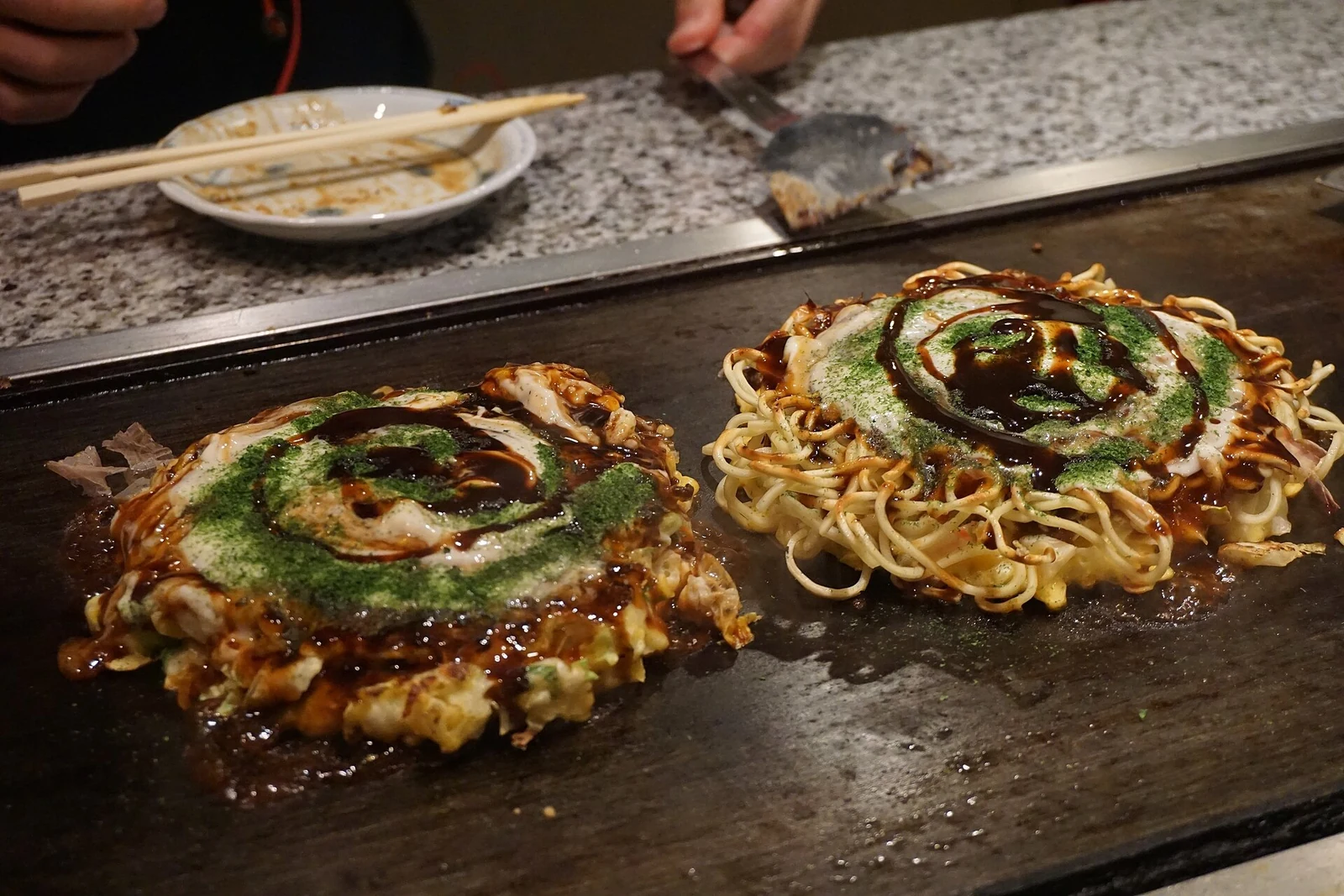
At some okonomiyaki restaurants, staff cook for you; at others, you cook at the table. If you are unsure, ask how it works. Follow each kushikatsu restaurant’s instructions for using its sauce as well.
Beyond flour-based dishes, there is kitsune udon. Ingredients such as kombu reached Osaka from other regions, helping nourish its dashi culture. With sweet fried tofu and noodles in front of me, I would want to try a sip of the broth first.
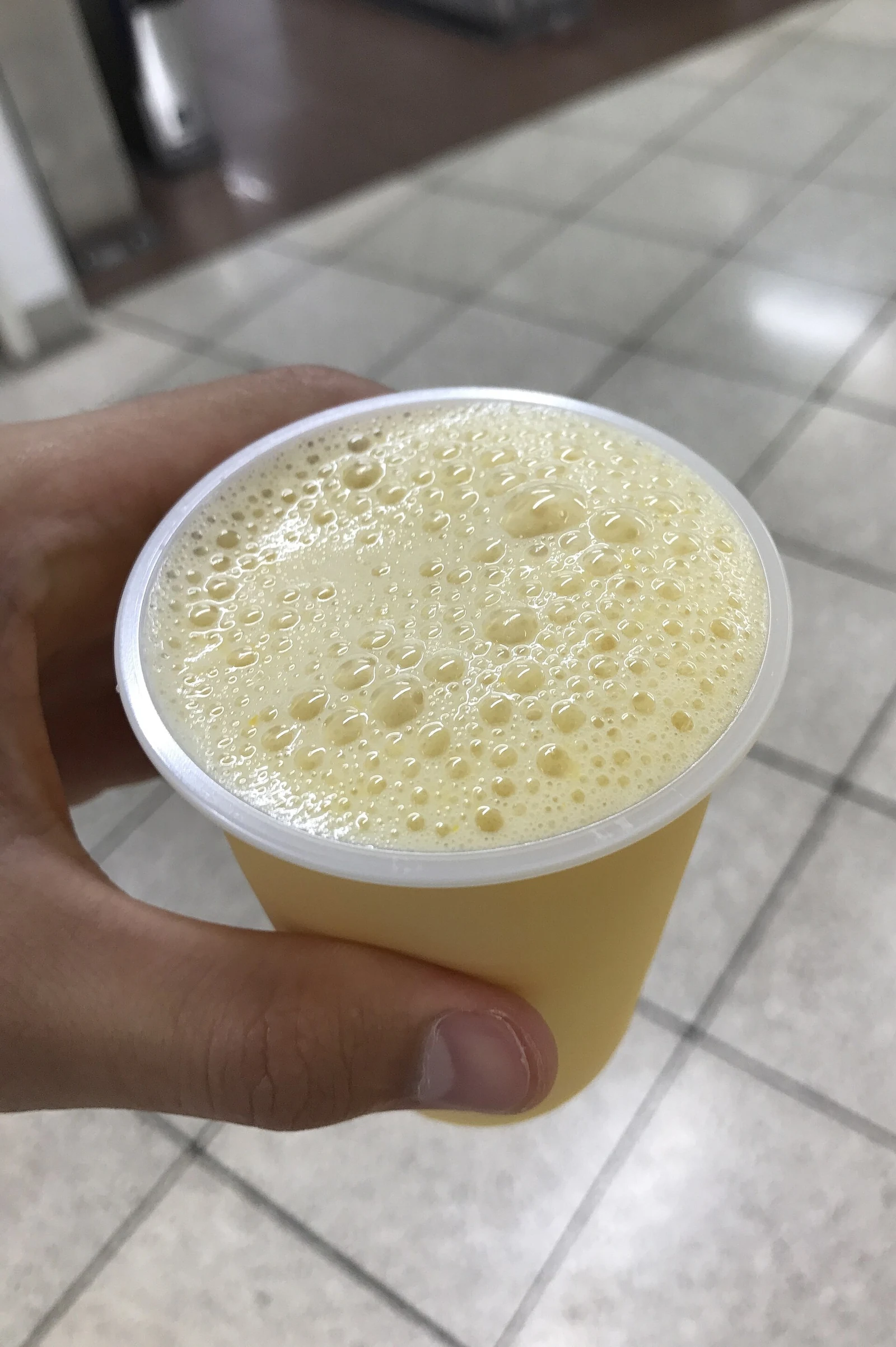
After a walk, a coffee shop’s mixed juice is another appealing choice. Each shop’s blend of fruit has its own character.
There is so much to try… perhaps we should save a few discoveries for next time, too.
Osaka flavours
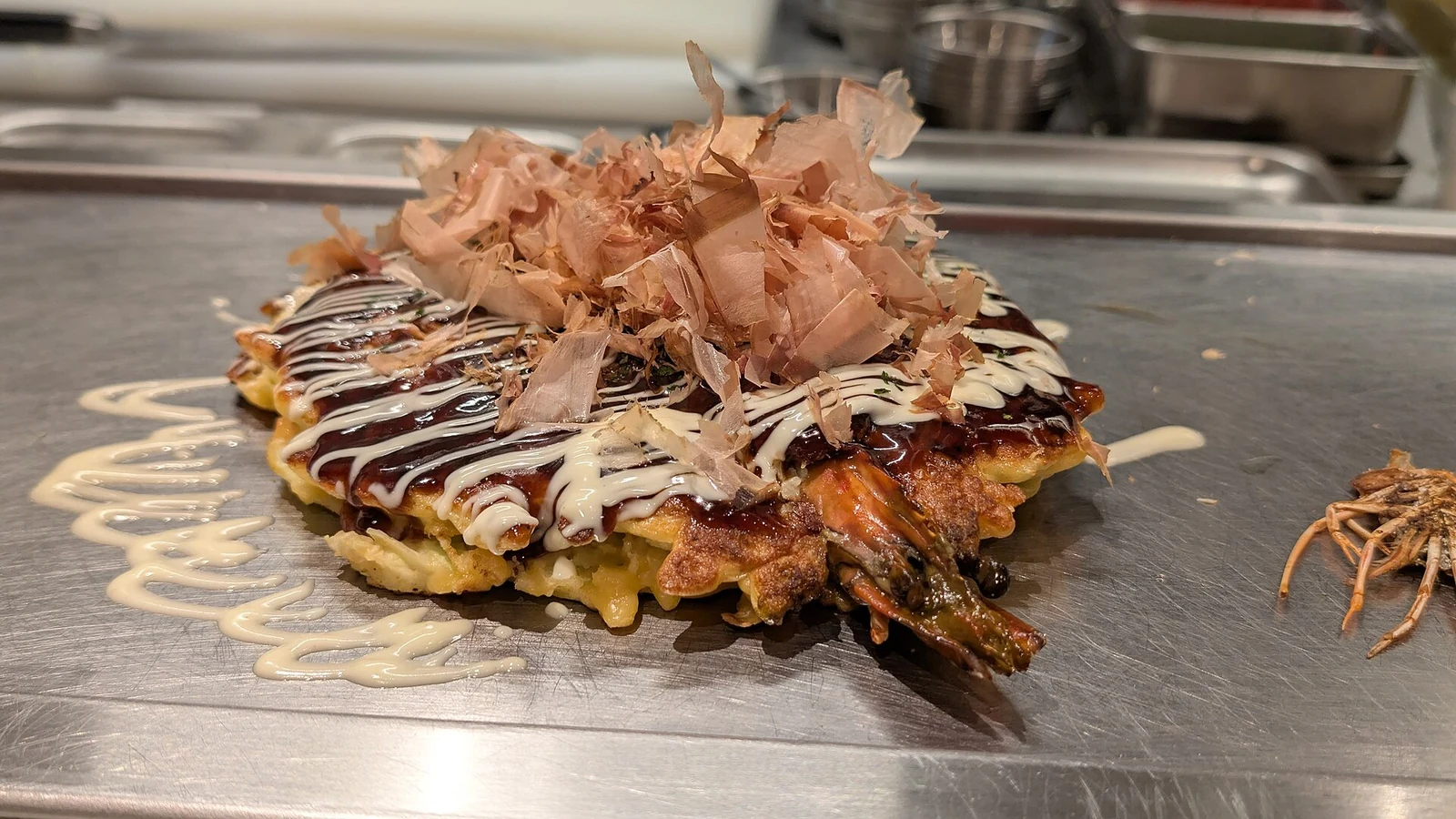
A boat of takoyaki from Kogaryu in Amerikamura.Photo date: 2018-05-12 10:55:48 · Thankei · CC BY-SA 4.0A selection of takoyaki photographed at Kuromon Market.Photo date: 13 July 2026 · Gatorfan252525 · CC BY-SA 4.0Okonomiyaki on a hotplate in Namba.Photo date: 2019-11-15 19:38:01 · Cheng-en Cheng · CC BY-SA 2.0Bonito flakes and toppings on an Osaka okonomiyaki.Photo date: 2025-11-08 20:17:11 · Joli Rumi · CC BY-SA 4.0Okonomiyaki cooking on a teppan in Osaka.Photo date: 2016-05-21 14:10:57 · Lianguanlun · CC BY 4.0Takoyaki cooking in their round moulds.Photo date: 2018-04-09 16:48 · Ajay Suresh from New York, NY, USA · CC BY 2.0A cup of mixed juice photographed in Umeda in 2017.Photo date: 2017-08-01 09:16:13 · 沢庵師匠 · CC BY-SA 4.0
Photo & map credits
File:A boat of 'KOUGARYU Takoyaki' 「甲賀流」たこ焼き「ソースマヨ」.jpg — Thankei. https://commons.wikimedia.org/wiki/File:A_boat_of_%27KOUGARYU_Takoyaki%27_%E3%80%8C%E7%94%B2%E8%B3%80%E6%B5%81%E3%80%8D%E3%81%9F%E3%81%93%E7%84%BC%E3%81%8D%E3%80%8C%E3%82%BD%E3%83%BC%E3%82%B9%E3%83%9E%E3%83%A8%E3%80%8D.jpg | CC BY-SA 4.0 https://creativecommons.org/licenses/by-sa/4.0. Resized and re-encoded; no crop or retouch.
File:A plate of assorted Takoyaki in Kuromon Market in Osaka, Japan.jpg — Gatorfan252525. https://commons.wikimedia.org/wiki/File:A_plate_of_assorted_Takoyaki_in_Kuromon_Market_in_Osaka,_Japan.jpg | CC BY-SA 4.0 https://creativecommons.org/licenses/by-sa/4.0. Resized and re-encoded; no crop or retouch.
File:2019-11-15 Okonomiyaki at Namba.jpg — Cheng-en Cheng. https://commons.wikimedia.org/wiki/File:2019-11-15_Okonomiyaki_at_Namba.jpg | CC BY-SA 2.0 https://creativecommons.org/licenses/by-sa/2.0. Resized and re-encoded; no crop or retouch.
File:Okonomiyaki -a Japanese savory pancake in Osaka, Japan.jpg — Joli Rumi. https://commons.wikimedia.org/wiki/File:Okonomiyaki_-a_Japanese_savory_pancake_in_Osaka,_Japan.jpg | CC BY-SA 4.0 https://creativecommons.org/licenses/by-sa/4.0. Resized and re-encoded; no crop or retouch.
File:Okonomiyaki cooking on teppan Osaka.jpg — Lianguanlun. https://commons.wikimedia.org/wiki/File:Okonomiyaki_cooking_on_teppan_Osaka.jpg | CC BY 4.0 https://creativecommons.org/licenses/by/4.0. Resized and re-encoded; no crop or retouch.
File:Takoyaki Ready for Consumption - Osaka (28289212368).jpg — Ajay Suresh from New York, NY, USA. https://commons.wikimedia.org/wiki/File:Takoyaki_Ready_for_Consumption_-_Osaka_(28289212368).jpg | CC BY 2.0 https://creativecommons.org/licenses/by/2.0. Resized and re-encoded; no crop or retouch.
File:Juice.umeda.jpg — 沢庵師匠. https://commons.wikimedia.org/wiki/File:Juice.umeda.jpg | CC BY-SA 4.0 https://creativecommons.org/licenses/by-sa/4.0. Resized and re-encoded; no crop or retouch.
Beyond central Osaka, more awaits
Craftsmanship and tea in Sakai
South of Osaka city, Sakai offers a glimpse of the history of trade and craftsmanship.
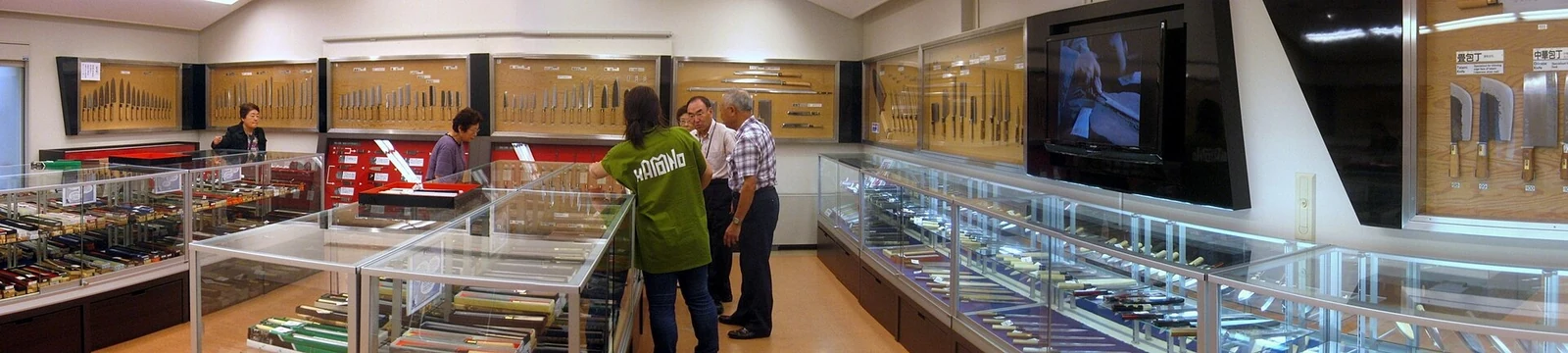
At Sakai Denshokan, traditional products include Sakai blades, chusen-dyed textiles, wasarashi cotton and incense. Learning how an everyday object is made can change the way you see it.
For tea culture connected with Sen no Rikyu, consider Sakai Risho no Mori. You can explore exhibitions or enjoy tea; its seated ryurei-style tea service offers an approachable introduction.
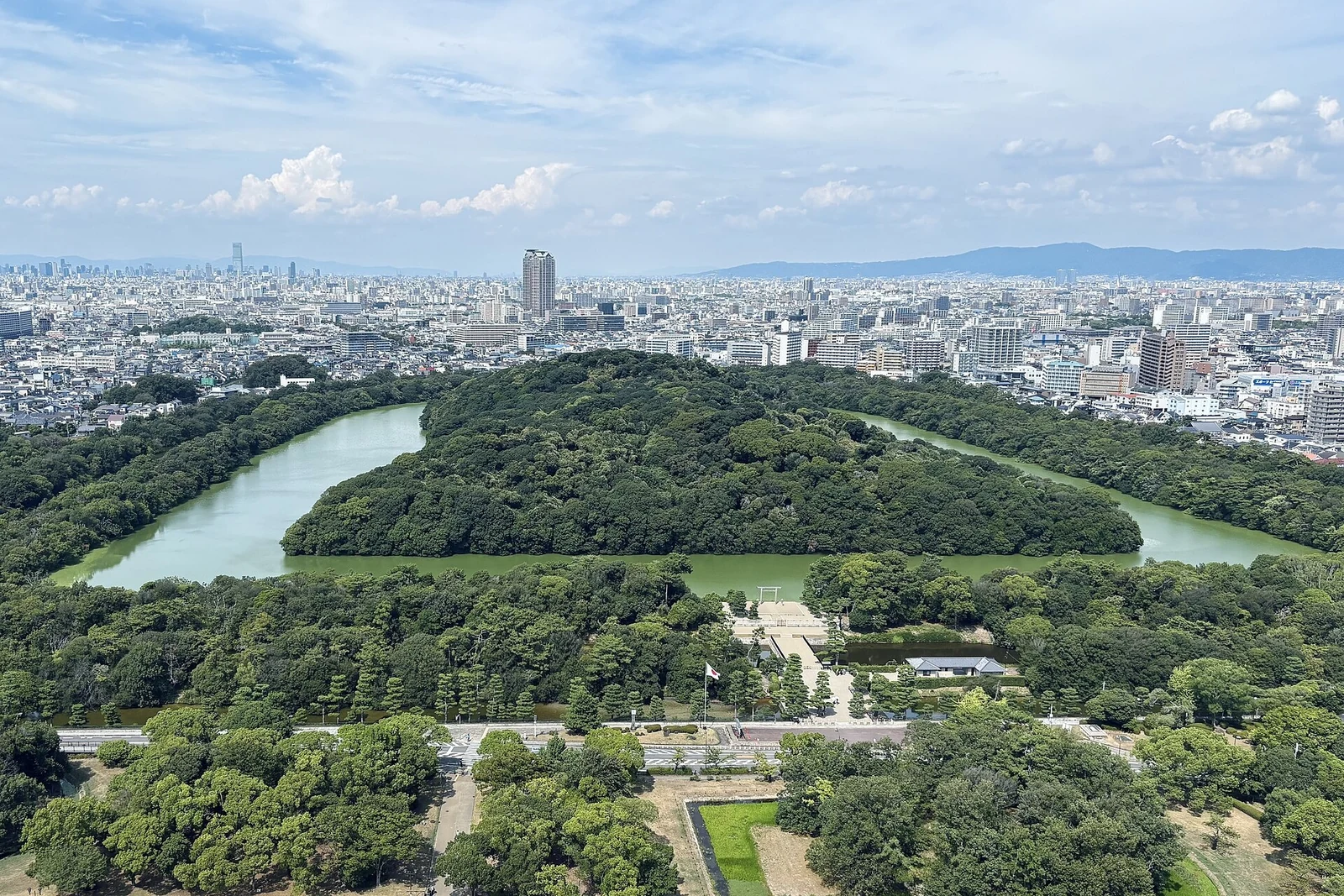
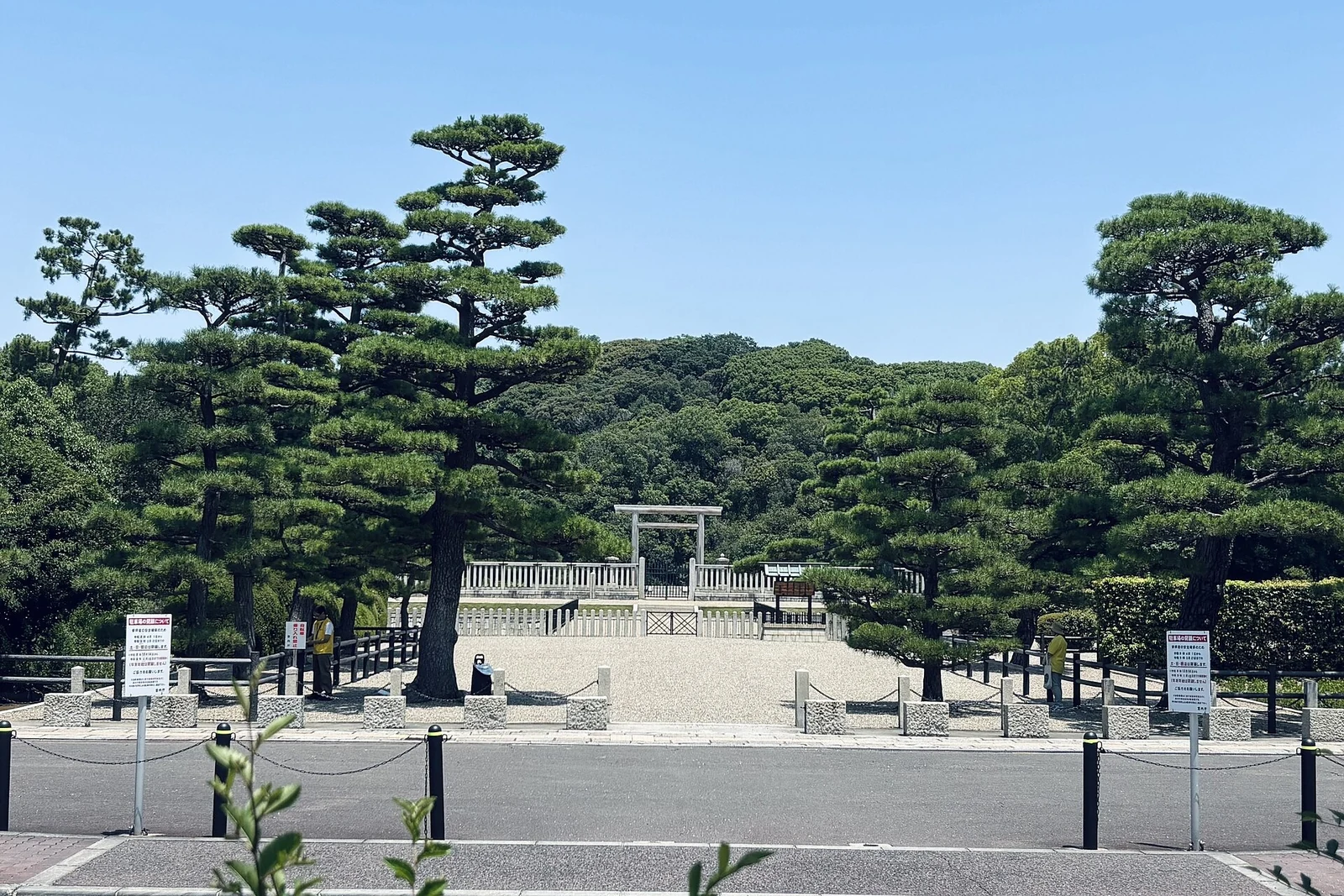
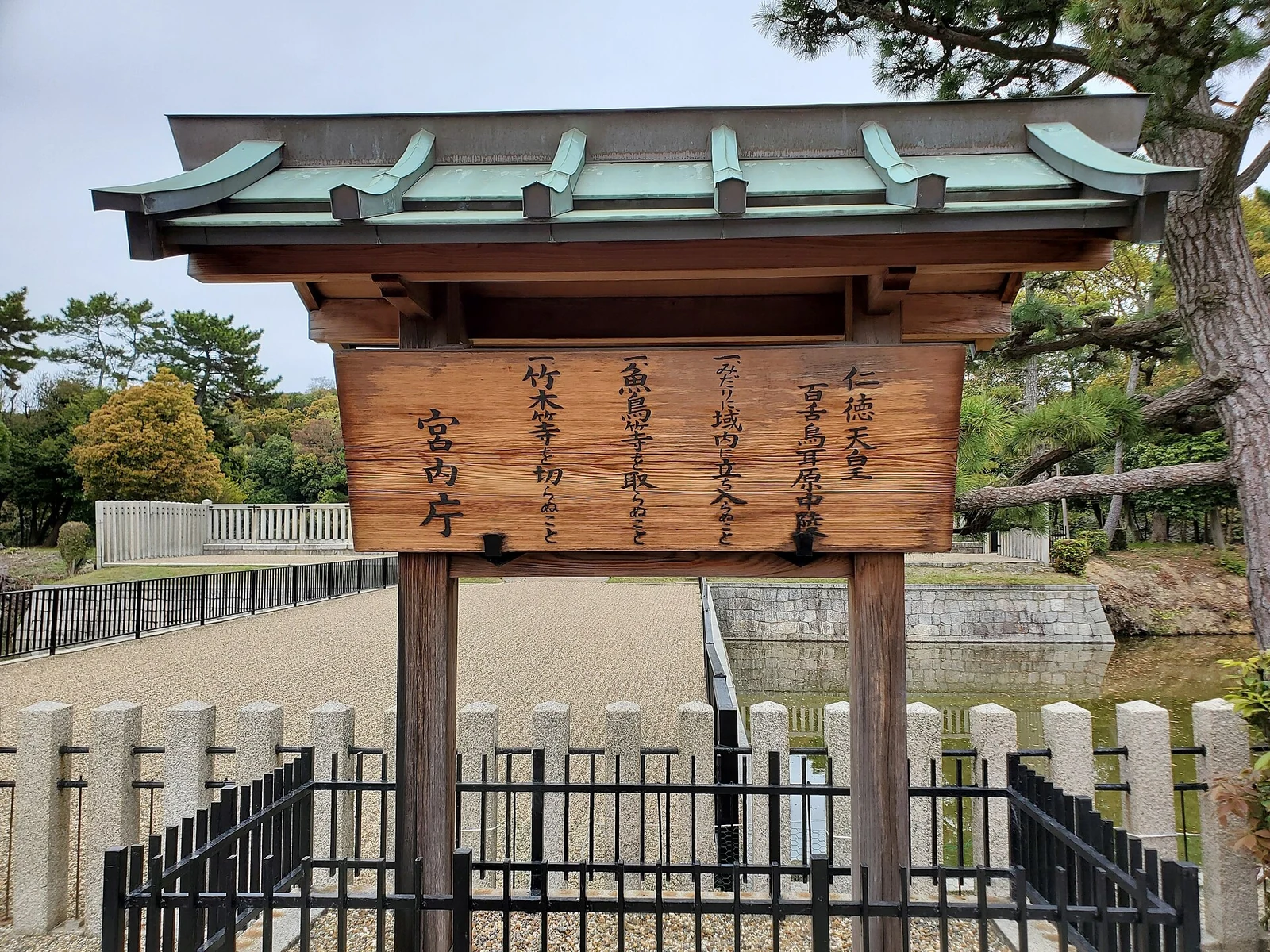
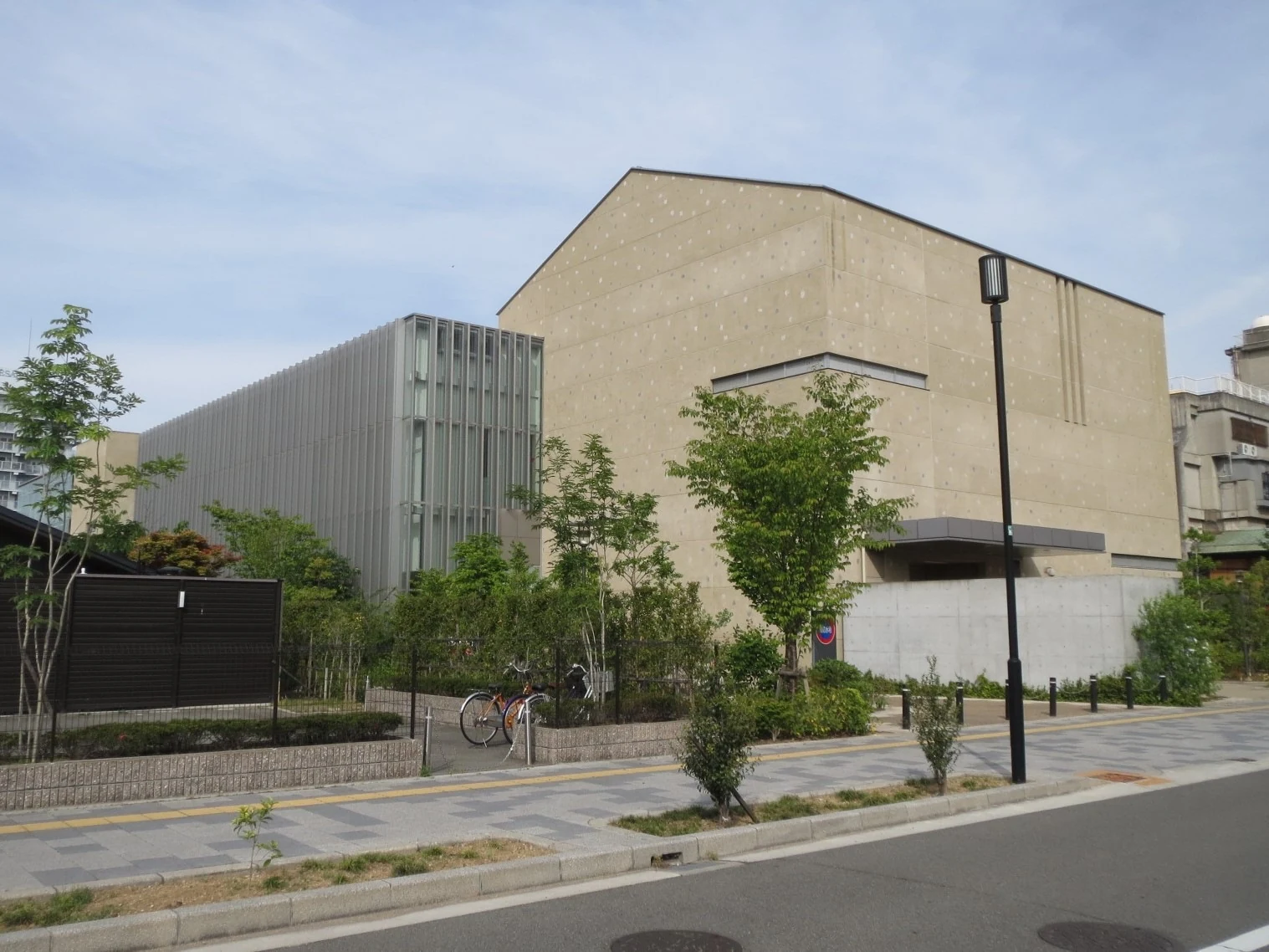
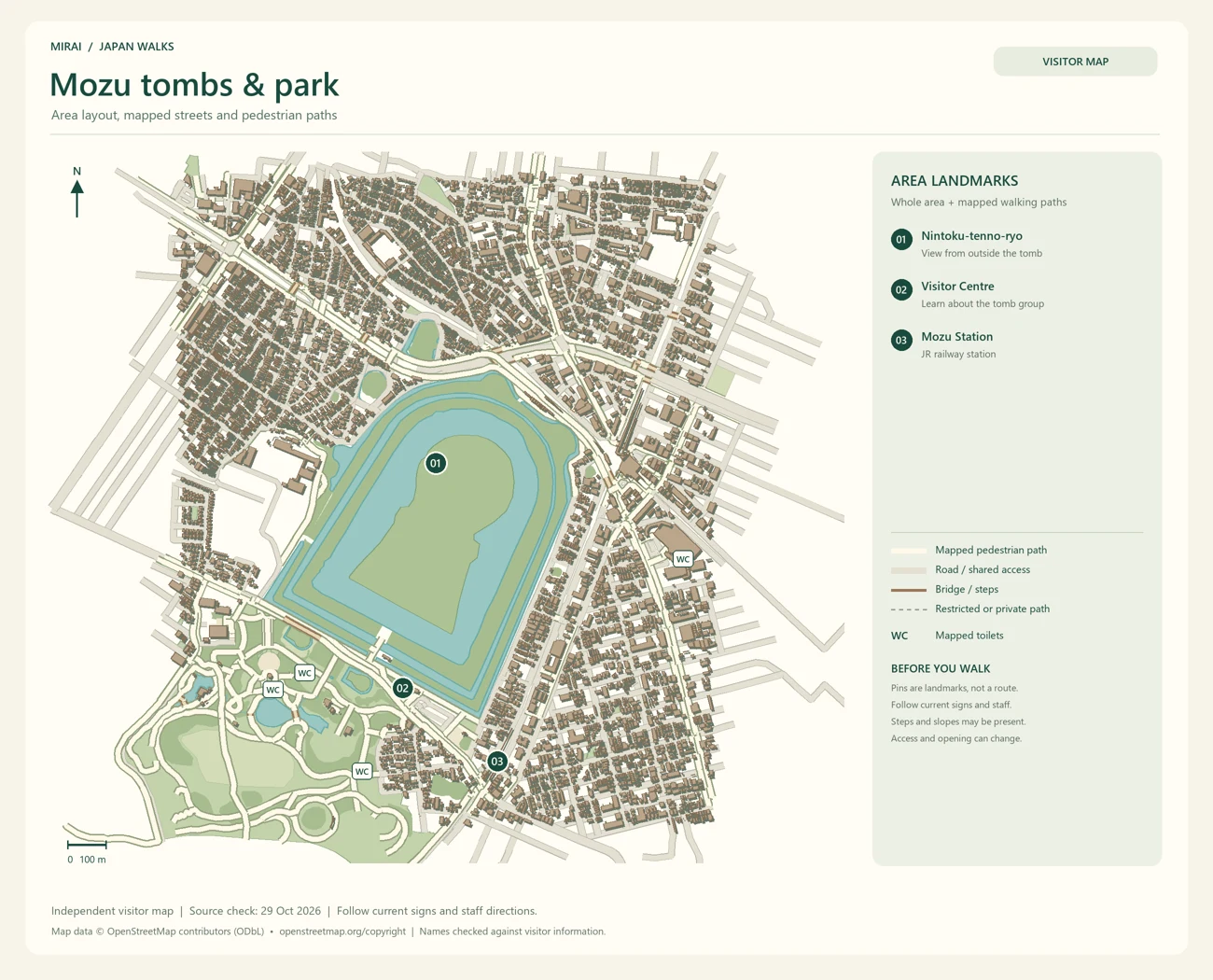
If ancient history interests you, there are the Mozu tombs. The great keyhole shape of the Nintoku-tenno-ryo Kofun is not visible in its entirety from ground level. Learning about it at the visitor centre before looking along the outer moat and greenery can help you imagine its scale.
Crafts, tea, tombs: your choice changes where you will walk in Sakai. Let’s begin with the one that interests you most.
Follow the river into Minoh’s greenery
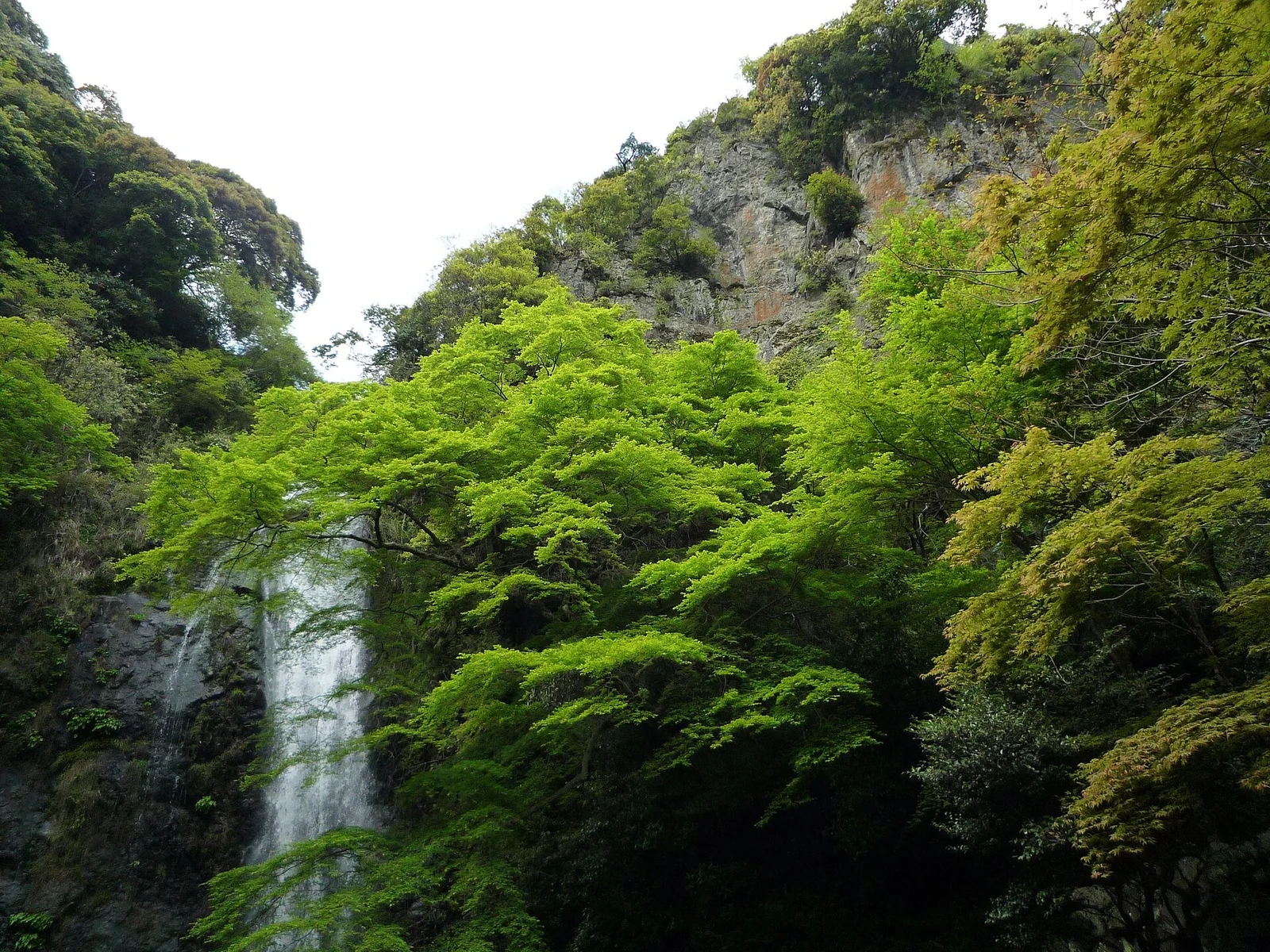
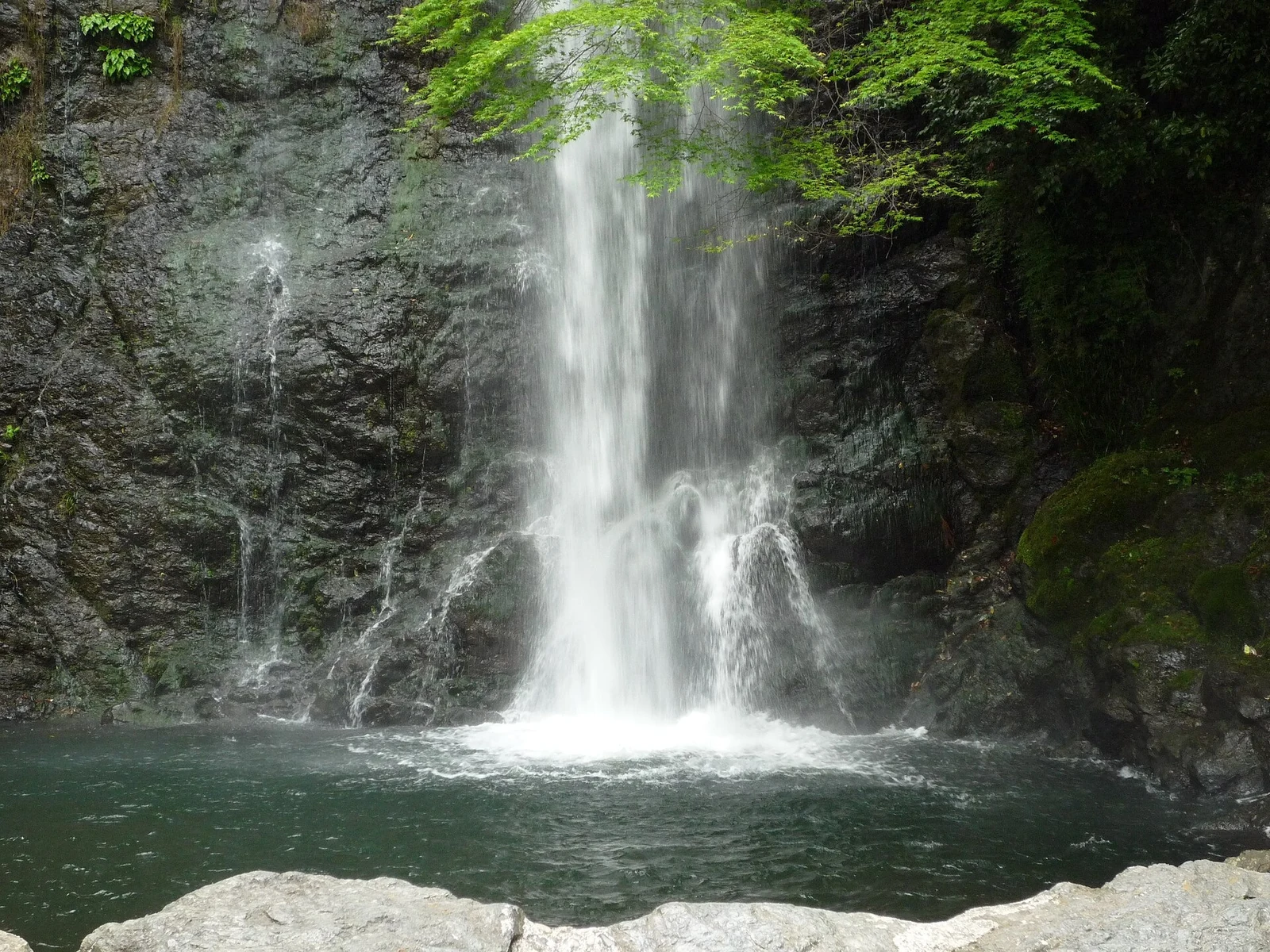
For a day in nature, look towards Minoh in northern Osaka Prefecture.
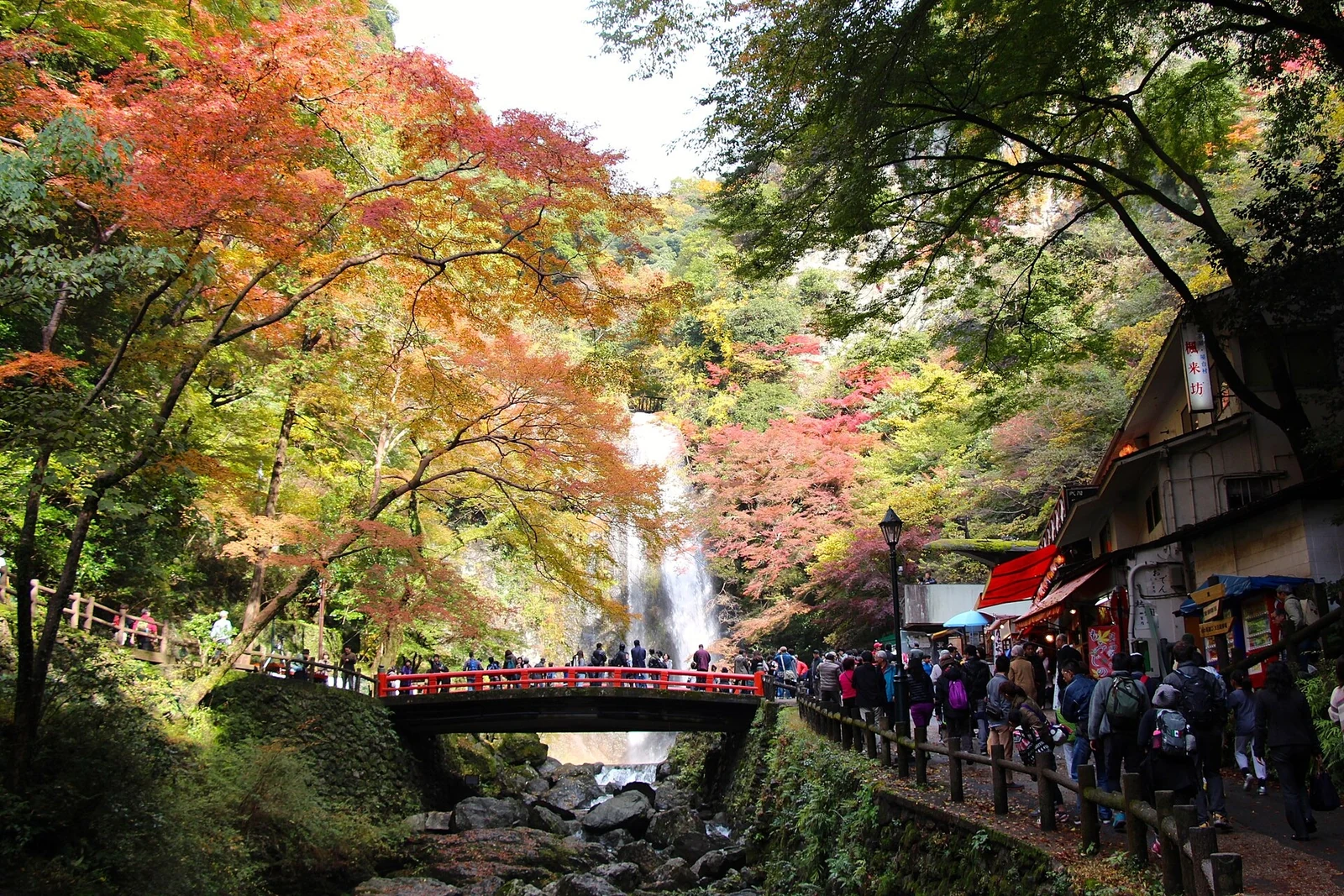
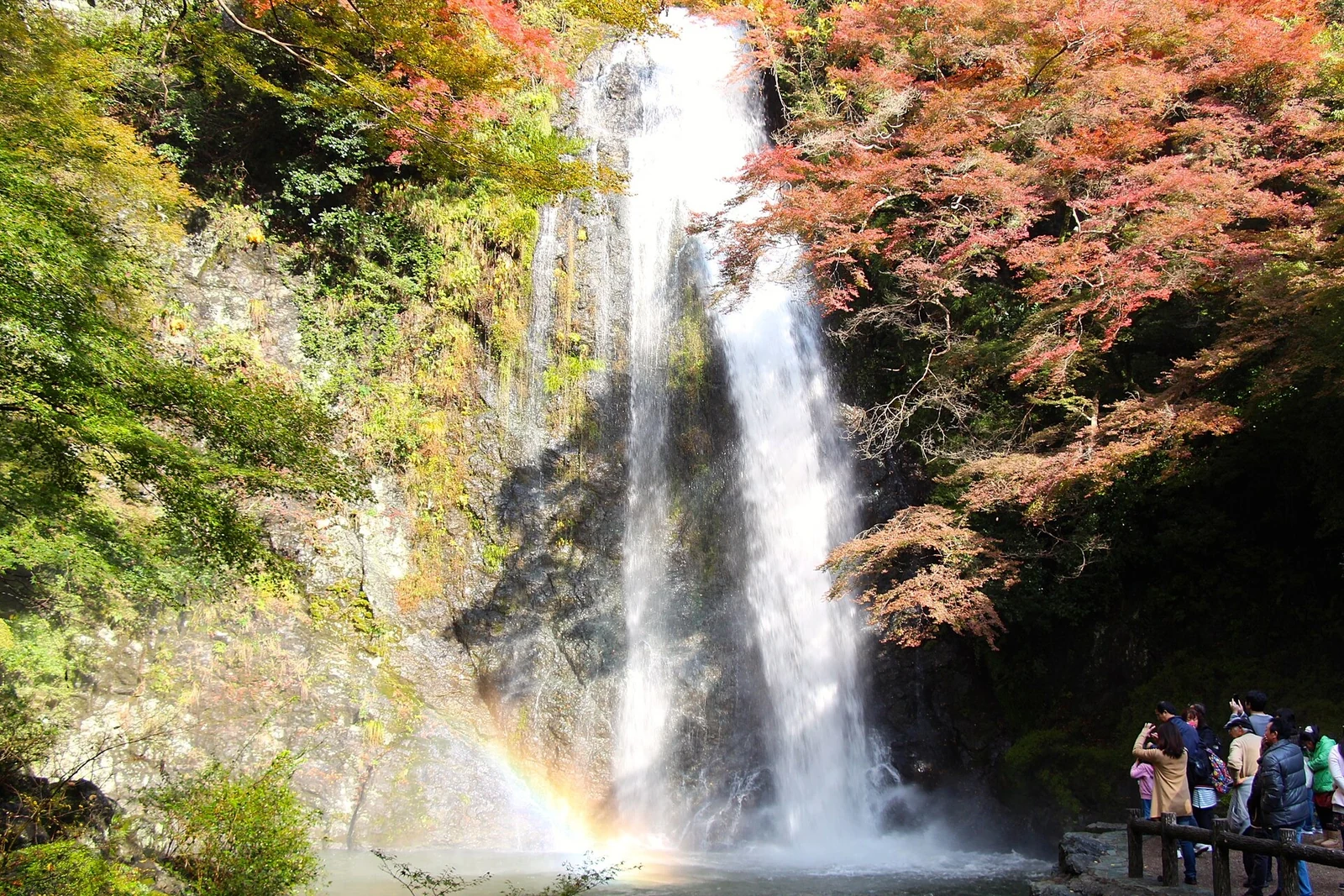
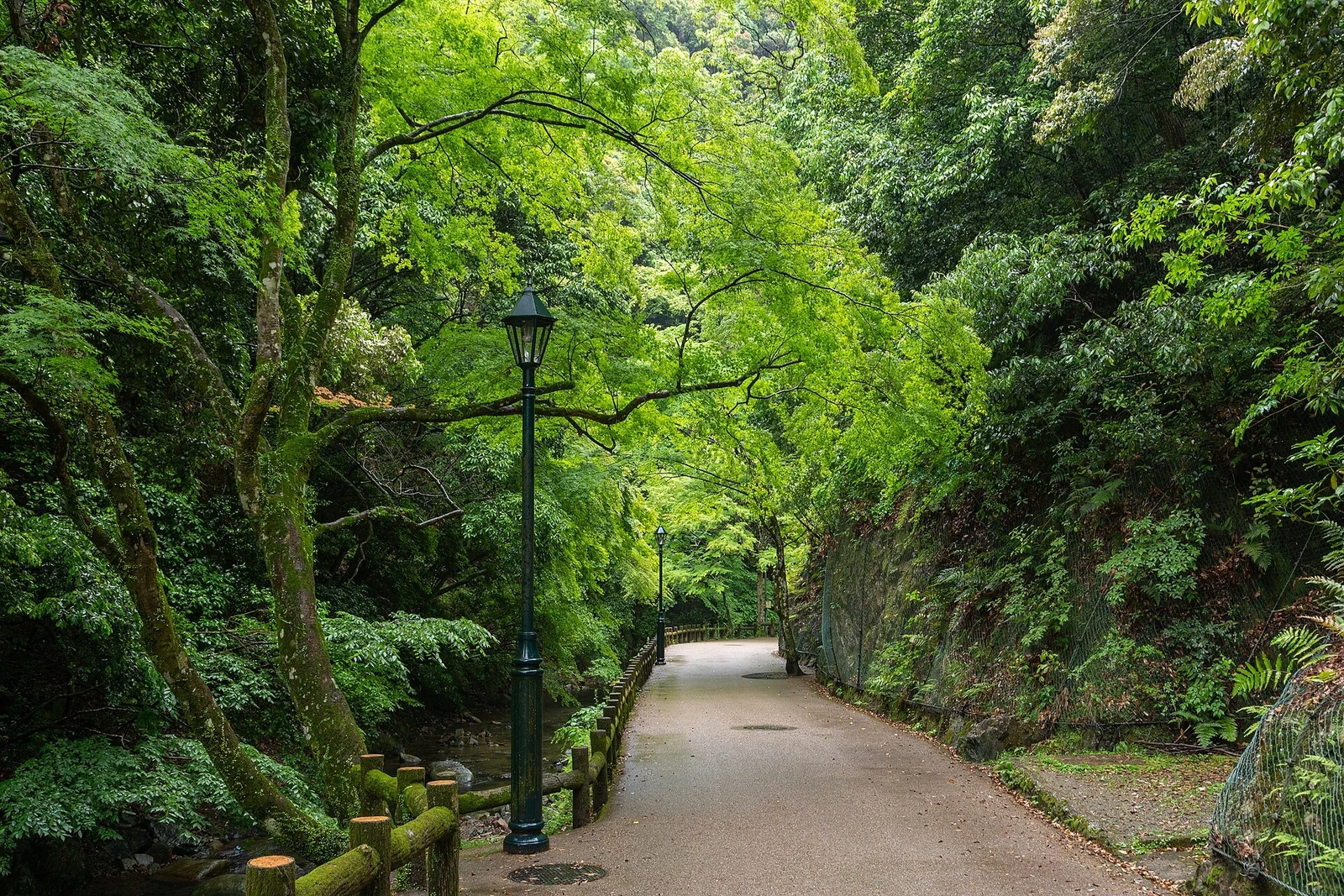
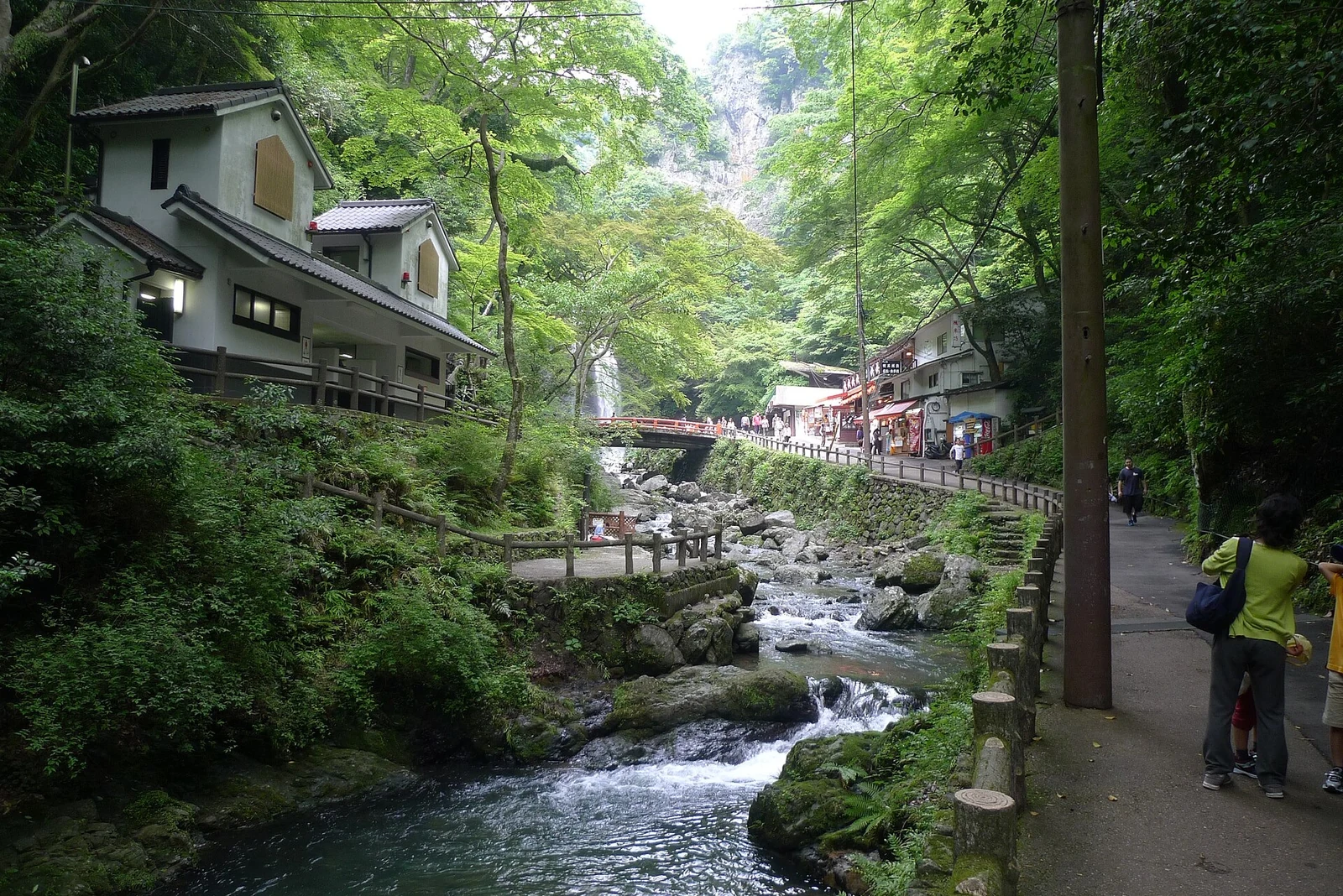
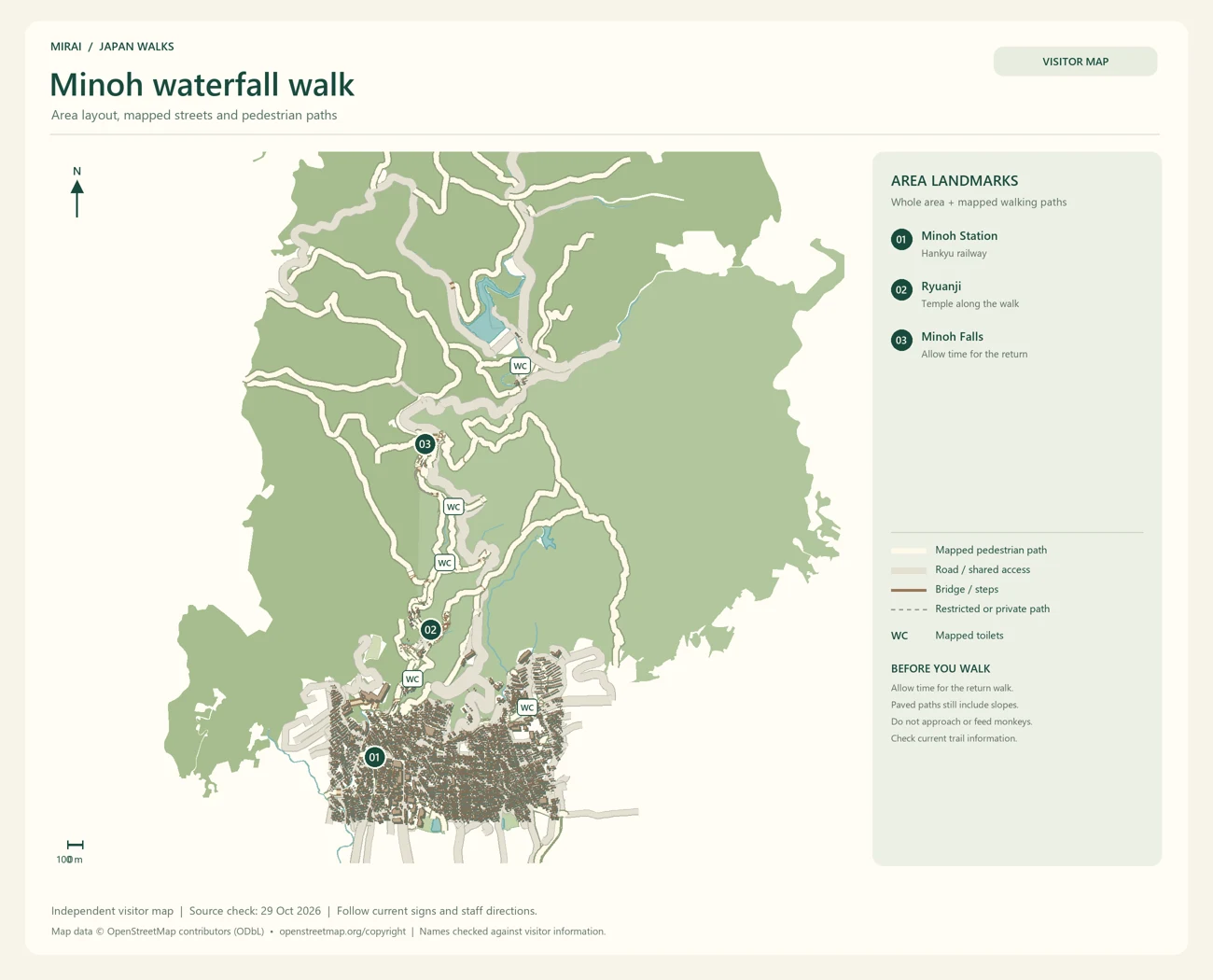
The waterfall path from Hankyu Minoh Station follows the sound of the river towards Minoh Falls. Fresh green leaves and autumn colour offer different scenes to look forward to.
The walk from the station to the falls takes about 40–50 minutes one way. The path is paved, but there are slopes. Allow time for the return, stopping by the waterfall and resting along the way.
If tea or the local maple-leaf tempura catches your eye on the way back, you could make one more little stop. Enjoy this quieter Osaka at your own pace.
File:Daisenryo Kofun from balloon.jpg — Sakai Yayoi. https://commons.wikimedia.org/wiki/File:Daisenryo_Kofun_from_balloon.jpg | CC0 http://creativecommons.org/publicdomain/zero/1.0/deed.en. Resized and re-encoded; no crop or retouch.
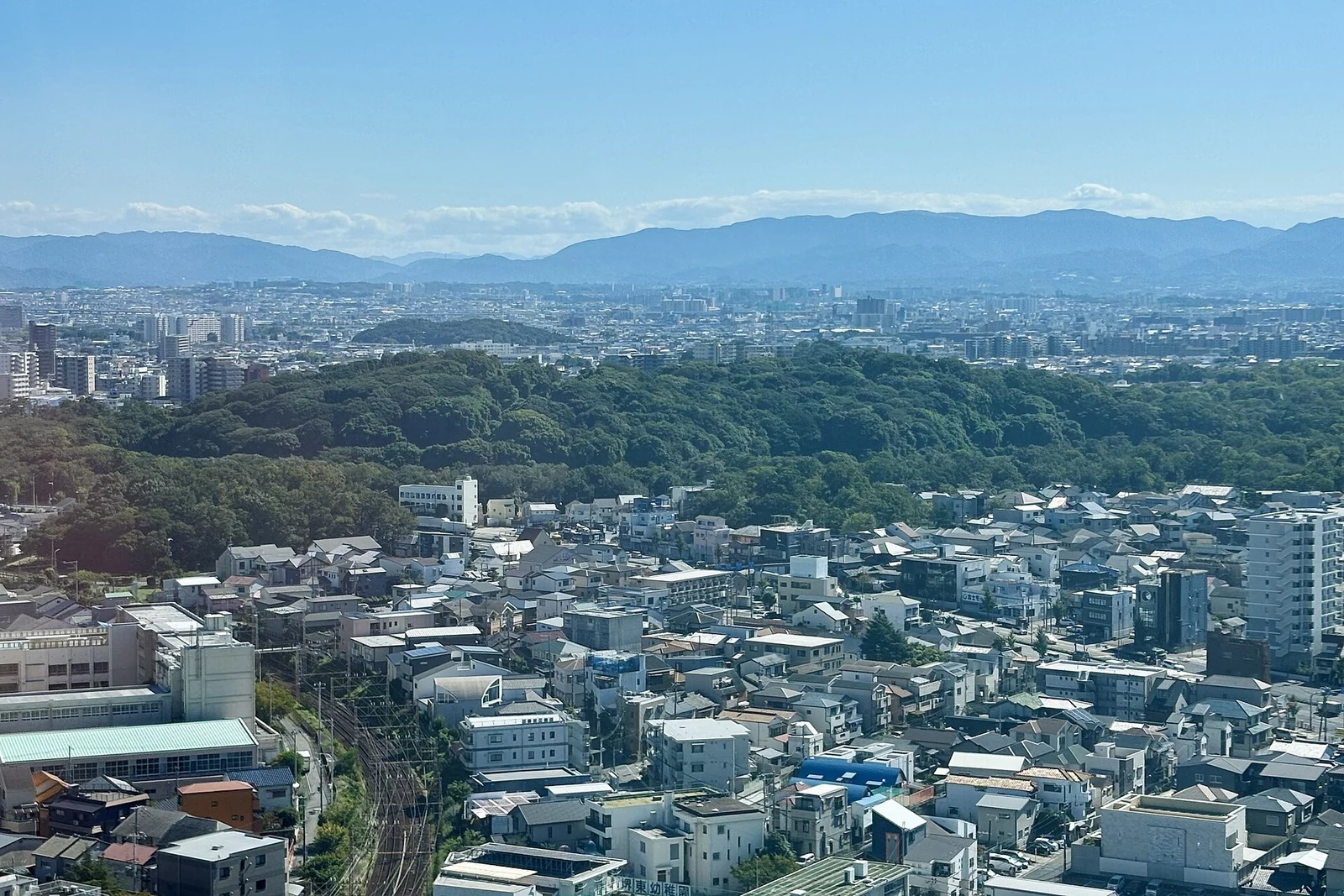
File:Daisenryo Kofun from Sakai City Hall.jpg — Sakai Yayoi. https://commons.wikimedia.org/wiki/File:Daisenryo_Kofun_from_Sakai_City_Hall.jpg | CC0 http://creativecommons.org/publicdomain/zero/1.0/deed.en. Resized and re-encoded; no crop or retouch.
File:Haisho of Daisen-Kofun, Mozu Kofun Group.jpg — Sakai Yayoi. https://commons.wikimedia.org/wiki/File:Haisho_of_Daisen-Kofun,_Mozu_Kofun_Group.jpg | CC0 http://creativecommons.org/publicdomain/zero/1.0/deed.en. Resized and re-encoded; no crop or retouch.
File:Daisenryo Kofun (2024) 01.jpg — Iflwlou. https://commons.wikimedia.org/wiki/File:Daisenryo_Kofun_(2024)_01.jpg | CC BY-SA 4.0 https://creativecommons.org/licenses/by-sa/4.0. Resized and re-encoded; no crop or retouch.
File:Risyonomori1.jpg — Ty19080914. https://commons.wikimedia.org/wiki/File:Risyonomori1.jpg | CC BY-SA 4.0 https://creativecommons.org/licenses/by-sa/4.0. Resized and re-encoded; no crop or retouch.
File:Cutlery heritage museum in Sakai city, Japan.jpg — Gpwitteveen. https://commons.wikimedia.org/wiki/File:Cutlery_heritage_museum_in_Sakai_city,_Japan.jpg | CC BY-SA 4.0 https://creativecommons.org/licenses/by-sa/4.0. Resized and re-encoded; no crop or retouch.
File:Minoh Taki Zenkei.jpg — osakaosaka. https://commons.wikimedia.org/wiki/File:Minoh_Taki_Zenkei.jpg | Public domain . Resized and re-encoded; no crop or retouch.
File:Minoh Taki 2009.jpg — osakaosaka. https://commons.wikimedia.org/wiki/File:Minoh_Taki_2009.jpg | Public domain . Resized and re-encoded; no crop or retouch.
File:JP-Osaka-Minoo-Minootaki -Over-View.JPG — Kanchi1979. https://commons.wikimedia.org/wiki/File:JP-Osaka-Minoo-Minootaki_-Over-View.JPG | CC BY-SA 4.0 https://creativecommons.org/licenses/by-sa/4.0. Resized and re-encoded; no crop or retouch.
File:JP-Osaka-Minoo-Minootaki -With-Rainbow.JPG — Kanchi1979. https://commons.wikimedia.org/wiki/File:JP-Osaka-Minoo-Minootaki_-With-Rainbow.JPG | CC BY-SA 4.0 https://creativecommons.org/licenses/by-sa/4.0. Resized and re-encoded; no crop or retouch.
File:Minoh-Park.jpg — Otto Domes. https://commons.wikimedia.org/wiki/File:Minoh-Park.jpg | CC BY-SA 4.0 https://creativecommons.org/licenses/by-sa/4.0. Resized and re-encoded; no crop or retouch.
File:Mino scene.jpg — Motokoka. https://commons.wikimedia.org/wiki/File:Mino_scene.jpg | CC BY-SA 4.0 https://creativecommons.org/licenses/by-sa/4.0. Resized and re-encoded; no crop or retouch.
Spring and autumn are good possibilities for a trip centred on walking. You could also choose by the view: plum or cherry blossoms at Osaka Castle Park, or fresh greenery and autumn leaves in Minoh.
Summer has festivals, with heat and humidity to plan around. In winter, dress warmly for riverside walks and outdoor observatories.
02
Local flavours, crafts and souvenirs
Takoyaki, okonomiyaki, kushikatsu and kitsune udon are dishes to enjoy during your visit. If you like sweets, look towards Sakai’s traditional confectionery, too.
For something to take home, you might choose sweets, small food-replica accessories or Sakai crafts. With food, check storage instructions and the use-by date as well.
03
Keep the day comfortable
Choose one main area, such as Kita, Minami, the castle district or the bay area.
A station-to-station map does not show the full effort of the Minoh return walk, walking through a park or the time spent at a performance. Leave room for meals and sitting down, too.
04
If rain or heat changes your plans
Consider Nakanoshima’s art museums or Osaka Science Museum, or Osaka Museum of History near the castle. Around Namba, browsing shops or trying a food-replica workshop could be another way to spend the day.
Closing days, exhibition changeovers and ticket availability vary. Workshops may need reservations, so check the particular place before setting out.
05
A few things to remember while exploring
Keep paths and shop entrances clear when taking photographs. Follow local instructions for queues, photography and eating.
At temples and shrines, check where shoes must be removed and which areas are open, and give worshippers space. If you meet wild monkeys in Minoh, do not show them food, feed them or approach them.
06
Taking souvenirs overseas? Check before buying, too
Pork buns and cheesecakes need suitable storage during travel, but you also need to check whether your destination permits them.
Rules for meat, dairy, plants and customs declarations differ by country or region. Something being sold at an airport does not mean you can bring it into your destination.
Check cabin-baggage restrictions separately for liquids such as sauces and sharp items such as kitchen knives. You can always enjoy a favourite food here and choose a different souvenir that is easier to take home.
Start with the Osaka you are curious about
Have you found the place you would like to visit first?
A day looking up at Dotonbori’s signs. An afternoon with art in Nakanoshima. A trip planned around a favourite shop or a performance, or a quieter day in Sakai or Minoh.
Start with the thing you are most looking forward to. Add a dish you would like to taste and somewhere nearby that catches your interest.
What little pleasures will your Osaka hold? I would love to choose the next detour with you.